 Originally published on Medium ↗
Six months ago, a B2B client asked one question: why are our competitors getting cited by AI and we’re not?
Everyone had an answer. Most of them were wrong.
What follows is what we actually did, what worked, and what we thought would matter but didn’t. No theory. No vendor pitches. Just what happened when we ran the experiment on a real site for six months.
What Did the Starting Point Look Like?
The client had a standard marketing site. Decent content. Some blog posts. No structured data beyond what their CMS auto-generated. No presence in AI answers.
We did not rebuild the site. We did not migrate platforms. We did not add an llms.txt file and call it done. We ran a compounding content system across eight overlapping inputs and tracked what moved.
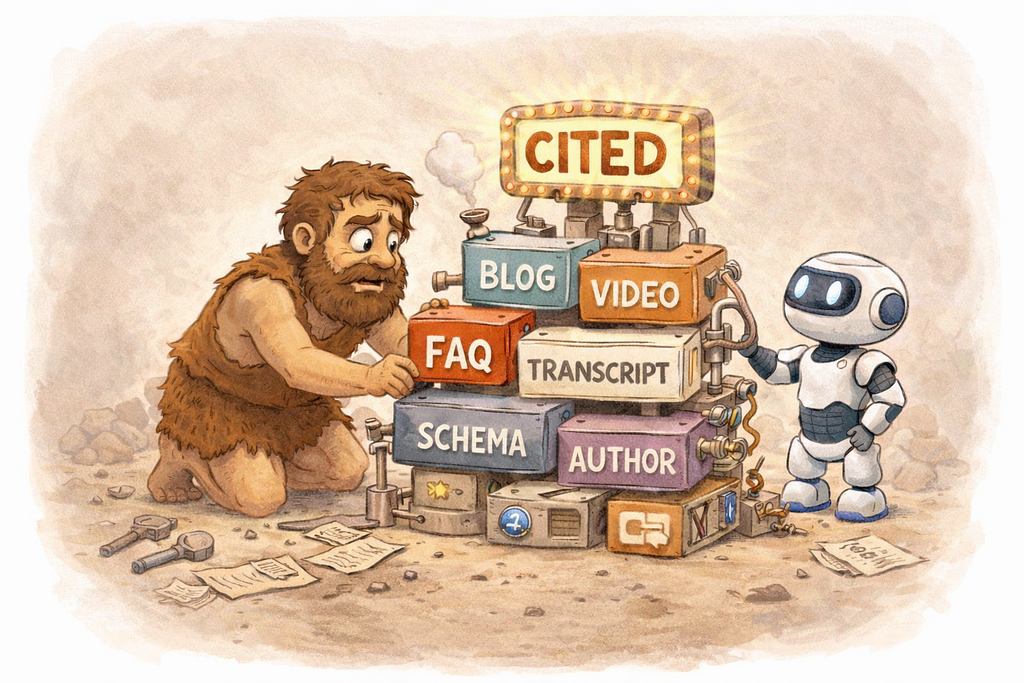
The eight inputs: blog-to-YouTube compounding loop, question-based heading structure, FAQ blocks repurposed into standalone posts, consistent author entity reinforcement, internal linking by topic cluster, schema markup across four types, weekly publishing cadence, and third-party distribution tests. Each one interacts with the others. Pull any one out and the whole thing slows down.
What Was the Single Biggest Lever?
Building a blog-to-YouTube compounding loop. It was the biggest lift in the entire system. And it is the part most people skip because it is actual work.
The workflow: a blog post goes live on the site. We read the blog and produce a YouTube video on the same topic. The video joins a topical playlist so the channel builds clusters. The YouTube title and description get their own optimization pass, separate from the blog. The video gets embedded at the bottom of the blog post. A full transcript gets added to the page. VideoObject schema wraps the transcript with the real YouTube URL.
That gives one piece of content living across three retrieval surfaces LLMs actually pull from: the blog, the video, and the transcript block on the page. The playlist reinforces topical authority on the channel. A query that retrieves the video can lead back to the blog. A query that retrieves the blog finds a video and a transcript reinforcing the same answer.
YouTube matters here for a reason most people miss. Titles, descriptions, and transcripts feed LLM training corpora and retrieval systems. The platform is one of the most indexed surfaces on the web. Optimizing both the blog and the video compounds across both systems.
The VideoObject schema for each post looked like this:
{
  "@context": "https://schema.org",
  "@type": "VideoObject",
  "name": "How Structured Data Affects AI Citations",
  "description": "What structured data does for AI visibility, which schema types matter most, and how to implement them without a developer.",
  "thumbnailUrl": "https://example.com/video-thumb.jpg",
  "uploadDate": "2026-04-02",
  "contentUrl": "https://www.youtube.com/watch?v=VIDEO_ID",
  "embedUrl": "https://www.youtube.com/embed/VIDEO_ID",
  "transcript": "Full cleaned transcript goes here as plain text...",
  "author": {
    "@type": "Person",
    "name": "Expert Name",
    "url": "https://example.com/about"
  }
}
Nothing else in the system produced this much compounding.
What Structural Changes Moved Citations the Most?
Every H2 became a question a real person would type into ChatGPT. “Schema Overview” became “What Does Schema Actually Do for AI Visibility?”
The highest-leverage change we made was simple: every section answered the question in the first sentence. No warmup. That single structural shift changed how LLMs chunked and extracted content from every page on the site.
We also added FAQ blocks to every post. Minimum four questions, written in the exact phrasing people use when asking an AI. According to Search Engine Land’s analysis cited by Frase.io, pages with FAQ schema are substantially more likely to appear in Google AI Overviews compared to pages without it, with the 3.2x lift figure appearing consistently across multiple analyses. That is the single highest-leverage schema change a site can make after restructuring headings.
The four FAQ answers at the bottom of one post became four full posts of their own within the next month. Each one ranked for a narrower query. Each one got its own citations. The parent post linked to all four. Topical authority compounded in both directions.
Why Does the Author Entity Matter So Much?
We reinforced a single named expert across every post. Same bio. Same credentials. Same link to a dedicated author page. Same structured data. Every post.
Research from Growth Memo and confirmed by Ahrefs across 75,000 brands shows brand search volume is among the strongest predictors of AI citations. Consistent author entity reinforcement is the single biggest lever most sites leave untouched.
The Person schema on the author page:
{
  "@context": "https://schema.org",
  "@type": "Person",
  "name": "Expert Name",
  "jobTitle": "Founder",
  "description": "Short, specific, credential-heavy bio",
  "worksFor": {
    "@type": "Organization",
    "name": "Company Name",
    "url": "https://example.com"
  },
  "sameAs": [
    "https://www.linkedin.com/in/...",
    "https://twitter.com/...",
    "https://www.youtube.com/@..."
  ]
}
What Were the Other Five Inputs?
Internal linking was built around topic clusters. Every post linked to three to five related posts using descriptive anchor text. Not “click here.” The actual question the linked post answered. LLMs use anchor text as a relevance signal during retrieval.
Schema markup covered BlogPosting, FAQPage, VideoObject, and Person across the site. This is where most AI visibility services stop. We treated it as table stakes. The schema did not drive citations by itself. The content structure behind the schema drove the citations. The schema helped Google AI Overviews and Bing Copilot specifically, which pull from their own indexes.
Continuous publishing ran every week without gaps. Between 40 and 60 percent of AI citations change monthly. A page that gets cited this week loses ground within weeks if nothing refreshes it. Cadence is not optional.
Distribution tests on third-party platforms rounded out the system, though these produced the weakest results of the eight inputs.
What Did the Impact Order Look Like?
The blog-to-YouTube compounding loop did the heaviest lifting. Question-based headings with front-loaded answers came second. Consistent author entity reinforcement came third. Topical depth from continuous publishing fourth. FAQ blocks repurposed into standalone posts fifth. Internal linking with descriptive anchor text sixth. Schema markup seventh, as a supporting layer rather than a leading one. Platform-specific distribution tests last, and a distant last.
The first four inputs drove the compounding. The rest amplified what was already working.
What Did We Test That Didn’t Matter?
We tested llms.txt. The file is fine. It is a crawl hint. It did not produce a measurable lift in citations on the platforms we track.
We tested syndicating posts to third-party platforms with low-follower accounts. Zero impact. A Medium post with one follower does not rank and does not get cited.
We tested aggressive keyword density. It made things worse. LLMs prefer clear, simple sentence structures over keyword-stuffed ones.
We tested thin backlinking campaigns. Minimal movement. Backlinks show weak or neutral correlation with LLM visibility. The old SEO playbook does not map cleanly to AI citations.
How Did We Track Citation Movement?
We ran weekly queries across ChatGPT, Claude, Perplexity, and Google AI Overviews. Logged every citation. Tracked which posts got cited, for which queries, on which platforms. Used Cloudflare bot logs to see which pages GPTBot, ClaudeBot, and PerplexityBot actually hit.
Tools like Profound, Otterly, and Peec automate this if manual tracking does not scale. Either way, the point is the same: without tracking, you are guessing. With a system this compounded, guessing is how the wrong thing gets credit for the right result.
FAQ
Q: Does schema markup drive AI citations directly? A: No, not directly. LLMs read rendered text, not JSON-LD. Schema helps Google AI Overviews and Bing Copilot because those surfaces pull from search indexes where schema affects ranking. For ChatGPT, Claude, and Perplexity’s direct retrieval, content structure matters more than schema.
Q: Is llms.txt worth implementing? A: It is a crawl hint and costs nothing to add. It is not a ranking or citation signal. Add it, then move on. Do not expect measurable citation lift from the file alone.
Q: How long before AI visibility work shows results? A: Early citations can appear within weeks once content structure and schema are in place. Meaningful compounding takes months of consistent publishing. Six months in, this system was producing citations weekly across multiple LLMs. Anyone promising faster is probably optimizing one input at the expense of the system.
Q: Which single change moves the needle most? A: Building a blog-to-YouTube compounding loop where every blog produces a video, every video lives in a topical playlist, and every blog embeds the video with a full transcript and VideoObject schema. It doubles the retrieval surfaces LLMs can pull from for every topic.
Q: Do I need to rebuild my site to do this? A: No. Every one of the eight inputs can be applied to an existing site. The client we worked with did not migrate platforms or rebuild anything.
Q: Does this work on hosted platforms, WordPress, Webflow, Squarespace? A: Yes. The principles are platform-agnostic. The implementation details differ. hosted platforms and Squarespace require more workarounds for schema. WordPress and Webflow give you more control. The content structure work is identical on all of them.
Q: Why does YouTube matter for AI citations on a blog? A: YouTube titles, descriptions, and transcripts feed LLM training and retrieval systems independently of your blog. Producing a video for every blog post and reinforcing both with cross-linked schema gives you two content engines feeding one topic cluster.
Most AI visibility advice optimizes the wrong layer. The layer that gets cited is the one most people avoid building.
Config files and plugins are easy to sell. Content architecture, entity authority, and cross-platform compounding are the layer that actually gets cited. The businesses getting cited in 2026 are not the ones who added llms.txt. They are the ones who restructured every post, reinforced a single expert voice, built a video engine around the blog, published weekly for six months, and treated schema as the floor instead of the ceiling.
AI Visibility Studio helps websites become easier for AI systems to find, read, and cite. aivisibilitystudio.com