 Originally published on Medium
There’s a third audience on your site now. It doesn’t read your page. It operates it.
Your website spent years learning to speak to two audiences: people and search engines. A third one just arrived, and it does not read your page so much as operate it. AI agents now browse sites, compare options, fill forms, and complete purchases on a user’s behalf. The question is no longer only whether AI can find and cite you. It is whether an agent can actually use you.
Key Takeaways
- AI agents capable of browsing and acting on websites have now shipped from every major AI lab, including OpenAI, Anthropic, Google, and Perplexity.
- Being discovered and cited is not the same as being usable. An agent can find your page and still fail to complete a task on it.
- As of April 2026, Cloudflare’s public scan of top domains found most of the web is not agent-ready, with basics like markdown content negotiation passing on under 4% of sites.
- Most agent-readiness is not exotic. It is clean structure, real labels, and content that is not buried in JavaScript, the same discipline that helps humans and citations.
- The heavy protocols like MCP and NLWeb matter most for commerce and documentation sites. Everyone else should start with legibility.
What Does It Mean for an Agent to Act on Your Site?
It means software is doing the clicking. An AI agent takes a goal like “find a retirement planning consultant near me and book a call,” then searches, navigates, compares, and completes steps a person would normally do by hand.
This is not a forecast. OpenAI shipped ChatGPT agent on July 17, 2025 with a browser and connectors, Perplexity’s Comet browser can shop and send email, and Google introduced Auto Browse for Chrome during its 2026 rollout, bringing agentic multi-step browsing to supported Chrome experiences. Anthropic’s Claude can operate a computer directly.
So there is now a real user of your website that never sees your design, ignores your hero image, and judges you entirely on whether it can get the job done. That user is patient with structure and merciless with friction.
Why Is Being Cited Not Enough Anymore?
Because citation and action are different jobs. Getting cited means an AI found your content worth quoting in an answer. Getting used means an agent can complete a task on your actual site, and a page can be great at the first and useless at the second.
Think about the layers. First AI has to discover you, which is crawlability. Then it has to understand and cite you, which is structure and schema. Now it has to be able to operate you, which is whether your buttons, forms, and flows make sense to something that is not looking at the screen.
A site can rank, get cited, and still stop an agent cold at a login wall, an unlabeled form field, or a checkout that only works with a mouse. The article you wrote gets quoted. The thing you sell never gets bought.
How Agent-Ready Is the Web Right Now?
Not very, and that is the opportunity. In April 2026 Cloudflare launched a public agent-readiness scanner and ran it across the most visited domains on the internet, and the results showed how early this still is.
Their scan found that robots.txt is nearly universal at around 78% of sites, but most of it is written for old-style search crawlers rather than agents. Markdown content negotiation, where a site can serve a clean text version to an agent that asks for one, passed on under 4% of sites. Newer capability standards appeared on fewer than 15 sites in a dataset of 200,000.
Treat those figures as one provider’s snapshot rather than a law of nature. The direction is what matters: almost nobody has done this yet, which means the bar to stand out is currently very low.
What Actually Makes a Site Agent-Ready?
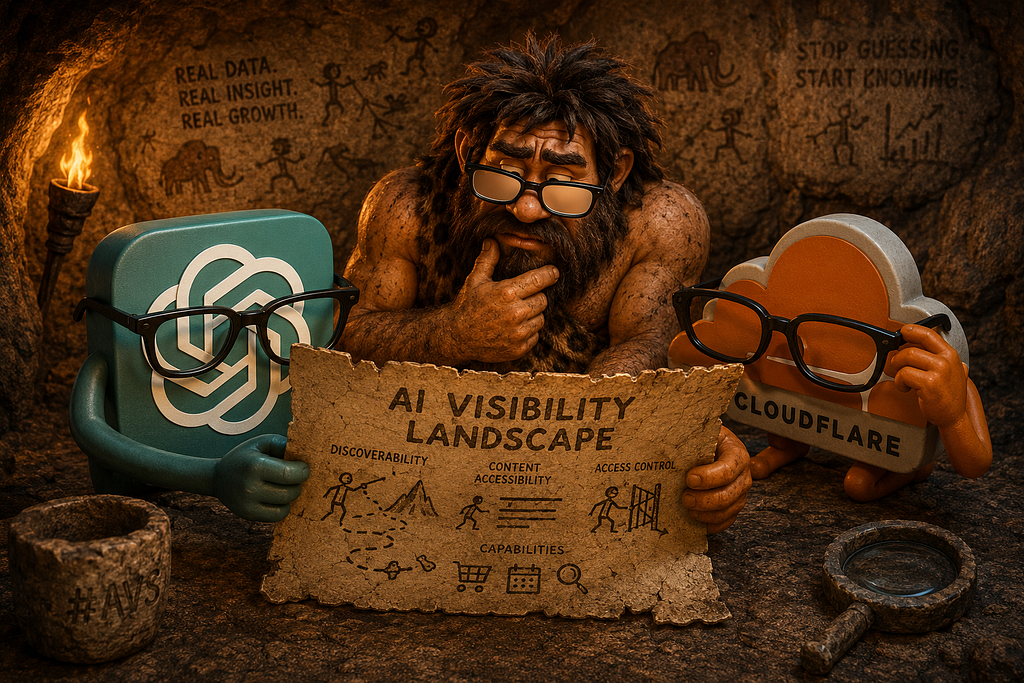
Mostly the same clarity you should already have, applied with machines in mind. Cloudflare’s scanner scores sites across four areas, and reading them as plain English is the fastest way to understand the whole shift.
Discoverability, meaning an agent can find your pages through robots.txt and a clean sitemap. Content accessibility, meaning your content can be read without fighting through heavy JavaScript, ideally with a clean text version available. Access control, meaning you decide which bots may do what with your content. And capabilities, meaning if your site has real functions like search or booking, an agent can find and call them.
The first two are where everyone should start, and they are not new asks. Many agents still perform better when important content is available directly in server-rendered HTML, since client-side rendering can reduce reliability and increase task failures. A button labelled only “Submit” and a form field with no label are friction for an agent for exactly the reason they are friction for a person using assistive technology. For most businesses, agent-readiness overlaps heavily with accessibility and semantic HTML, although the concepts are not identical.
How Deep Does the Rabbit Hole Go?
Deep, if you run a commerce or documentation site. This is the part most articles skip, so here is the actual architecture forming underneath the agentic web, named plainly.
A handful of open protocols are becoming the plumbing. Model Context Protocol (MCP), introduced by Anthropic in late 2024, is a shared way for an agent to connect to your tools and data, often described as a USB-C port for AI. NLWeb, from Microsoft, turns your existing schema.org data into an endpoint an agent can query in natural language. WebMCP lets a page expose tools an in-browser agent can call directly. A2A, now under the Linux Foundation, governs how agents talk to each other, and it is infrastructure you consume rather than install.
Then there is the money layer. Payments were built for humans clicking “pay,” which breaks when the buyer is software. New standards are fixing that: x402 revives an old HTTP status code to let agents pay for a resource, while the Agentic Commerce Protocol from OpenAI and Stripe and the Universal Commerce Protocol from Google and Shopify are intended to let agents discover products and eventually complete purchases through standardized commerce flows.
Here is the honest part. If you are a coach, a consultant, or a small business, you will not implement most of these this year, and you do not need to. These matter first for sites where agents transact at scale, catalogues, marketplaces, and large documentation sets. Knowing the names means you can tell when a plugin or agency is selling you tomorrow’s problem before you have solved today’s.
What Should Most Businesses Do First?
Make your site legible before you make it transactional. The unglamorous basics move your agent-readiness more than any protocol, and they help your human visitors and your AI citations at the same time.
Start here. Make sure your important content is in the HTML and not hidden behind JavaScript that an agent will not run. Give every form field a real label and every button a name that says what it does. Keep a clean robots.txt and sitemap so agents can find their way. Structure pages so one page means one thing. And if you want a number to work against, a free scan like Cloudflare’s isitagentready.com will grade a URL and hand you specific fixes.
None of that requires a new platform or a developer on retainer. It requires treating the agent as a real visitor with real limits, which is the same mindset that has always produced clear, accessible, well-structured sites. The businesses that win the agent era first will not be the ones with the fanciest protocols. They will be the ones whose sites were already easy to use, for anything.
Frequently Asked Questions About Agent-Ready Websites
Q: What is an agent-ready website?
A: An agent-ready website is one an autonomous AI agent can use to complete tasks, not just read. That means its content, forms, and functions can be understood and operated by software acting on a user’s behalf, without a person clicking through the screen.
Q: What is the difference between AI citation and agent-readiness?
A: Citation is whether an AI quotes your content in an answer. Agent-readiness is whether an AI can complete an action on your site, like filling a form or making a booking. A page can be cited well and still be impossible for an agent to operate.
Q: Do AI agents work on JavaScript-heavy websites?
A: Often poorly. Many agents do not render JavaScript single-page apps by default, so content and functions buried in client-side rendering can be invisible to them. Serving important content and links in the HTML is one of the highest-impact fixes.
Q: What is MCP and do I need it?
A: MCP, or Model Context Protocol, is an open standard that lets AI agents connect to a site’s tools and data through one shared interface. It matters most for commerce, documentation, and app-like sites. Most small business and creator sites should focus on clean structure and accessibility first.
Q: How do I check if my website is agent-ready?
A: Free scanners now exist, including Cloudflare’s isitagentready.com, which grades a URL across discoverability, content, access control, and capabilities, then returns specific fixes. It is a fast way to see where you stand before deciding what to change.
Q: Is agent-readiness the same as accessibility?
A: Not identical, but closely related. Many things that block an agent, unlabelled buttons, content hidden in JavaScript, forms with no clear structure, are the same things that block people using assistive technology. Improving one usually improves the other.
For thirty years we built websites for eyes. The next wave of visitors does not have any, and it is already knocking. The strange gift in that is how much of the work turns out to be the clarity we owed our human visitors the whole time.
AI Visibility Studio helps websites structure content so AI systems can find it, understand it, cite it, and actually use it when generating answers. aivisibilitystudio.com
References
- Cloudflare Blog, “Introducing the Agent Readiness score” (April 17, 2026): https://blog.cloudflare.com/agent-readiness/
- Model Context Protocol, “Getting Started”: https://modelcontextprotocol.io/docs/getting-started/intro
- OpenAI, “Introducing ChatGPT agent” (July 17, 2025): https://openai.com/index/introducing-chatgpt-agent/
- No Hacks, “MCP, A2A, NLWeb, and AGENTS.md: The Standards Powering the Agentic Web”: https://nohacks.co/blog/agentic-web-protocols