 Originally published on Medium ↗
Getting cited by AI feels like the win. It is only half of one. When an AI links your page as a source, there is a real chance the claim it attached to your name is not actually what your page says. A peer-reviewed study put numbers on this, and they are not comforting. The citation is not the finish line. Being represented accurately is.
Key Takeaways
- A Nature Communications study of medical queries found that 50% to 90% of LLM answers were not fully supported, and sometimes contradicted, by the sources they cited.
- The study measured medical questions specifically, but the mechanism that causes it is not unique to medicine.
- There are two separate failure modes: a fabricated citation that points to nothing, and a real citation that does not support the claim attached to it.
- Retrieval-augmented models reduced the dead-link problem. They did not eliminate the accuracy problem.
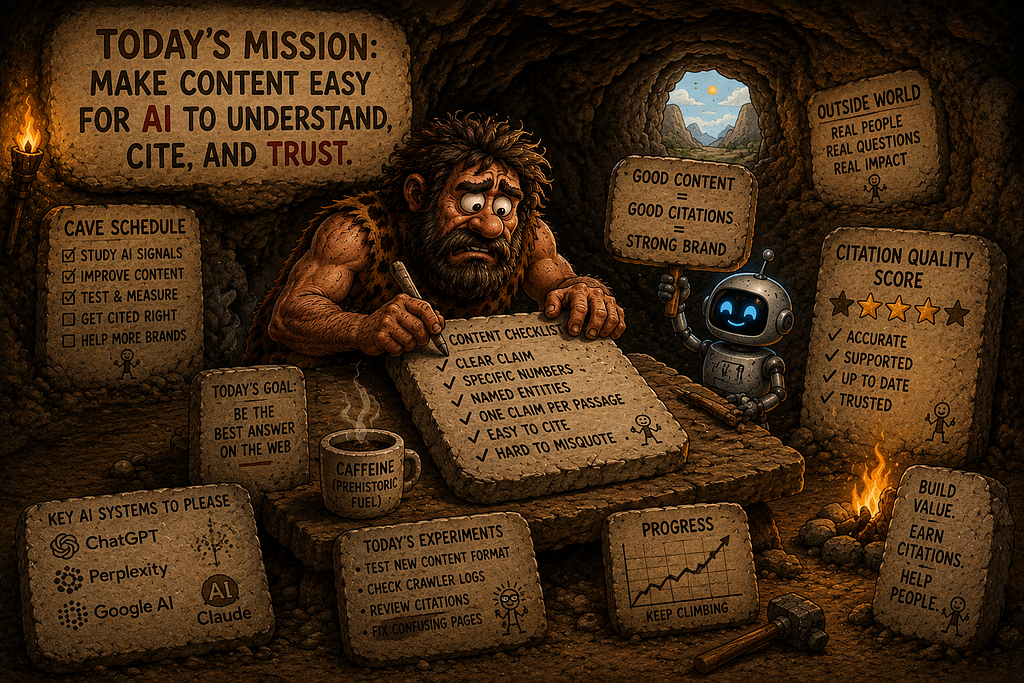
- The defense is content that is hard to misread: specific numbers, named entities, and one clear claim per passage.
What Did the Study Actually Find?
Researchers at Stanford built an automated pipeline called SourceCheckup and used it to check whether the sources LLMs cite actually support what the models say. The answer was mostly no.
Across seven popular models, 800 questions, and 58,000 statement-source pairs, the team found that between 50% and 90% of LLM responses were not fully supported by the sources they cited, and some were outright contradicted by them. Even GPT-4o with web search left roughly 30% of individual statements unsupported and nearly half of its full responses not fully backed. Independent review by doctors agreed with the findings.
One caveat matters and the study is explicit about it. These were medical queries, a domain where being wrong has consequences and where the bar for “supported” is high. The exact percentages do not transfer cleanly to a query about your pricing or your service area. The mechanism behind them does.
Why Does AI Misquote a Source It Linked Correctly?
Because many AI systems generate claims and attach sources through separate retrieval and generation steps. The link can be real while the claim still fails to match it.
This is the part people miss. A correct link is not evidence of a correct claim. The model can fetch your page, pull a number from somewhere in its training, attach your URL to it, and present the whole thing as sourced. To the reader it looks airtight. To you it looks like words you never wrote.
The cleaner your page is to interpret, the less room the model has to fill gaps with its own guess. Ambiguity is where misquotes are born.
What Is the Difference Between a Fabricated Citation and an Unsupported One?
A fabricated citation points to a source that does not exist. An unsupported citation points to a real source that does not back the claim. They are different problems with different causes.
Fabrication is the famous one. A November 2025 study in JMIR Mental Health found that 19.9% of GPT-4o citations across six literature reviews were entirely fabricated, with no traceable publication behind them. Retrieval-augmented generation, the approach behind ChatGPT Search and Perplexity, reduces this. It tends to cite pages that actually exist.
The unsupported citation is the one still standing. The page is real, the link works, and the claim still does not match what the page says. That is the failure mode you cannot fix by waiting for better models, because it is still a known weakness in how retrieval and generation work together.
How Do You Make Your Content Harder to Misquote?
Write claims that cannot be bent. A vague sentence is an invitation for a model to paraphrase it into something you did not mean. A specific one resists that.
Three things reduce misattribution, and they are the same things that improve citation in the first place. Use precise numbers instead of soft quantifiers, so “cuts onboarding time by 40%” instead of “saves a lot of time.” Name entities directly, so the model has no room to swap in a competitor or a generic. Make one clear claim per passage, so an extracted chunk carries its full meaning without the surrounding context.
Here is the difference. This is hard to misquote:
Our onboarding audit takes 5 business days and covers up to 50 pages. It does not include content rewriting, which is a separate engagement.
This is easy to misquote:
We offer flexible onboarding options designed to meet you where you are and get you up and running quickly.
The first sentence pins every fact in place. The second is a cloud a model can reshape into almost any claim and still feel justified linking you as the source.
Does This Mean AI Citations Are Not Worth Chasing?
They are worth chasing, with eyes open. A citation that misrepresents you is not a neutral event. It can attach a wrong price, a wrong claim, or a wrong fact to your brand in front of someone who will never visit your actual page to check.
So the goal shifts. It is not just to be cited more. It is to be cited accurately, which means writing content that gives the model the least possible room to get you wrong. Volume of citations is a vanity metric if half of them put words in your mouth.
Frequently Asked Questions
Q: How often does AI cite sources incorrectly?
A: A 2025 Nature Communications study found that 50% to 90% of LLM responses were not fully supported by the sources they cited, on medical questions. Even GPT-4o with web search left nearly half of its responses not fully supported.
Q: Is the 50 to 90% figure true for all topics?
A: No. That study measured medical queries specifically, where accuracy standards are strict. The exact rate does not transfer to general topics, but the underlying cause, which is that models generate claims separately from the sources they attach, applies broadly.
Q: What is the difference between a fabricated citation and an unsupported citation?
A: A fabricated citation points to a source that does not exist. An unsupported citation points to a real, working source that does not actually support the claim attached to it. Retrieval-augmented generation reduces dead-link and fabricated-source problems but does not eliminate them, and it does not fix the support problem.
Q: Why does AI misrepresent a page it linked to correctly?
A: Because the model predicts the sentence and retrieves the link as separate steps. A correct link is not proof of a correct claim, since nothing guarantees the generated text matches what the source says.
Q: How do I stop AI from misquoting my website?
A: Write claims that resist paraphrasing. Use specific numbers, name entities directly, and make one clear claim per passage so an extracted chunk keeps its meaning without surrounding context.
Q: Does retrieval-augmented generation fix AI citation accuracy?
A: Partly. It reduces fabricated and dead links because it cites real pages, but it does not guarantee the cited page supports the claim. Studies still find a large share of unsupported statements even with retrieval enabled.
Everyone is measuring how often AI mentions them. Almost no one is checking whether the mention is true. The brands that win the next phase of AI search will not be the most cited. They will be the hardest to get wrong.
Sources
- Wu et al. (2025), “SourceCheckup: Verifying citations in clinical answers from large language models.” Nature Communications. https://www.nature.com/articles/s41467-025-58551-6
- JMIR Mental Health (November 2025), study on GPT-4o fabricated citations in literature reviews. https://mental.jmir.org/2025/1/e80371
AI Visibility Studio helps websites structure content so AI systems can find it, understand it, cite it, and actually use it when generating answers. aivisibilitystudio.com