 Originally published on Medium ↗
OpenAI has said it is testing ads in ChatGPT in the U.S. for logged-in adults on Free and Go plans. Sponsored placements appear when a user is already asking questions, comparing options, or moving toward a decision. That is a meaningfully different moment to reach someone.
But if you are thinking about what this means for your business, the more important question is not whether ChatGPT ads work. It is whether you understand what they can and cannot do.
– – -
What the ChatGPT Ad Rollout Actually Looks Like
OpenAI is currently testing ads in the U.S. for logged-in adults on Free and Go plans. Plus, Pro, Business, and Enterprise plan users are not seeing ads in this test.
OpenAI has stated that:
- Ads are clearly labeled and separate from the organic answer
- - Ads do not influence what the assistant says
- - Advertisers do not get access to chats, chat history, memories, or personal details, and only receive aggregate performance information
This is not a self-serve dashboard situation yet. OpenAI’s advertiser page is essentially an interest list. Businesses that want early access are signing up to learn more, not buying inventory on a finished platform.
– – -
Why the Placement Actually Makes Sense for Certain Businesses
Most digital ads hit people who are doing something unrelated to buying. A banner ad appears while someone reads about sports. A social ad interrupts a video. The context is noise.
ChatGPT is different because users are already in a task-oriented mindset. Someone asking “what’s the best project management software for a small agency” is further along in a decision than someone who happened to see a retargeting ad while checking their phone.
OpenAI frames the opportunity around users who are “actively researching and ready to take action.” That language is worth taking seriously, because it describes something closer to search intent than social interruption.
The businesses that stand to benefit most are ones people research before buying: software, professional services, finance tools, education, B2B services. High consideration categories where showing up in a decision-making moment has real value.
Even without a click, appearing inside a trusted research environment can put a brand into the consideration set earlier. That matters more as AI interfaces take on the discovery function that used to belong to search engines.
– – -
The Part That Gets Skipped in Most Coverage
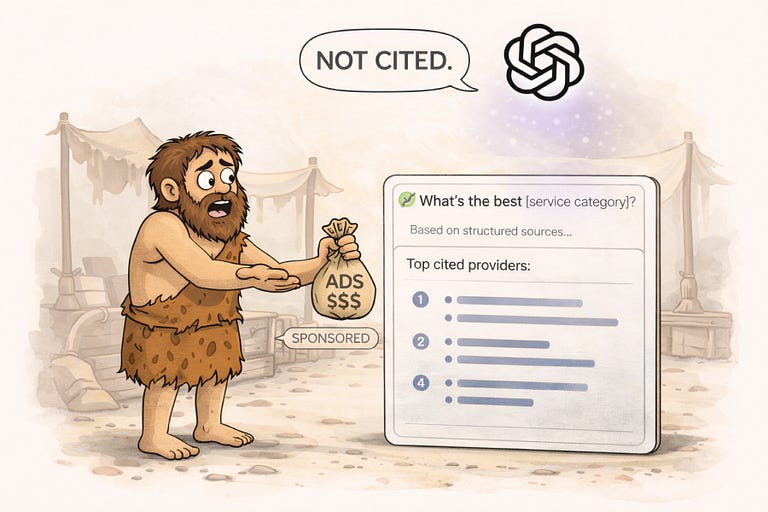
OpenAI has been explicit: ads are separate from answers. Paid placement does not influence what ChatGPT says organically.
That means if your brand is invisible in AI-generated answers, advertising is an add-on, not a fix.
If someone asks ChatGPT which service providers to consider in your category and your business does not come up organically, a sponsored label next to your name is doing different work than an organic citation would. Both have value. They are not the same thing.
The businesses that will get the most from ChatGPT ads are the ones that already have both:
- Structured content that AI systems can read, trust, and cite
- A paid placement to show up in decision-adjacent moments
One without the other is either invisible or renting attention without building anything underneath it.
– – -
What This Means for a Service Business Right Now
The honest answer is: it depends on your timeline and your category.
If you sell something people research before buying and you want to be in front of ChatGPT users who are mid-consideration, joining the advertiser interest list is a reasonable move. OpenAI has not opened self-serve access yet, so this is not an immediate campaign you can run tomorrow. It is positioning for when the inventory opens.
What you can do right now is the other half of the equation. That means structured data, clear entity signals, machine-readable content, and a site architecture that lets AI systems understand what your business does and who it serves.
Paid placement buys attention. Organic inclusion in answers builds presence. The strongest position combines both. Grim little ecosystem, elegant in its own way.
– – -
Frequently Asked Questions
Q: Are ChatGPT ads live for all users?
A: No. OpenAI is currently testing ads in the U.S. for logged-in adults on Free and Go plans. Plus, Pro, Business, and Enterprise users are not seeing ads in this test.
Q: Will ChatGPT ads influence the answers the assistant gives?
A: OpenAI has said no. Ads are labeled separately and do not affect the organic answer. Advertisers do not get access to chats, chat history, memories, or personal details, and only receive aggregate performance information.
Q: Can I run ChatGPT ads right now as a small business?
A: Not through a self-serve dashboard. OpenAI’s current advertiser page is an interest sign-up. The platform is in early testing, not open for general campaign buying.
Q: What kinds of businesses would benefit most from ChatGPT ads?
A: High-consideration categories where users research before buying: software, professional services, education, finance tools, B2B services. The value comes from reaching users during a decision-making context rather than random interruption
– – -
ChatGPT ads are a real opportunity for some businesses. They are not a shortcut around the harder work of making your content machine-readable and trustworthy. The ones who figure that out first will have the better position regardless of which paid options open up later.
AI Visibility Studio helps businesses make their websites easier for AI systems to read, understand, and cite, so they are not relying on paid placement alone.