 Originally published on Medium ↗
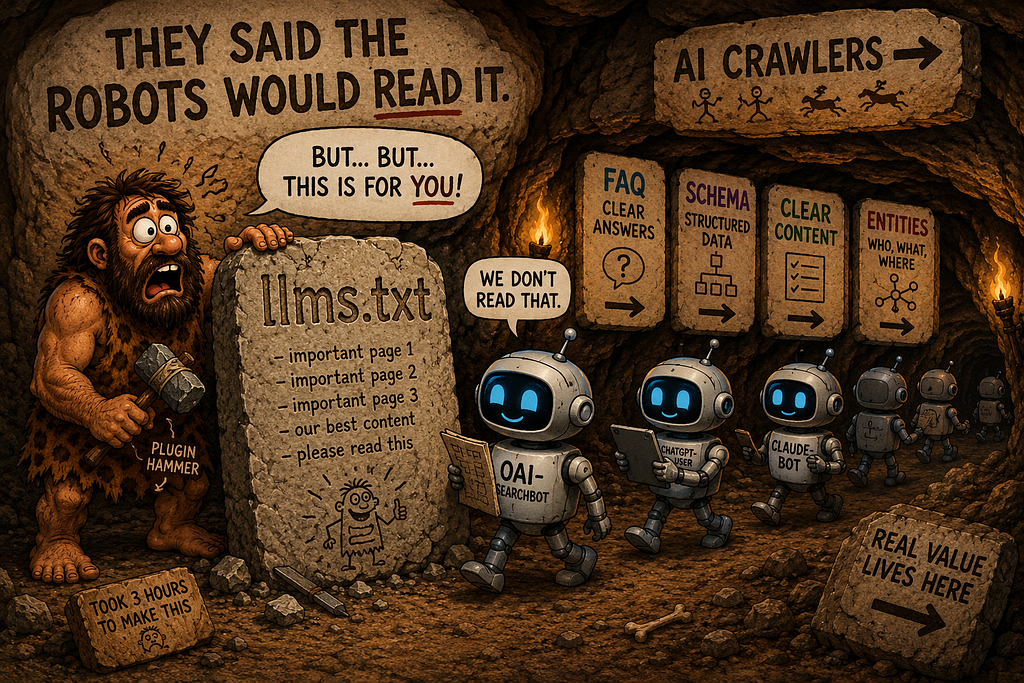
llms.txt may be the most confidently recommended AI visibility tactic with the least evidence behind it. A plugin will generate one for you. A dozen guides will tell you it’s the new robots.txt. Then you check your server logs and find that almost no AI crawler ever asks for the file. The idea is sound. The data, as of mid 2026, is not.
What is llms.txt supposed to do?
llms.txt is a markdown file you put at the root of your site, like yoursite.com/llms.txt. It lists your most important pages so an AI system can find your best content without crawling everything. Think of it as a curated map written for machines instead of people.
The proposal came from Jeremy Howard in September 2024. The logic is clean. Search crawlers index your whole site, but LLMs often work from a smaller window, so a hand-picked list of your strongest pages should help them reach the right content faster.
A basic one looks like this:
# AI Visibility Studio
> A system for making websites readable and citable by AI search.
## Core pages
- [What we do](https://aivisibilitystudio.com/services): schema, structured data, AI readability
- [AI visibility audit](https://aivisibilitystudio.com/audit): scores how AI-ready a site is
## Guides
- [FAQ schema for AI citation](https://aivisibilitystudio.com/faq-schema): how FAQPage maps to LLM answers
Nothing wrong with the file itself. The problem is whether anything reads it.
Does llms.txt actually get read by AI crawlers?
Mostly no. SE Ranking analyzed close to 300,000 domains and found llms.txt on only 10.13% of them, with almost nine out of ten sites having no file at all. More telling, they ran the data through both statistical analysis and an XGBoost model and found no correlation between having llms.txt and how often a domain gets cited by LLMs. Removing the file from the model actually improved its accuracy.
The crawl-level data is worse for the file. OtterlyAI put llms.txt on a test domain and watched AI bot traffic for 90 days. Out of 62,100 AI bot visits, 84 requests went to the llms.txt file. That is 0.1% of all AI crawler traffic. They later dropped llms.txt from their audit checklist because it was pulling attention away from things that actually move citations.
You can read SE Ranking’s full breakdown here and Search Engine Journal’s coverage of the study here. Both land in the same place. No measurable effect yet.
Sources for this section:
- SE Ranking, 300,000-domain llms.txt study: https://seranking.com/blog/llms-txt/
- Search Engine Journal coverage of the study: https://www.searchenginejournal.com/llms-txt-shows-no-clear-effect-on-ai-citations-based-on-300k-domains/561542/
- OtterlyAI 90-day crawl experiment: https://otterly.ai/blog/the-llms-txt-experiment/
- Google’s position, via Search Engine Land: https://searchengineland.com/google-says-normal-seo-works-for-ranking-in-ai-overviews-and-llms-txt-wont-be-used-459422
Has Google or any AI lab said they use it?
Not in any meaningful confirmed way, and Google said so out loud. In July 2025 at Google’s Search Central Deep Dive, Gary Illyes said Google does not currently support llms.txt for search ranking or AI Overviews, and won’t be crawling the file. His reasoning was that the file’s contents are fully controlled by the site owner, which makes it easy to manipulate and unreliable as a signal, the same flaw that got the keywords meta tag ignored years ago.
No major provider has publicly confirmed using it as a production citation signal. Some bots fetch it occasionally. Occasional fetching is not the same as using the file to decide what gets cited.
That does not mean no crawler will ever request the file. It means there is no public evidence that major AI systems use it as a ranking, retrieval, or citation signal.
That is the whole gap. The file exists, a few crawlers glance at it, and nobody has confirmed it changes a single answer.
Should you add llms.txt anyway?
If it costs you nothing, sure. An auto-generated file from a plugin like Slim SEO on WordPress, or a CI script that builds one from your sitemap, is a few minutes of work and carries no downside. Treat it as cheap insurance in case adoption shifts later. Standards sometimes get respected after sites adopt them, not before.
The mistake is treating it as a results lever. Do not build a strategy around it, do not sell it to a client as a citation booster, and do not let it crowd out the work that does move the needle. One common implementation actually backfires: copying every page into its own markdown file. If those files get indexed, you have just created duplicate content at scale, which dilutes crawl budget and can suppress your real pages.
There is also a quieter signal worth noticing. Among the 50 most AI-cited domains in SE Ranking’s study, only one had an llms.txt file. The sites winning AI citations right now are mostly not using it. They are winning on something else.
What actually moves AI citations instead?
Structure inside the page, not a file pointing at the page. AI systems pull answers from content they can extract cleanly: a clear definition, a specific number, a direct comparison, a step-by-step sequence. A page built in those units gets absorbed into answers. A page of vague prose gets skipped, llms.txt or not.
That is the part the file cannot fix for you. llms.txt can point an AI at your page. It cannot make the page worth quoting. The work that earns citations happens in the content itself: schema that labels what each section is, FAQ blocks written the way people actually ask questions, and entity clarity so the model knows who you are and what you cover.
Frequently Asked Questions About llms.txt and AI Search Visibility
Q: Does llms.txt help with AI search visibility in 2026?
A: There is no evidence that it does yet. A 300,000-domain study by SE Ranking found no correlation between having llms.txt and how often a site is cited by LLMs, and major AI crawlers rarely request the file.
Q: Do ChatGPT, Claude, or Perplexity read llms.txt?
A: No provider has confirmed using it as a production signal. Some bots fetch the file occasionally, but in one 90-day test only 0.1% of AI crawler traffic touched it.
Q: Does Google use llms.txt?
A: No. In July 2025 Google’s Gary Illyes said Google does not currently support llms.txt for search ranking or AI Overviews and won’t crawl the file, on the grounds that its owner-controlled contents make it an unreliable signal.
Q: Should I still add llms.txt to my site?
A: Only if it costs you almost nothing. An auto-generated file is harmless and gives you optionality if adoption changes, but it is not a citation lever and should not replace on-page structure and schema.
Q: What actually helps a site get cited by AI?
A: Content built in extractable units. Clear definitions, specific statistics, direct comparisons, step sequences, plus schema markup and FAQ blocks that match how people ask questions in AI tools.
Q: Will copying my whole site into markdown files for llms.txt help?
A: No, and it can hurt. If those markdown files are indexable they create duplicate content at scale, which dilutes crawl budget and can suppress your original pages.
Adding llms.txt feels like progress because it produces a file you can point at. The sites getting cited are not pointing at files. They are writing pages an AI can lift a sentence out of.
This may change if major AI providers adopt llms.txt later. For now, the data points the other way.
AI Visibility Studio helps websites become easier for AI systems to find, read, and cite. If your AI visibility strategy depends on one text file, the robots have already won. [aivisibilitystudio.com]