 Originally published on Medium ↗
You can be cited by ChatGPT and still contribute almost nothing to the answer. The link sits at the bottom of the response, the user never clicks it, and your page shaped none of the words above it. That is a citation. It is not influence. A new measurement framework splits AI visibility into two separate events, and most people are optimizing for the wrong one.
Key Takeaways
- Citation selection is when an AI picks your page as a source. Citation absorption is when your page actually contributes language, evidence, or structure to the answer. They are not the same win.
- A 2026 analysis of 18,151 successfully fetched pages found that citation selection and citation absorption behave like separate outcomes.
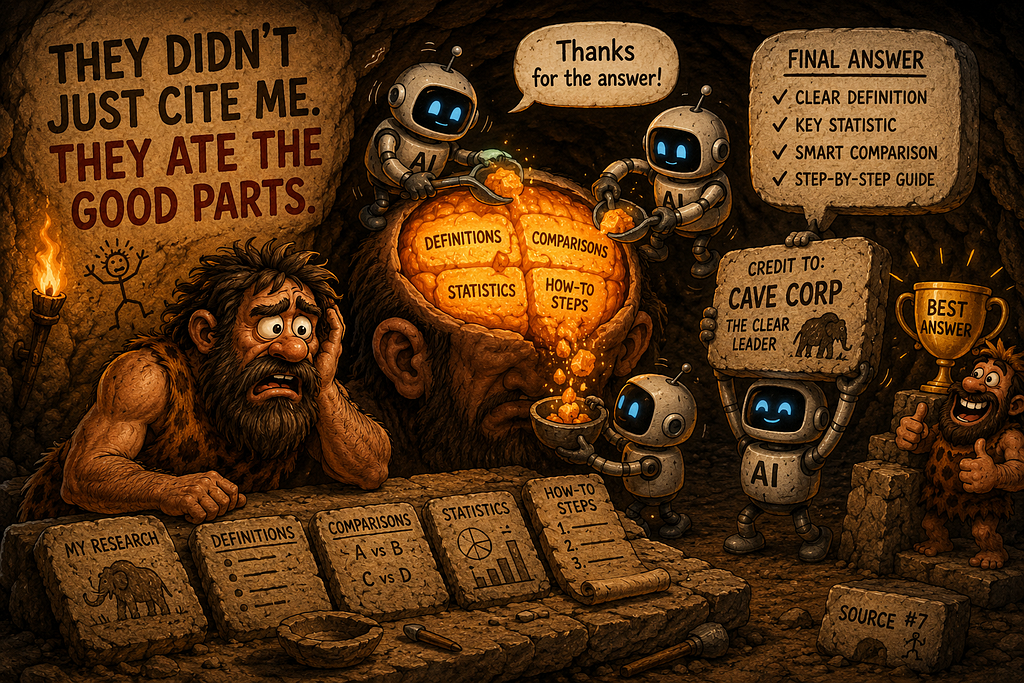
- Pages that get absorbed tend to be modular and dense with extractable evidence: definitions, numbers, comparisons, and how-to steps.
- ChatGPT cites fewer sources than Perplexity or Google but leans on each one harder, so getting into its small set is high value.
- Optimizing for absorption is content structure work, which is something you control directly.
What Is the Difference Between Citation Selection and Citation Absorption?
Citation selection is the AI choosing your page as a source. Citation absorption is your page feeding actual content into the generated answer. The first gets you a link. The second gets your ideas into the response a person reads.
The framework comes from a 2026 paper, From Citation Selection to Citation Absorption. The authors analyzed the public geo-citation-lab dataset: 602 controlled prompts across ChatGPT, Google AI Overview, Gemini, and Perplexity, with over 21,000 search-layer citations and more than 18,000 successfully fetched pages.
Their core finding is that breadth and depth pull apart. A page can be selected often and absorbed rarely. Another page can be selected less but absorbed deeply. If you only count citations, those two pages look similar. They are not.
Why Being Cited Does Not Mean Being Used
Most AI visibility tools count citations. A citation count tells you that you were on the list. It does not tell you whether your content did any work.
The paper measures absorption with an influence score: how much a fetched page actually contributed to the final answer, not just whether it was linked. This is the authors’ own constructed metric, so treat it as a careful research signal rather than a number any platform publishes. The point still holds. Presence and contribution are different measurements.
This is the gap most AI visibility tools do not measure. Everyone is chasing the citation. The citation is the easy half. The hard half, and the half that moves a reader, is whether the model paraphrased your page or just parked a link under one it actually used.
What Kind of Content Actually Gets Absorbed?
Content that travels in reusable units. The paper found that pages containing definitions, numbers, comparisons, and how-to steps show higher mean influence among fetched pages. The semantic roles with the highest influence were definitions and comparisons.
The authors call this the evidence-container hypothesis. A page absorbed into an answer is not just relevant, it is built from chunks a model can lift intact: a clean definition, a specific statistic, a direct comparison between two things, a procedural step. The same direction held across length, headings, paragraph structure, list density, and semantic similarity.
Here is the difference in practice. This gets absorbed:
Kajabi does not generate FAQPage schema automatically. To add it, paste JSON-LD into the page’s custom code block in the page settings.
This does not:
There are a few things worth thinking about when it comes to schema on your site, and platforms handle it in different ways that are worth understanding before you decide on an approach.
The first one is a reusable support unit. A model can drop it straight into an answer. The second is filler wrapped around an idea that never arrives.
Why the Q&A Format Result Is Worth Understanding
Here is the counterintuitive part. In the same study, Q&A formatting showed lower influence, the opposite direction from definitions and statistics. That sounds like an argument against FAQ sections. It is not, and the distinction matters.
The likely reason, per the authors, is that Q&A format is a surface wrapper. Phrasing something as a question does not create evidence. A heading that says “What is schema?” followed by vague prose is still vague prose with a question mark on top. The format alone earns nothing.
The fix is not to drop the FAQ. It is to make sure each answer contains a real evidence unit: a definition, a number, a concrete step. The question framing helps a human scan and helps match conversational queries. The absorption comes from what sits underneath it. Structure is not a substitute for substance, it is a container for it.
Does This Mean Citations Do Not Matter?
They still matter, because absorption cannot happen without selection. You have to be chosen before you can be used. The two stages stack: get selected, then get absorbed.
The platform behavior is worth noting here. The study found Perplexity and Google cite more sources on average, while ChatGPT cites fewer but shows substantially higher average influence among the pages it fetches. A spot in ChatGPT’s shorter list is harder to earn and does more work once earned. That is an argument for building pages worth absorbing, not just pages worth listing.
Frequently Asked Questions
Q: What is the difference between citation selection and citation absorption?
A: Citation selection is when an AI system chooses your page as a source for an answer. Citation absorption is when your page actually contributes language, evidence, or structure to the generated answer. You can be selected without being meaningfully absorbed.
Q: Can a page be cited by AI without influencing the answer?
A: Yes. A page can appear as a linked source while contributing little or nothing to the words in the response. Counting citations alone does not measure whether your content shaped the answer.
Q: What kind of content gets absorbed into AI answers?
A: Content built from reusable evidence units. A 2026 study found that definitions, statistics, comparisons, and how-to steps showed higher influence among fetched pages, with definitions and comparisons ranking highest.
Q: Do FAQ sections still help with AI visibility?
A: Yes, when the answers contain real evidence. The same study found that Q&A formatting on its own showed lower influence, because the format is a wrapper. An FAQ helps when each answer holds a definition, number, or concrete step, not just a question heading over vague text.
Q: Why does ChatGPT cite fewer sources than Perplexity?
A: The 2026 analysis found ChatGPT cites fewer sources on average but draws more heavily on each one. Perplexity and Google tend to cite more sources with lower average influence per page. Getting into ChatGPT’s smaller set is harder and carries more weight.
Q: How do I optimize my content for citation absorption?
A: Write in extractable units. Lead sections with a direct definition or answer, include specific numbers, use clear comparisons, and break procedures into discrete steps so a model can lift them intact.
Everyone is counting citations right now. A citation that contributes nothing to the answer is a link in a footnote no one reads. The pages winning AI search are not the ones that got mentioned. They are the ones that got used.
AI Visibility Studio helps websites structure content so AI systems can find it, understand it, cite it, and actually use it. aivisibilitystudio.com