 Originally published on Medium ↗
Google Changed Its Algorithm and Its Search Box in the Same Week. Here Is What It Means for AI Visibility.
On May 21, 2026, Google started rolling out a core update. Two days earlier, at Google I/O, it announced that AI Mode had passed one billion monthly users and redesigned the search box for the first time in 25 years. Most coverage treated these as two stories. They are one story, and the connection is the part that matters for whether AI cites you.
Key Takeaways
- The May 2026 core update and the AI Mode expansion landed in the same I/O week, and they should be read together.
- A core update no longer just reshuffles rankings. It adjusts what feeds AI Overviews and AI Mode, because they draw from the same quality signals.
- Google published its first official AI search optimization guide and its position is blunt: this is still SEO.
- The same guide says you do not need llms.txt, content chunking, or special AI-only schema for Google’s AI features.
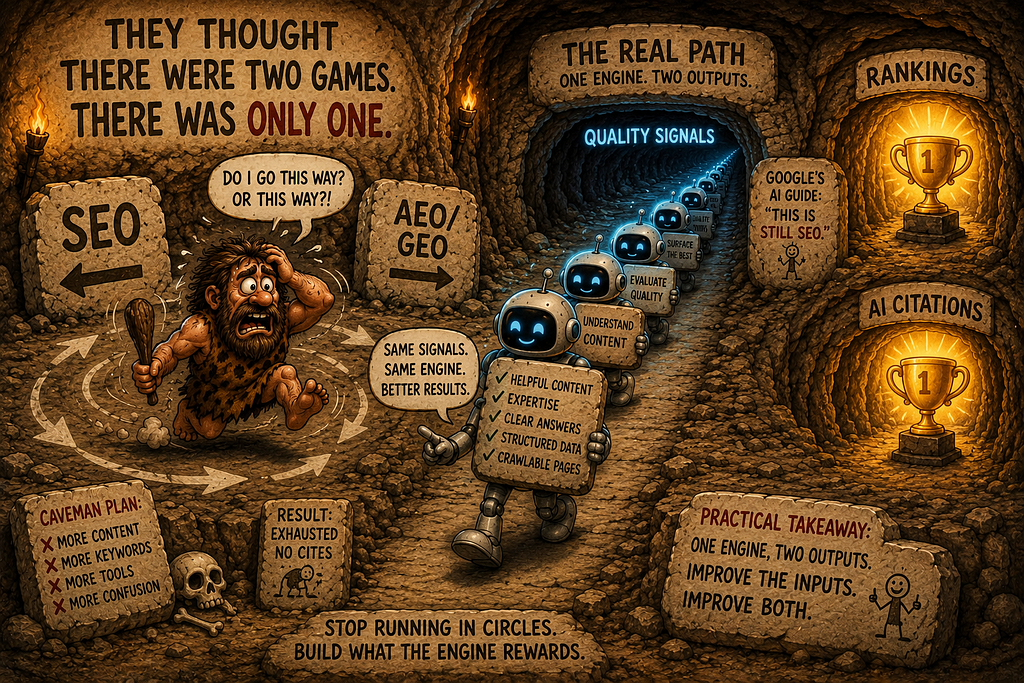
- The practical takeaway is one engine, two outputs. Improving the inputs improves both ranking and citation at once.
Why the Timing of These Two Announcements Matters
A core update changes how Google judges which content is satisfying and relevant. The AI Mode expansion changes how often that judgment gets shown as a synthesized answer instead of a list of links. Put them together and the update reaches further than any core update before it.
Here is the mechanism. When Google’s AI surfaces expand, more queries get answered by AI Overviews and AI Mode. Those surfaces pull from the same index and the same quality signals that decide organic rankings, so a shift in the ranking algorithm is now also a shift in what gets cited.
Google confirmed the update on May 21 via its Search Status Dashboard, the same week as I/O. That overlap is a strong signal. The ranking layer and the AI answer layer increasingly draw from the same underlying evaluation systems.
What Is One Engine, Two Outputs?
It means the same content evaluation produces both your search ranking and your AI citation odds. You are not optimizing for two audiences. You are feeding one engine that emits two results.
For years the mental model was: rank on Google, and separately, figure out this new AI citation thing. That model is now wrong for Google specifically. The page that earns a strong quality assessment is the page eligible to rank and the page eligible to be cited in an AI Overview or AI Mode answer.
This is why a core update can move your AI visibility even if you never changed anything about AI. The engine got recalibrated. Both outputs moved.
What Did Google’s New AI Search Guide Actually Say?
On May 15, Google published its first official guide to optimizing for generative AI features. The headline position is that answer engine optimization and generative engine optimization are, for Google Search, still SEO.
The guide is most useful for what it tells you to stop doing. In a section on what you do not need, Google states that you do not need to create llms.txt files, you do not need to chunk your content into small pieces, and you do not need special AI-only markup or rewriting. Google says its systems understand nuance across a full page and can surface the relevant part on their own.
That is worth sitting with if you spent the last year being told otherwise. Google’s own guidance says you do not need to restructure pages into artificial chunks for AI systems. The llms.txt file gets no special treatment, content chunking is not required, and AI-only markup is not something its systems reward. The advice that actually carries weight is old advice: be crawlable, be indexable, be clear, demonstrate expertise.
Does Schema Still Matter If Google Says You Do Not Need Special Markup?
Yes, and the distinction is precise. Google said you do not need special, AI-only schema invented for generative features. It did not say structured data is dead.
Standard, valid schema still does what it always did: it confirms what your page is, who wrote it, and what each part means. Google’s guide still points to its existing structured data documentation and standard markup. The thing being retired is the cottage industry of bespoke AI markup, not Organization, Article, or FAQPage schema.
So the move is not to rip out your JSON-LD. It is to stop chasing AI-specific markup schemes that were never standard and that Google just confirmed it ignores.
What Should You Actually Do During a Core Update Rollout?
Wait for it to finish before drawing conclusions. The rollout completed on June 2, 2026, after 11 days and 21 hours, and throughout it Google advised against major reactive changes mid-rollout. Watching rankings bounce daily and editing in a panic is how you mistake noise for signal.
What does hold up across the current guidance is consistent: lead a page with a concise, direct answer, support it with specific evidence, attribute it to a named person or organization, and keep the technical foundation clean so the page can be crawled and indexed. None of that is new. That is the point. Google just told you the durable inputs are the ones you already knew, and the engine that reads them now powers two outputs instead of one.
Frequently Asked Questions
Q: What is the Google May 2026 core update?
A: It is Google’s second broad core update of 2026, confirmed on May 21 via the Search Status Dashboard. It adjusts how Google evaluates content quality and relevance, and it completed on June 2, 2026, after 11 days and 21 hours.
Q: How does a Google core update affect AI visibility?
A: AI Overviews and AI Mode draw from the same index and quality signals that determine organic rankings. So a core update now shifts what gets cited in AI answers, not just what ranks in the link results.
Q: Did Google say AEO and GEO are just SEO?
A: Effectively, yes. Google’s guidance emphasizes that the same fundamentals used for SEO also support visibility in AI Overviews and AI Mode, rather than treating answer engine optimization and generative engine optimization as separate disciplines.
Q: Does Google use llms.txt or require special schema for AI search?
A: No. Google’s guide says you do not need llms.txt, content chunking, or special AI-only markup for its generative features. Standard structured data still helps, but AI-specific markup schemes do not receive special treatment.
Q: Should I make major content changes based on the core update?
A: Wait for stable data before reacting. The update completed on June 2, 2026, and Google advised against major changes mid-rollout. Daily ranking movement during a rollout is noise, and reacting to it tends to cause more harm than good.
Q: What is the difference between AI Overviews and AI Mode?
A: AI Overviews are passive summaries that appear automatically at the top of standard search results. AI Mode is a separate conversational experience users enter deliberately, and it rewards depth and follow-up answers more than a single concise summary.
Google spent the last week telling everyone the future of search is AI. Then it published a guide explaining that the way to show up in that future is to do the unglamorous things people have known about for fifteen years. The studios still chasing the magic AI markup file missed the only sentence that mattered.
AI Visibility Studio helps websites structure content so AI systems can find it, understand it, cite it, and actually use it when generating answers. aivisibilitystudio.com