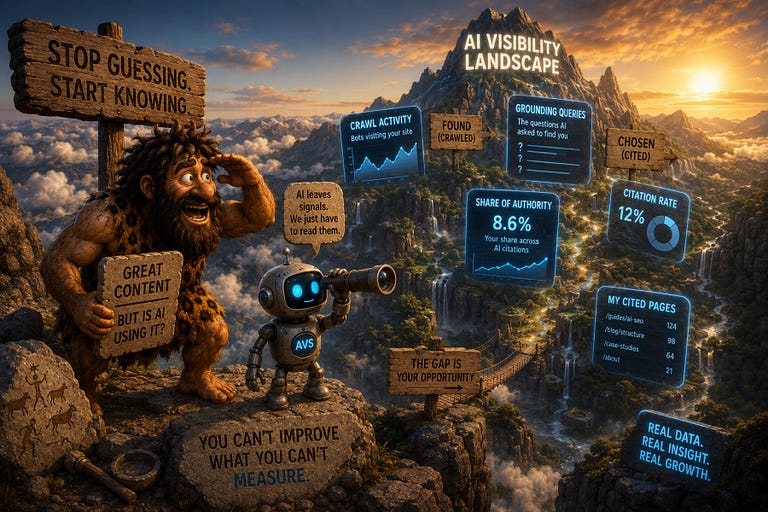
For two years the honest answer to “is AI actually reading my site” was a shrug. Microsoft Clarity changed that. Its AI Visibility section, free and now generally available, shows which AI bots crawl your pages, which of your pages get cited in AI answers, and the grounding queries AI systems used when retrieving your content. Most people open it, see a wall of panels, and close it again. This is how to read each one.
Key Takeaways
- Clarity’s AI Visibility is free and splits into two dashboards: Bot Activity (the crawl) and Citations (the outcome).
- Bot Activity shows which AI crawlers hit your site, which pages they request, and whether your setup reveals crawl issues.
- Citations shows Share of Authority, the grounding queries AI systems used to retrieve your content, and which of your pages get cited.
- The single most useful signal is the gap between being crawled and being cited. Getting crawled is not the same as getting chosen.
- Clarity’s citation data covers Microsoft’s grounding ecosystem and supported partner experiences that use Bing grounding, which may include ChatGPT, not every AI engine.
What Is Clarity’s AI Visibility Section, and Why Should You Care?
It is the first free tool that shows your content moving through the AI pipeline, from crawl to citation. Microsoft Clarity’s AI Visibility is a behaviour analytics product, and its data comes from Microsoft’s own grounding infrastructure, the retrieval layer that sits under the AI answers themselves.
That matters because most AI visibility tools guess. They send test prompts to an AI engine and check whether your brand appeared. Clarity reports aggregated citation and grounding activity from supported AI experiences instead, not modelled prompt tests, which is a different and stronger kind of signal.
One honest caveat before you read a single panel. Clarity does not prove a bot read your page the way a person reads it. It proves requests, citations, and grounding signals inside supported systems. That is a small distinction with a large difference, and it keeps you from overclaiming what the numbers mean.
The important mental model: AI visibility is a funnel, not a moment. First an AI bot crawls your page. Then, when someone asks a question, the system retrieves candidate pages. Then it decides which ones to actually cite. Clarity gives you a view into each stage, and reading the panels as one funnel is what makes them useful.
What Does the Bot Activity Dashboard Actually Show?
Who is crawling you, how much, and whether the crawl even worked. Bot Activity is the top of the funnel, and it needs a supported CDN or server-side integration to populate, unless you are on the latest Clarity WordPress plugin, which may surface it automatically.
The top row gives you the volume: number of requests from AI bots, their share of your total traffic, how many unique pages they hit, and a violations figure. Below that, the panels break it down. Bot operator tells you which companies are crawling, so you can see the split between Anthropic, OpenAI, Amazon, Google, and others. Bot activity type groups requests by purpose, such as search, AI assistants, developer tools, data services, or crawler activity, which tells you whether bots are indexing you or answering live questions with you.
Two panels matter more than people realise. Path requests shows which of your URLs the bots hit most, and it is worth checking whether your important pages are the ones getting attention or whether bots are burning most of their requests on your robots.txt and sitemap. If your setup surfaces redirects, failures, or unusual request patterns, treat that as the quiet alarm. When a large share of AI bot requests are redirecting or failing instead of returning a clean success, the bots are working harder than they should to reach your content, and some may give up. A site can show heavy crawl volume and still be handing bots a messy path in.
What Does the Citations Dashboard Show That Bot Activity Does Not?
Whether any of that crawling turned into being used in an actual answer. Citations is the bottom of the funnel, and unlike Bot Activity it does not need a CDN, though a project admin does need to verify domain ownership, either through the Clarity tracking code, Google Search Console, or Bing Webmaster Tools.
The headline metrics are the ones to learn. Page Citations is the total count of times your pages were referenced in AI answers over the selected period. Share of Authority is the one to watch: your slice of all citations, across the queries where your domain appeared, versus every other domain. It is a competitive benchmark you get without supplying a single competitor name. AI referral traffic shows the share of your sessions that arrived from AI assistants, which is usually small today and growing.
Then the two panels that exist nowhere else. Grounding queries shows the actual retrieval instructions the AI wrote before fetching your content, which are not always the words a user typed but reveal how the system frames your topic. My cited pages ranks which of your URLs earn citations. Together they answer a question SEO never could: not what you rank for, but what AI actually pulls you into.
What Is the One Number Most People Miss?
The gap between query volume and citation rate. It is the most actionable signal in the whole tool, and it is easy to scroll past.
Query volume is every time your domain was eligible to appear, meaning the AI found your content and put it in the running. Citation rate is how often you were actually chosen from that pool. When volume is high but citation rate is low, the AI is finding you and passing you over. That is not a discoverability problem, it is an authority or clarity problem, and it points straight at which pages need the work.
This is also why Bot Activity and Citations have to be read together. Heavy crawling with few citations means the bots reach you but the content does not win. Light crawling with steady citations means the opposite. The space between the two dashboards is where the actual strategy lives.
How Do You Use Clarity Every Week Without Drowning in It?
Pick five things and check them on a fixed day. The tool rewards trend-watching, not staring, so the goal is noticing what moved, not admiring the dashboard.
A workable weekly loop:
- Share of Authority. Note whether your slice went up or down. Rising means you are gaining ground, flat while citations climb means the whole space is growing without you.
- My cited pages. See which pages gained or lost citations, and which of your topics AI leans on most.
- Grounding queries. Read the questions AI asked to find you. New ones show emerging topics worth writing toward.
- Crawl issues in Bot Activity. Check whether important pages are being requested and whether your setup shows redirects, failures, or unusual patterns.
- The volume-to-citation gap. Flag any page or query where AI clearly finds you but rarely cites you. That is your next content job.
Fifteen minutes, same day each week. The number that matters is the direction of travel, not any single reading.
What Are the Limits You Should Know Before You Trust It?
Clarity sees Microsoft’s grounding ecosystem, not the entire AI web. Its citation data covers Microsoft AI experiences like Copilot and Bing, plus supported partner experiences that rely on Bing grounding, which may include ChatGPT when Bing grounding is used. It should not be treated as coverage for Google AI Overviews, Gemini, Perplexity, Claude, or every answer engine.
So treat it as a strong Microsoft-side signal, not a complete census of every AI answer on earth. It also shows your Share of Authority without naming the other domains you are competing against, so it tells you how you are doing without telling you exactly who is beating you.
None of that makes it less worth using. It is free, it is first-party, and it is the clearest window most site owners have ever had into the crawl-to-citation pipeline. You just read it knowing what it can and cannot see.
Frequently Asked Questions
Q: Is Microsoft Clarity’s AI Visibility free?
A: Yes. Both the Bot Activity and Citations dashboards are included at no cost in every Clarity project. You add the Clarity tracking code to your site, and for citation data a project admin verifies domain ownership through the Clarity tracking code, Google Search Console, or Bing Webmaster Tools.
Q: What is the difference between Bot Activity and Citations in Clarity?
A: Bot Activity shows which AI crawlers access your site and how often, which is the crawl stage. Citations shows whether that access turned into your content being referenced in AI answers, which is the outcome. One is who is reading you, the other is who is using you.
Q: What is Share of Authority in Microsoft Clarity?
A: Share of Authority is your domain’s percentage of all citations across the queries where your domain appeared, compared to every other cited domain. A rising share means you are gaining ground in AI answers for your topics, and you get the benchmark without naming any competitor.
Q: What are grounding queries in Clarity?
A: Grounding queries are the internal retrieval instructions an AI system writes before fetching content to answer a question. They are not always the exact words a user typed, but they show how the AI frames and searches your topic, which is data no keyword tool provides.
Q: Which AI engines does Clarity track citations for?
A: Clarity covers Microsoft’s grounding ecosystem, including Copilot, Bing AI surfaces, and supported partner experiences that rely on Bing grounding, which may include ChatGPT when Bing grounding is used. It should not be treated as coverage for Google AI Overviews, Gemini, Perplexity, Claude, or every answer engine, so pair it with other measurement for a fuller picture.
Q: Does high AI bot activity mean my content will be cited?
A: No. Heavy crawling does not guarantee citations. A site can receive substantial AI bot traffic and still be cited rarely if its content does not meet the authority or relevance thresholds the AI applies when choosing sources.
Clarity will not tell you everything, and it only sees Microsoft’s slice of the AI web. But it turns “I think AI reads my site” into a dashboard you can open on a Monday. For a free tool, being able to watch the crawl-to-citation gap at all is the part that used to be impossible.
For a broader view that adds Google’s own AI reporting and ChatGPT referral tracking, see our guide on how to measure AI visibility every week.
AI Visibility Studio helps websites structure content so AI systems can find it, understand it, cite it, and actually use it when generating answers. aivisibilitystudio.com
References
- Microsoft Clarity, “AI Visibility”: https://clarity.microsoft.com/ai-visibility
- Microsoft Learn, “Citation Dashboard Overview”: https://learn.microsoft.com/en-us/clarity/ai-visibility/ai-citations
- Microsoft Clarity Blog, “Understanding Your Influence in AI Answers with Microsoft Clarity”: https://clarity.microsoft.com/blog/understanding-your-influence-ai-citations/
- Microsoft Clarity Blog, “Citations in Microsoft Clarity Now Generally Available”: https://clarity.microsoft.com/blog/citations-now-generally-available/