 Originally published on Medium ↗
Your Google rankings are fine. Your AI visibility is another story.
Researchers analyzing millions of AI citations have found that content receives the most citation activity within the first few days of publishing, then drops off sharply. By the time a post is 3 months old, its citation probability has fallen by roughly 75%. By 6 months, it’s negligible in fast-moving categories.
That library of blog posts you’ve built? Most of it isn’t being cited. Not because it’s bad. Because it’s old.
Why AI Systems Are Structurally Biased Toward Recent Content
This isn’t a preference. It’s architecture.
Every LLM has a training cutoff. ChatGPT, Perplexity, Gemini – none of them “know” what you published 8 months ago from memory. To answer questions in real time, they query live search indexes. And live search indexes favor recently updated content.
Qwairy’s analysis of over 100,000 AI-generated queries found that AI systems automatically append the current year to 28% of sub-queries, even when users never typed it. That means your post titled “Best hosted platforms Alternatives” is competing against posts titled “Best hosted platforms Alternatives 2026” in the retrieval layer, not just in Google rankings.
The gap compounds. An Ahrefs analysis of 17 million citations across 7 AI platforms found that cited pages averaged 1,064 days old, compared to 1,432 days for traditionally ranked organic results. That 25% freshness advantage is not a rounding error. It’s the difference between being cited and being invisible.
The Metric You’re Probably Not Tracking
Most site owners look at organic traffic. Some look at keyword rankings. Almost nobody is tracking citation frequency across AI platforms.
That’s the problem. Only 6.82% of ChatGPT results overlap with Google’s top 10 organic results. And 28.3% of ChatGPT’s most-cited pages have zero organic visibility in Google search.
Read that again. More than a quarter of what ChatGPT cites doesn’t rank on Google at all. And less than 7% of what ranks on Google gets cited by ChatGPT.
These are different games. Playing one does not mean you’re playing the other.
What Signals Freshness to an LLM
AI systems cannot read your mind or your editorial calendar. They read signals.
The signals that register as “fresh”:
The `dateModified` value in your structured data. This is the most direct freshness signal you can control. If you refresh a post and don’t update the schema, you get no credit.
In-content recency markers. Citing a 2026 study reads differently than citing a 2022 one. Updating your statistics, examples, and references updates how current your content appears to retrieval systems, not just to readers.
The publish or update date visible on the page. Platforms that use live indexing read this directly.
Outbound links to current resources. A page that links to a deprecated tool or a 2021 pricing page signals staleness throughout. Pages citing sources from the current year tend to appear at earlier citation positions than pages with only older references.
A cosmetic update changes nothing. Swapping “2025” for “2026” in the title and republishing is the kind of refresh that looks like effort and produces none of the results.
What a Real Refresh Looks Like
A meaningful update takes 30 to 90 minutes depending on the post. It is not a rewrite.
Replace outdated statistics with current ones. If your post cites a 2023 study on AI adoption, find the 2025 or 2026 version. Update the reference. This alone re-signals the page.
Add a short new section. One paragraph answering a question that didn’t exist when you first published. This creates new content within an existing URL, which is a stronger freshness signal than changing old content.
Update the `dateModified` field in your JSON-LD schema. If your site doesn’t have structured data yet, that’s a separate problem. But if it does, this step takes 30 seconds.
Check your outbound links. Broken links or links to outdated pages drag down freshness scores across the board.
Republish with the new date visible. Not buried. Visible at the top of the post.
One documented case showed a content piece go from 0 out of 10 AI citations to 7 out of 10 after a three-hour refresh, measured over four weeks. That’s a real result. It’s also an outlier. Treat it as a ceiling, not an expectation.
How Often to Refresh, by Content Type
Not all content decays at the same rate.
If your post answers a question that changes regularly (tool comparisons, pricing, platform features, regulatory guidance), treat it as perishable. Product pages need monthly attention. Data-heavy guides and blog posts, quarterly. Evergreen content every six months at minimum.
If your post is definitional (“what is structured data,” “how does schema markup work”), the decay is slower. Foundational topics hold citation eligibility longer. But they still need annual reviews.
The practical rule: any post that earns you traffic and is older than 90 days is a candidate for review. Start with the ones that rank on Google but don’t appear when you search your topic in Perplexity or ChatGPT. That gap tells you where the decay has happened.
The hosted platforms-Specific Problem
hosted platforms does not make content refresh easy.
There is no native “last updated” field that surfaces in schema. There is no automated prompt to revisit posts on a schedule. The default assumption is that publishing is a one-time event.
That assumption is now expensive. A course creator with 40 blog posts and no refresh system has a library that is mostly invisible to AI search, regardless of how good those posts were when they went live.
The fix is not a platform change. It’s a system. A simple spreadsheet tracking publish date, last refresh date, and whether the post appears in ChatGPT and Perplexity for its primary query is enough to start. Set a quarterly calendar reminder. Refresh the oldest high-value posts first.
We don’t usually include a FAQ section. This one earned its place because these are the exact questions people type into ChatGPT, and that’s precisely the point.
Frequently Asked Questions
Does updating a blog post hurt its Google rankings?
No. Refreshing content with a new dateModified date and updated statistics typically maintains or improves Google rankings. Keep the URL unchanged to preserve backlink equity.
How do I know if my content is being cited by AI?
Search your primary keywords directly in ChatGPT, Perplexity, and Google AI Overviews. If your site does not appear as a source, you are not being cited for that query. Check this monthly for your highest-value posts.
Is freshness more important than quality for AI citations?
Neither alone is sufficient. Recently updated content from high-authority domains outperforms both old authoritative content and new low-authority content. Freshness signals that content is maintained. Quality signals that it’s worth citing. Both have to be present.
Does this affect all AI platforms equally?
No. ChatGPT shows the most aggressive freshness preference. Perplexity follows closely. Google AI Overviews weighs freshness against traditional ranking signals. A refresh strategy improves your position across all of them, but the effect is strongest in ChatGPT and Perplexity.
Can I just publish new content instead of refreshing old posts?
You can, but it’s less efficient. A refresh on a post with existing backlinks, indexed history, and established keyword associations compounds faster than a new post starting from zero. New posts and refreshes serve different functions. You need both.
What if I’m on hosted platforms and can’t add JSON-LD schema?
Schema markup is the most direct freshness signal you control. Without it, you rely entirely on visible page dates and in-content recency markers. That still moves the needle, but schema gives you an additional layer that hosted platform’s defaults don’t provide.
The posts that will get cited six months from now are the ones being refreshed today.
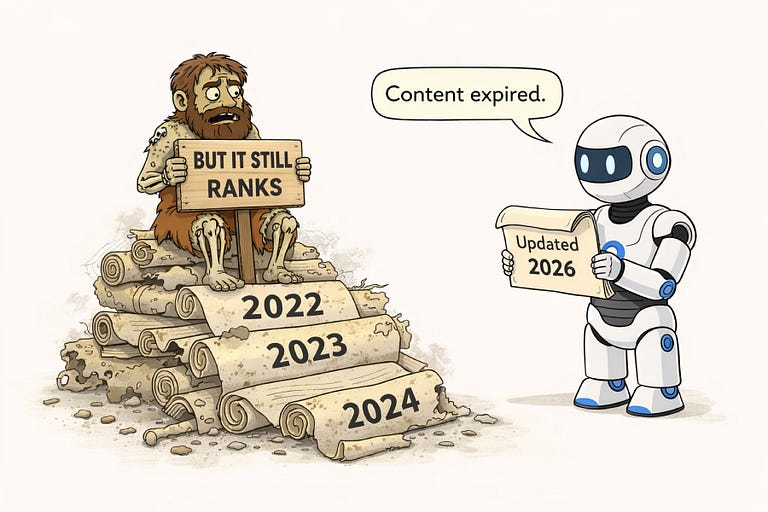
Most people are still treating content as something you publish once. That was fine in 2022.
AI Visibility Studio helps websites add the structured signals that make content readable and citable by AI systems. [aivisibilitystudio.com](https://aivisibilitystudio.com)