 Originally published on Medium ↗
For years the advice was to pick one home for each piece of content. Put it on your site or put it on Medium, but not both, or Google would punish you for duplication. That fear kept a lot of good content locked to a single page. It was mostly wrong for Google, and AI search works differently enough that the old advice can become a disadvantage. Being in more than one place is now an advantage, not a liability.
Key Takeaways
- Google has no duplicate content penalty. It picks one version to rank and ignores the rest, which is consolidation, not punishment.
- The real risk with republishing is that the wrong copy ranks, which a canonical tag fixes.
- AI systems do not always pick one winner. They can encounter the same idea across multiple sources, and repetition may act as a form of corroboration.
- Most AI citations about a brand come from sites the brand does not own.
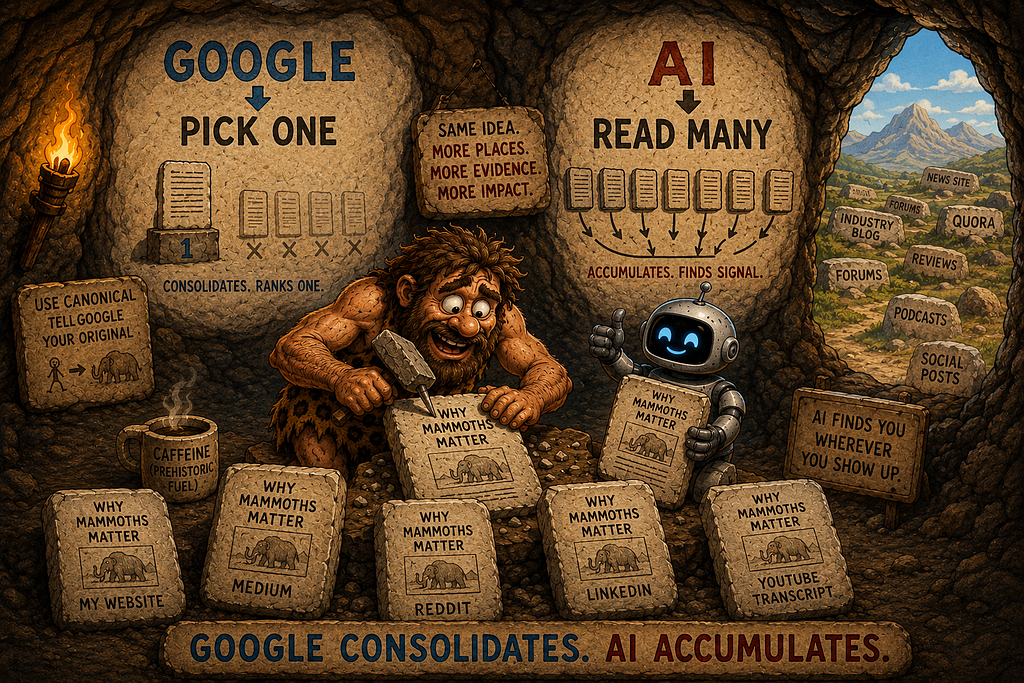
- The honest framing is two systems, two rules. Google consolidates. LLMs accumulate.
Does Google Actually Penalize Duplicate Content?
No. Google has said this directly and repeatedly, and the myth has outlived the truth by more than a decade. There is no duplicate content penalty in the way most people mean it.
Google’s own Search Central put it plainly years ago: duplicate content is not grounds for action unless the intent is deceptive, like scraping or republishing with no added value. What people call a penalty is just Google choosing one URL to show and setting the others aside. Your site does not get demoted. The duplicate simply does not appear next to the original.
The thing people feared was never the thing that happens. What does happen is a ranking decision, and you have a tool to control it.
What Is the Real Risk of Republishing on Medium?
The real risk is that Google ranks the Medium version instead of yours. When the same article lives on a high-authority platform, that platform can win the search slot, and your own site gets none of the credit.
Google’s John Mueller described the tradeoff directly: when you republish across platforms, you trade extra visibility on that platform for the chance that the platform outranks your own page. He also confirmed, in the same discussion, that there is no duplicate content penalty, and cautioned owners against hiding their own content out of fear of one.
The fix is the canonical tag. A rel=canonical pointing back to your original tells Google which version is the source of truth. Medium supports it through its import tool, which sets the canonical automatically when you bring in a post from your site.
<link rel="canonical" href="https://yoursite.com/your-original-post" />
It is a hint, not a command, so Google treats it as a signal rather than a directive. Studies and industry analyses suggest Google respects canonical hints most of the time, though it is not guaranteed. That is enough to make publishing in two places safe rather than scary.
How Is AI Search Different From Google Ranking?
Google consolidates. AI accumulates. That single difference changes the whole calculation around republishing.
A search engine has one ranking slot to award, so it must pick a winner and set duplicates aside. A language model has no such constraint. It can encounter your idea on your site, on Medium, in a Reddit thread, and in a YouTube transcript, and each encounter is another data point that you are a real source on the topic. Repetition across independent places appears to function as a form of corroboration for many retrieval and citation systems, not redundancy.
This is why the old instinct backfires in the AI era. Locking content to one page to stay “safe” from Google means handing an AI system a single thin signal where it could have had five. The duplication you were taught to avoid may now contribute to the footprint AI systems use when deciding which sources are credible enough to retrieve and cite, while the exact weighting differs by system and is rarely disclosed publicly.
Where Do AI Systems Actually Find Brand Information?
Mostly not on your own website. The single biggest surprise for most owners is how much of their AI presence is built from sites they do not control.
AirOps research reported that approximately 85% of top-of-funnel brand visibility in LLMs comes from unowned domains, not the brand’s own site. A separate analysis of 200 million prompts found that no single domain dominates AI citations, with even the most-cited source rarely exceeding 5% of the total. AI visibility is a long tail spread across thousands of places, not a single page you can perfect and forget.
That reframes content distribution entirely. The goal is not one flawless page. It is consistent presence across the surfaces AI actually reads.
Does Publishing in More Places Increase AI Citations?
The available evidence suggests a relationship between broader distribution and higher citation visibility, though much of the research remains vendor-led and should be treated as directional rather than definitive. More surfaces means more opportunities to be retrieved, referenced, and reinforced.
One December 2025 study by Stacker, reported across industry coverage, reported an association between broader content distribution and significantly higher AI citation rates, in some cases exceeding 300% compared to publishing only on an owned site. The same coverage notes that brands with substantial presence on Reddit and Quora showed roughly 4x higher citation rates than those with little. Treat the exact numbers as directional, since this is vendor and early-stage research, but the direction is consistent everywhere.
The practical move is to stop treating your website as the only place that counts. Your site, Medium, a relevant subreddit, a YouTube video with a real transcript, each one is a surface an AI can pull from.
Frequently Asked Questions About Duplicate Content and AI Search
Q: Does Google penalize you for duplicate content on your website and Medium?
A: No. Google has stated there is no duplicate content penalty. It selects one version to rank and sets the others aside, which is consolidation rather than punishment, as long as the content is not deceptive or scraped.
Q: Should I use a canonical tag when I republish on Medium?
A: Yes. A canonical tag pointing to your original tells Google which version is the source of truth, so the platform does not outrank your own page. Medium’s import tool sets this automatically when you bring a post in from your site.
Q: Will posting the same article on my site, Medium, and LinkedIn help with AI visibility?
A: Generally yes. AI systems can encounter the same idea from multiple places, which may strengthen the signals available for retrieval and citation, which is different from Google awarding a single ranking slot. More surfaces means more chances to be retrieved and cited.
Q: Where do AI systems get information about my brand?
A: Mostly from sites you do not own. AirOps research reported that around 85% of top-of-funnel brand visibility in LLMs comes from unowned domains like review sites, forums, and editorial coverage, not the brand’s own website.
Q: Is duplicate content good or bad for SEO?
A: It is neutral for ranking as long as you signal the canonical version. It does not cause a penalty, but without a canonical tag you risk the wrong copy ranking and splitting the credit between URLs.
Q: What is the difference between how Google and AI handle the same content in two places?
A: Google consolidates, picking one URL to rank and ignoring duplicates. AI accumulates, treating each independent appearance as another signal that you are a credible source on the topic.
Your friend who kept her best work on one page to stay safe did the cautious thing. The cautious thing was protecting her from a penalty that was never real, and costing her the footprint that AI now uses to decide who to cite. In practice, being present across multiple credible platforms often creates more opportunities to be discovered than keeping content confined to a single location.
AI Visibility Studio helps websites structure content so AI systems can find it, understand it, cite it, and actually use it when generating answers. aivisibilitystudio.com
References
- Google Search Central, “Demystifying the duplicate content penalty”: https://developers.google.com/search/blog/2008/09/demystifying-duplicate-content-penalty
- John Mueller on content syndication and canonicals, via Practical Ecommerce: https://www.practicalecommerce.com/seo-aspects-of-content-syndication
- Google canonical treated as a signal not a directive, Demand Signals summary of Search Central guidance: https://demandsignals.co/blog/gsc-handling-duplicate-content
- AirOps, brand citation tracking research (85% from unowned domains): https://www.airops.com/blog/llm-brand-citation-tracking
- Contently / Evertune, 200M-prompt citation distribution analysis: https://contently.com/2026/04/29/top-sources-llms-cite/
- Stacker content distribution study (association with higher AI citation rates, in some cases exceeding 300%), reported via NO-BS Marketplace: https://nobsmarketplace.com/blog/ai-visibility-2026-what-gets-brands-cited