If you spend enough time online, something starts to feel off.
You land on a blog. It’s well formatted. The sections are clear. The sentences are confident. And somewhere in the first three paragraphs, you’re gone.
Not because it was bad. Because it felt like something you’d already read. Déjà vu, except less interesting.
Somewhere else. On a different site. In a different industry. About a completely different topic.
You can’t always name it. But you felt it. And you didn’t finish reading.
This Is What Dilution Looks Like
It doesn’t announce itself. It accumulates.
When enough websites, emails, and blogs use the same AI-generated structures, the same phrasing, the same rhythm, readers start pattern-matching before they’re even conscious of it. The content gets filed as generic before the argument has a chance to land.
It’s not that any one piece is bad. It’s that they all sound like each other.
And once a reader has seen the pattern enough times, the pattern itself becomes the signal. Not “this is well written.” Not “this person knows their stuff.” Just: “I’ve seen this before. Next.”
Trust doesn’t collapse dramatically. It quietly drains away.
The Brands Doing This Don’t Know They’re Doing It
That’s the part worth understanding.
Most people pasting AI output aren’t being cynical. They’re busy. The tool is fast. The output looks clean. And if you’re not pattern-matching for it, you might not notice what you’re putting out sounds identical to your competitor, your competitor’s competitor, and a coaching business in a completely unrelated field.
The em dashes. The “navigating a complex landscape.” The “in today’s rapidly evolving world.” The sentence that starts with a one-word paragraph for emphasis.
Done.
These aren’t bad writing choices in isolation. They’re invisible individually. But they compound across an industry, and readers absorb the cumulative effect even when they can’t articulate what they’re reacting to.
Your Thinking Is the Only Thing That Doesn’t Scale
Here’s the flip side.
If everyone is pulling from the same source, sounding like yourself is no longer just a nice creative goal. It’s a structural advantage. The content that cuts through right now isn’t necessarily the most polished or the most optimised. It’s the content that sounds like it came from an actual person with an actual point of view.
That’s harder to fake than most people realise. And it’s getting harder to fake as readers get more sensitised to the alternative.
So What Do You Actually Do About It
You don’t abandon the tools. That’s not the point.
The point is that your thinking needs to get into the content before the AI does. Not after. Not as an edit pass. Before.
The simplest version of this:
Speak first.
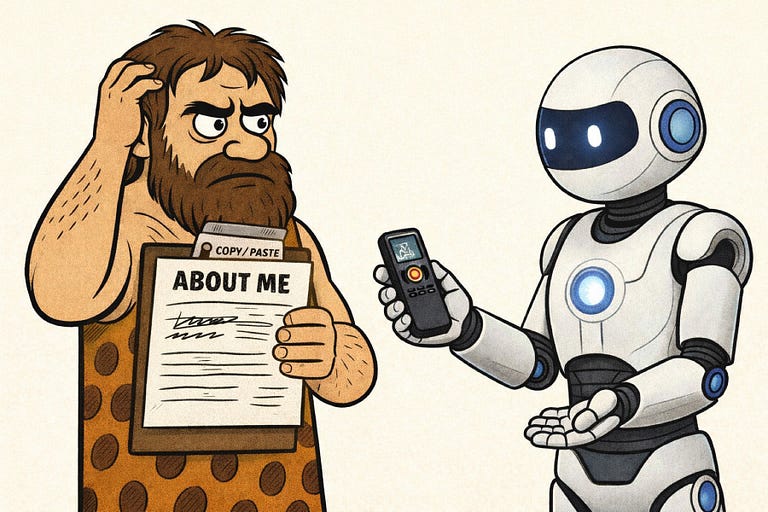
Before you open a writing tool, open your voice recorder. Say what you actually think. Explain the idea like you’re talking to someone who pushed back on it. Get your actual words, your actual reasoning, your actual examples into the room first.
Then use AI to clean it, structure it, and make it readable.
What you’re doing is using the tool for what it’s genuinely good at, organising and clarifying, while keeping the one thing it can’t replicate, which is your specific perspective on a specific thing, intact.
The output will sound different. Not because you avoided AI. Because you didn’t let it replace the part that actually mattered.
The Window Is Open Right Now
This problem is going to get more visible, not less. Readers are getting faster at pattern recognition. The register is getting more familiar. You can predict the next sentence before you finish reading the current one.
The trust erosion is accelerating.
The brands and creators who figure this out early aren’t going to look clever in hindsight. They’re just going to still have an audience.
The internet may be starting to sound like one loud person.
More fool you if you think nobody’s noticed.