 Originally published on Medium ↗
Most of your competitors are not doing this. That window will not stay open.
Sites implementing structured data and FAQ blocks see a 44% increase in AI search citations. JSON-LD schema markup improves LLM discoverability by 67%. Schema markup adoption has only risen 35% from 2023 to 2026 across the web, which means the majority of sites still do not have it implemented correctly.
For site owners specifically, the gap is even wider. The platform does not add schema by default. Most hosted sites are invisible to AI systems in ways their owners do not realize.
⸻
What Schema Actually Does for AI Visibility
Schema markup is code you add to your site that labels what your content is.
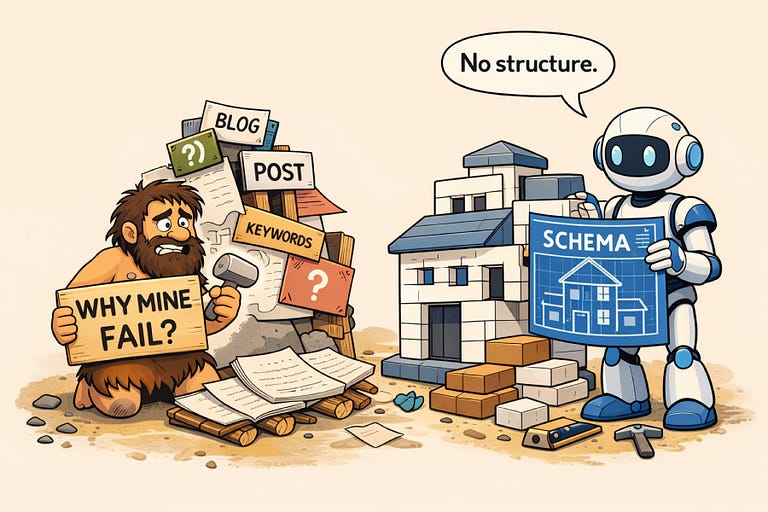
Without it, an AI system visiting your page sees text. It has to infer that your blog post is a blog post, that your FAQ section contains questions and answers, that you are the author, that your business offers a specific service. Sometimes it gets this right. Often it does not.
With schema, the labels are explicit. The page says: this is an Article, written by this Person, published on this date, about this topic. This is a FAQPage, with these specific questions and answers. This is an Organization, with this name, this URL, this area of expertise.
AI systems use these labels when deciding what to cite and how to attribute it. Structured data reduces ambiguity. Reduced ambiguity means more citations.
⸻
The Three Schema Types That Matter Most
You do not need to implement every schema type. Start with these three.
Organization schema belongs on your homepage. It tells AI systems who you are, what your business does, and how to consistently identify you across the web. Without it, different AI platforms may describe your business differently, or not at all. Organization schema is the single most important schema block for any business site. It is also the one most likely to be missing entirely.
Article schema belongs on every blog post. It tells AI systems that this page is a piece of content, who wrote it, when it was published, and when it was last updated. The dateModified field is particularly important because AI systems use it as a freshness signal. A post with valid Article schema and a recent dateModified date is treated differently than the same post with no schema and an unknown update history.
FAQPage schema belongs on any page with question-and-answer content. This schema type maps directly to how AI systems generate conversational responses. When ChatGPT or Perplexity constructs an answer to a question, it is looking for sources that have already answered that question in a structured, citable format. FAQPage schema makes your answers explicitly machine-readable. A well-written FAQ section with no schema is less citable than the same section with schema applied.
These three alone are enough to put you ahead of most competitors. The majority of sites have none of them implemented correctly.
⸻
Why hosted platforms Makes This Harder
hosted platforms is a strong platform for running an online business. It is not a strong platform for schema markup.
By default, hosted platforms does not generate Article schema for blog posts. It does not add Organization schema to your homepage. It has no FAQPage schema support. The platform handles basic meta tags and some Open Graph data, but structured data for AI visibility is not part of its default output.
This matters because hosted platforms users cannot install a plugin to fix it. On WordPress, you install Yoast or RankMath and most of the basics are handled. On hosted platforms, the only option is to manually insert JSON-LD code blocks into your page header settings.
That is not a complicated process, but it is a manual one. And because most site owners do not know it is necessary, it simply does not get done.
The result: most hosted sites have clean, well-designed pages that AI systems cannot confidently interpret. Good content, no labels. Invisible to the systems that increasingly mediate how people discover things.
⸻
What Other Platforms Do Differently
WordPress with Yoast or RankMath handles Article schema automatically for posts and generates basic Organization schema from your site settings. It is not perfect, but it covers the most important cases without manual intervention.
Webflow allows custom code injection at the page level and site level, which makes schema implementation straightforward for anyone comfortable with JSON-LD.
Ghost generates reasonable Article schema by default, including author and publication data.
None of these platforms do everything correctly out of the box. But they give creators a starting point that hosted platforms does not. For hosted platforms users, schema is a manual task from the beginning.
⸻
How to Validate What You Have
Before adding anything, check what is already on your site.
Paste any page URL into Google’s Rich Results Test at search.google.com/test/rich-results. It will show you what structured data is currently being detected, if any. For most hosted sites, the result is minimal or empty.
For a broader check, use the Schema Markup Validator at validator.schema.org. This will show you any schema present and flag errors in existing implementations.
If both tools return empty or show only basic Open Graph data, you have no meaningful schema. That is the starting point for most hosted platforms sites.
⸻
The Practical Priority Order
You do not need to add schema to every page at once. This is the order that produces the fastest AI visibility gains.
Start with your homepage. Add Organization schema. This anchors your brand identity for every AI system that visits your site. It is a one-time setup that benefits everything else you publish.
Second, add Article schema to your most important blog posts. Not all of them. Start with the posts that rank for keywords or already generate traffic. These are the pages most likely to be considered as citation sources. Schema helps them get over the line.
Third, add FAQPage schema to any page with a question-and-answer section. This includes blog posts with FAQ sections, your main service or offer pages if they answer common objections, and any standalone FAQ page you have built.
That sequence covers the highest-impact schema work in three defined steps.