 Originally published on Medium ↗
You have detailed, accurate, well-researched content. ChatGPT cites someone else anyway.
If your answer isn’t early, it doesn’t exist.
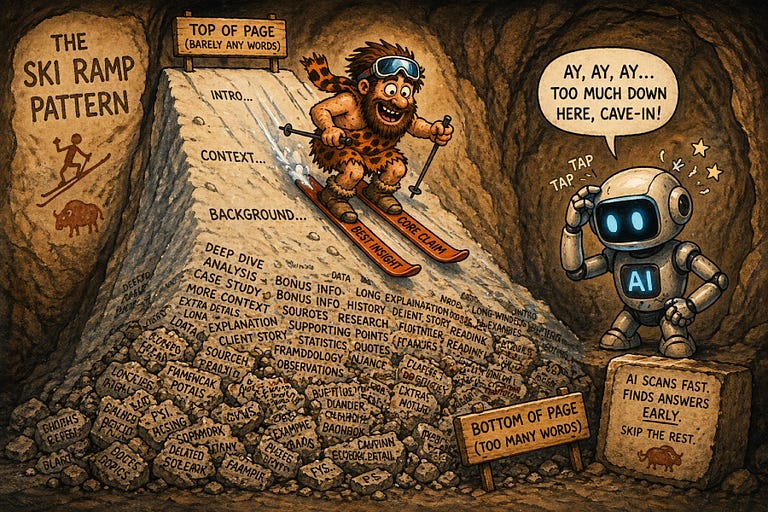
ChatGPT pulls 44% of its citations from the first 30% of a page. That’s not a preference. It’s a pattern, and it’s why most “good” blog posts don’t get cited.
Growth advisor Kevin Indig confirmed this after analyzing 1.2 million ChatGPT answers and 18,012 verified citations. What he found is now called the ski ramp pattern. The consequence is simple: the structure most long-form blog posts use is the structure least likely to produce AI citations.
Key Takeaways
• 44% of AI citations come from the first 30% of content
• If your answer is buried, it won’t be cited
• You don’t need to rewrite. You need to reposition.
• Clear, definitive language gets cited more often than hedged, qualified language
What the Ski Ramp Pattern Actually Shows
The ski ramp pattern is the tendency for AI systems to extract and cite information primarily from the first 30% of a page, with sharply declining attention beyond that point.
After analyzing 1.2 million verified ChatGPT citations, Indig found a pattern with a P-value of 0.0. The result is statistically indisputable: 44.2% of citations come from the first 30% of content.
The shape of the data is where the name comes from. Indig describes it as a ski ramp effect: a steep cliff after the first third of the page, then a long, slow tail to the bottom.
That’s the problem in a single sentence. If your best insight, your clearest definition, your most citable claim is sitting at the 60% mark because you built up to it, AI is frequently not getting there.
Why AI Reads Like a Journalist Under Deadline, Not a Loyal Reader
Large language models are trained predominantly on journalism and academic writing, both of which follow a “bottom line up front” structure. The model weights early framing heavily, then interprets everything after through that established context.
The style of writing that built SEO traffic: long intros, careful context-setting, the insight revealed at the end. That is the style of writing least likely to produce AI citations. Indig describes this as a “clarity tax”: substance must be surfaced early, or it becomes statistically less likely to appear in AI-generated answers.
What Most Long-Form Blog Posts Actually Look Like
A typical course creator or blogger follows a recognizable structure:
• Three paragraphs explaining why this topic matters
• A personal story or client example
• Background context on the problem
• The actual answer, buried after the reader (and the AI) already left
• A conclusion that restates everything above
That structure works fine for human readers who arrived with low intent and need warming up. It doesn’t work for AI systems that retrieve and cite your content in under a second.
The irony: the writer who spent the most time researching their topic buries the finding the deepest, because they want to show their work. AI doesn’t care about your work. It cites your conclusion, if it can find it fast enough.
How to Restructure Without Rewriting
The fix is not starting over. It’s repositioning.
For any existing post, run this four-step check:
Step 1: Find your core claim. What is the single most citable sentence in this article? The definition, the finding, the direct answer to the question in the title. Locate it on the page.
Step 2: Move it to the opening section. It should appear in your first 150 to 200 words. Not hinted at. Stated plainly. The rest of the article can still prove it, add context, and elaborate. But the claim needs to be findable before the 30% mark.
Step 3: Rewrite your intro as an answer-first summary. Your opening is not throat-clearing. It’s a citation target. Every major section should open with a concise 40 to 60 word direct answer. According to Indig’s analysis, 72.4% of pages cited by ChatGPT included an identifiable answer capsule. That was the single strongest commonality among cited posts.
Step 4: Check your subheadings. Pages with headlines that directly answer the query get cited 41% of the time. Pages with loosely related headlines drop to 29%. “Why Your Content Isn’t Getting Cited” is a better subheading than “Content Strategy Overview.”
None of this requires a rewrite. It requires moving pieces around and adding one direct statement near the top of each section.
Front-Loading Doesn’t Replace Depth
Depth still matters. Pages between 5,000 and 10,000 characters average nearly twice the citations of shorter pages. Front-loading your answer doesn’t mean shortening your content. It means putting the point first and the supporting argument after. Same structure a journalist uses.
At the paragraph level, 53% of citations come from the middle of paragraphs, 24.5% from first sentences, and 22.5% from last sentences. This means you don’t have to force every insight into an opening sentence. The goal is information density throughout, with the most citable material surfaced before the 30% mark of the full article.
One pattern worth noting from Indig’s linguistic analysis: citation winners are almost twice as likely to contain definitive language, phrases like “is defined as” or “refers to,” compared to non-cited content. Declarative structure works. “X is Y” gets cited. “X might be considered Y in some contexts” does not.
FAQ
Q: Why is my detailed, long-form content not being cited by ChatGPT?
A: Length doesn’t matter as much as placement. If your most citable claim appears after the 30% mark, ChatGPT is statistically less likely to reach it. Move key findings and definitions to the opening section of each article.
Q: What is the ski ramp pattern in content and AI citations?
A: The ski ramp pattern is a term from Kevin Indig’s analysis of 1.2 million ChatGPT citations. It describes how citation likelihood drops sharply after the first 30% of a page, then tapers slowly to near-zero at the bottom. 44.2% of all citations in the study came from that first 30%.
Q: How long should my blog post introduction be if I want AI to cite it?
A: Short, and answer-first. Your first 150 to 200 words should contain the clearest direct statement of what the article covers and what its core finding is. Context and elaboration can follow, but the citable claim needs to appear before the 30% mark.
Q: Does this apply to blog posts specifically?
A: Yes. blog posts are crawled and indexed like any other web content. The structural issue, burying the point, is common to the long-form blog format regardless of platform. The fix is the same: move your answer earlier, tighten your section openings, and write subheadings that directly match the question being answered.
Q: Do I need to shorten my content to fix this?
A: No. Depth still correlates with more citations overall. The fix is structural, not length-based. Put your clearest claim first, then support it. Don’t shorten the article. Move the answer to the front.
Q: What kind of language gets cited most by AI?
A: Definitive language. Phrases like “X is defined as” or “X refers to” are nearly twice as common in cited content as in non-cited content, according to Kevin Indig’s analysis of 18,012 verified ChatGPT citations. Hedged, qualified language is harder for AI to extract as a clean citation.
⸻
Most long-form content was built to reward patient readers. AI is not a patient reader.
If your answer isn’t early, it doesn’t exist.
The ski ramp doesn’t care how good your conclusion is.
⸻
AI Visibility Studio helps websites become easier for AI systems to find, read, and cite.