 Originally published on Medium ↗
AI Mode and AI Overviews are both Google products. They can answer the same queries. In Ahrefs’ dataset, they often reached semantically similar conclusions.
They cite completely different pages to get there.
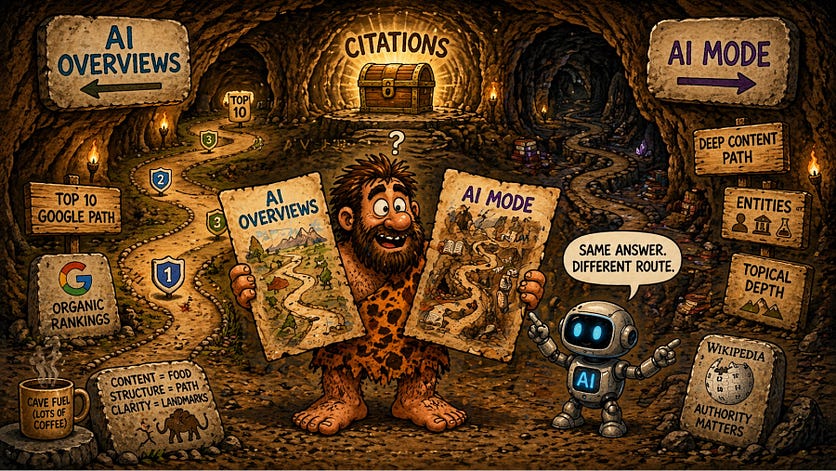
Ahrefs analyzed 540,000 query pairs and found only 13.7% URL overlap between the two surfaces. If you have been optimizing for one and assuming the other follows, you have been drawing one map and hoping it covers two different cities.
Key Takeaways
• AI Mode and AI Overviews cite the same URLs only 13.7% of the time
• AI Overviews navigate toward pages that already rank in Google’s top 10. AI Mode does not.
• Each surface uses different wayfinding logic to locate and cite content
• Appearing in one does not predict appearance in the other
How Wayfinding Psychology Explains What AI Systems Are Actually Doing
Wayfinding is the cognitive process of orienting yourself in an unfamiliar environment using landmarks, signs, and structure. Architects design hospitals with color-coded floors and oversized signage because without clear orientation cues, people get lost and stop moving.
AI retrieval systems have the same problem at scale.
When an LLM scans your page, it is looking for orientation cues: a heading that names the topic, an opening sentence that states the point, a section structure that signals what comes next. If those cues are absent or vague, the system does what a lost visitor does in a poorly designed building. It moves on.
This is more than a metaphor. It is the practical behavior publishers need to design for. Both AI Overviews and AI Mode are navigating your content, but they are using different maps, looking for different landmarks, and stopping at different points.
AI Overviews: The Familiar Neighborhood
AI Overviews operates on well-marked terrain. It appears automatically at the top of standard Google search results and draws heavily from pages that already rank well in traditional search.
Approximately 38% of AI Overview citations come from pages in Google’s top 10 organic results. If you rank on page one, the landmark already exists. AI Overviews knows how to find you because the organic index told it where to look.
The wayfinding cues it responds to are the same ones that have always mattered in SEO: clear page structure, direct answers to specific queries, strong E-E-A-T signals, and content focused tightly on one topic. The safer takeaway is simpler: AI Overviews still have a much stronger connection to traditional Google visibility than AI Mode does. The map is familiar. The landmarks are established.
AI Mode: A Different Map Entirely
AI Mode is a separate, conversational search experience. Users switch into it intentionally. It generates longer responses, cites more expansively, and reaches significantly deeper into the index.
Only about 12% of AI Mode citations come from top-10 organic results, according to Moz’s study of 40,000 keywords. AI Mode is navigating unfamiliar territory by design. It is not following the organic ranking map. It is reading the content itself and looking for different landmarks.
What AI Mode appears to navigate toward: topical depth, named entities, encyclopedic structure, and content that demonstrates expertise across a subject rather than optimizing for a single keyword. It cited Wikipedia in 28.9% of responses compared to 18.1% for AI Overviews. The landmark it trusts is authority, not position.
This is the experiment worth running. Publish two versions of the same content: one structured with explicit wayfinding signals (orientation sentences at the top of each section, landmark headings that name the topic precisely, clear conceptual exits at the end of each section), one written in standard blog format. Test citation rates across both surfaces. The hypothesis is that AI Mode responds more strongly to wayfinding architecture than AI Overviews does, because AI Mode is navigating without the safety net of organic rankings to guide it.
No controlled study has confirmed this directly yet. But the citation pattern data points toward it.
The Gap Between the Two Maps Is Larger Than Expected
The 13.7% overlap figure deserves a moment. It means that across the dataset, roughly 87% of cited URLs did not overlap between AI Mode and AI Overviews.
In Ahrefs’ dataset, they often reached semantically similar conclusions. Ahrefs found 86% semantic similarity between the two surfaces’ responses. They agree on what to say. They found that information in almost entirely different places.
One useful asymmetry: if your brand or entity appears in AI Overviews for a query, Ahrefs found there is approximately a 61% chance it also appears in AI Mode. The reverse does not hold at the same rate. AI Overview visibility provides a partial signal for AI Mode, but AI Mode draws from a wide enough pool that the correlation weakens in the other direction.
Treat them as two separate navigation systems that occasionally share a landmark. Not as one system with two displays.
AI Mode Has a Volatility Problem That Changes How You Track It
Before treating AI Mode citations as a stable metric, one number matters.
When the same query is run three times in AI Mode, the results overlap with themselves only 9.2% of the time.
AI Mode is not just citing different pages than AI Overviews. It is citing different pages than itself. The map shifts between uses.
This does not make optimization pointless. It changes what optimization means. Content optimized for a single keyword and a single ranking signal will appear inconsistently across AI Mode’s variable runs. Content that signals topical authority across many related queries, with clear wayfinding structure throughout, is more likely to surface repeatedly across that instability.
The goal is not to appear once. The goal is to be a landmark that AI Mode recognizes regardless of which path it takes to get there.
What to Actually Build for Each Surface
The structural requirements overlap, but not completely.
For AI Overviews: the organic ranking connection means traditional signals still apply. Front-load your answer, use descriptive subheadings, keep each page focused on one topic. The wayfinding architecture here is familiar and relatively well-documented.
For AI Mode: topical depth and entity density matter more than position. Write content that covers a subject thoroughly, names specific people, tools, studies, and organizations, and uses section openings that orient the reader immediately. Each section should answer one clear question before moving to the next. That structure serves both the human reader navigating the page and the AI system deciding whether this page is worth citing.
The shared principle across both surfaces: content that makes the retrieval system guess at what you are saying will be skipped. Clear landmarks get cited. Ambiguous terrain gets passed over.
FAQ
Q: What is the difference between Google AI Mode and Google AI Overviews?
A: AI Overviews appear automatically at the top of standard Google search results. They draw primarily from pages with strong organic rankings. AI Mode is a separate conversational search experience that users switch into intentionally. It generates longer responses, cites more sources per query, and navigates a much broader pool of pages, including many that do not rank in the top 10.
Q: Why do AI Mode and AI Overviews cite such different pages?
A: They use different retrieval logic. AI Overviews navigate toward pages that already rank well in traditional Google search, roughly 38% overlap with top-10 results. AI Mode navigates by content signals: topical depth, entity density, and structure, with only about 12% overlap with top-10 results. Same query, different maps.
Q: Do I need separate content strategies for AI Mode and AI Overviews?
A: Yes. Ahrefs’ analysis of 540,000 query pairs found only 13.7% URL overlap between the two surfaces. What gets you cited in one does not reliably get you cited in the other. AI Overviews appear more connected to organic ranking signals. AI Mode appears more influenced by topical authority and content structure.
Q: How often do AI Mode citations change for the same query?
A: Frequently. SE Ranking found that when the same query is run three times in AI Mode, citations overlap with themselves only 9.2% of the time. Single-snapshot tracking is unreliable. Content needs to signal consistent topical authority across many queries to appear repeatedly across AI Mode’s variable runs.
Q: What is wayfinding and how does it apply to AI content optimization?
A: Wayfinding is the cognitive process of navigating an unfamiliar environment using landmarks and orientation cues. Applied to AI content retrieval, it describes how LLMs scan pages looking for structural signals: headings that name the topic, opening sentences that state the point, section structure that signals what comes next. Clear wayfinding architecture makes content easier to locate, parse, and cite. Ambiguous structure gets skipped.
Q: If my site appears in AI Overviews, will it also appear in AI Mode?
A: Sometimes. If your brand or entity appears in AI Overviews for a query, Ahrefs found there is approximately a 61% chance it also appears in AI Mode. But the reverse is weaker, and the 13.7% overall URL overlap means you should track both surfaces separately rather than assuming cross-surface visibility.
⸻
Two surfaces. Two retrieval systems. Two different sets of landmarks they navigate toward.
Most sites built one map and stopped.
⸻
AI Visibility Studio helps websites become easier for AI systems to find, read, and cite.