 Originally published on Medium ↗
The site was built to be machine-readable and citable by AI systems. In theory.
The audit found two live articles still broadcasting placeholder titles to every crawler on the internet.
That is the thing about AI visibility problems. They are rarely missing tactics. They are mismatches between what a site says it is and what the machine-readable layer actually says.
We used OpenClaw to run a live audit on a client site in the AI visibility space, built on a custom stack. No theory. Just a pass over the actual pages, metadata, schema, sitemap, and crawl signals. Here is what it surfaced.
What OpenClaw Actually Checked
OpenClaw pulled the homepage, blog index, several article pages, the support page, and the directory page. It also checked robots.txt, sitemap.xml, llms.txt, page titles, meta descriptions, canonicals, JSON-LD presence, and response times.
The site had real foundations. Clean homepage title and meta. Correct canonical. A working llms.txt, which most sites still do not have. Organization, WebSite, WebPage, FAQPage, and Product schema on the homepage. TTFB under 100ms.
Not a broken site. But the audit surfaced eight specific findings. Several of them were exactly the kind of quiet, invisible problems that erode AI trust without anyone noticing.
Finding One: The Sitemap Was Pointing at Dead Pages
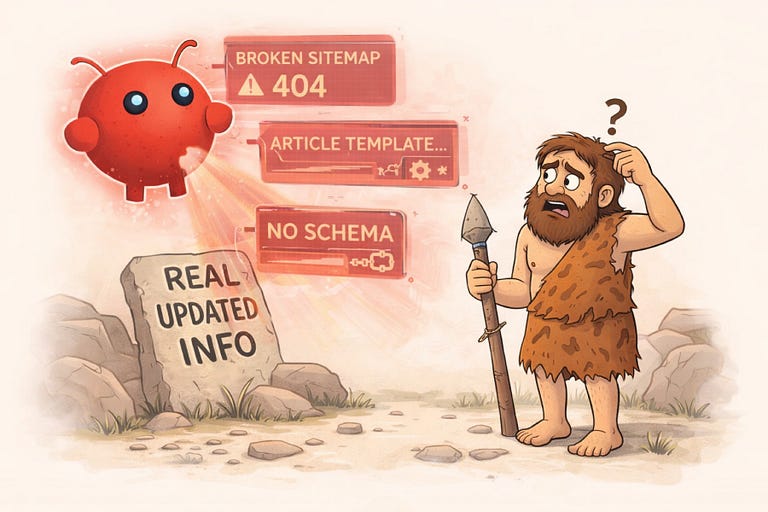
Two URLs were listed in the live sitemap. Both returned 404.
/how-it-works. /pricing. Both advertised to every crawler as valid destinations. Both dead.
Crawlers and AI retrieval systems use sitemaps to understand a site’s structure. A sitemap that points at pages that do not exist tells the machine the site’s own map cannot be trusted. For a site built around machine-readable clarity, that is a direct contradiction.
The fix is binary: either publish those pages or remove them from the sitemap. There is no middle option that does not damage credibility with crawlers.
Finding Two: Two Live Articles Had Placeholder Metadata
This was the sharpest finding in the audit.
Two published blog articles were still carrying template defaults across their titles, meta descriptions, and schema:
Page title: “Article Template”
Meta description: “Article description goes here.”
Schema headline: “Article Template”
These pages are publicly indexed. Every crawler that visits them, including the bots behind ChatGPT, Perplexity, and Google AI Overviews, sees a page that declares itself a template.
Placeholder metadata is not harmless draft residue. It is a live signal. The machine reads it the same way it reads everything else. What it reads is that this source cannot be trusted to maintain its own content.
Both pages needed real titles, real descriptions, real Article schema headlines, and correct OG tags before anything else on the list mattered.
Finding Three: The Machine-Readable Layer Was Telling a Different Story Than the Site
The homepage used one naming convention. The llms.txt file used a different one. The schema referenced an older product name. Old indexed search snippets surfaced language that did not match any current page.
None of these individually would sink the site. Together they created what OpenClaw flagged as an entity consistency problem.
AI systems build their understanding of a brand by aggregating signals across multiple sources. If the homepage says one thing, the schema says another, and the llms.txt says a third, the system cannot resolve a clean entity. It hedges. It omits. It cites someone else instead.
The core finding here: most sites do not have a schema problem. They have a consistency problem. Multiple slightly different versions of the truth, scattered across layers the owner rarely reviews at the same time.
Finding Four: OG Metadata Was Missing on Most Pages
The homepage had og:title, og:description, and og:image. Most other key pages had none of those.
Blog articles, the directory page, and the support page were all missing basic Open Graph and Twitter card metadata.
When AI systems and aggregators assemble a summary identity for a page, they pull from OG tags alongside page titles and meta descriptions. Pages without OG metadata leave that summary identity partially undefined. The machine fills the gap with whatever it can extract from body copy, which is less reliable than declared metadata.
Every key public page needs a title, meta description, canonical, og:title, og:description, og:image, and Twitter card tags. On many platforms and custom stacks, this requires a deliberate implementation pass since it does not happen automatically per page.
Finding Five: Schema Was Missing on Strategically Important Pages
The homepage had solid schema coverage. The directory page, support page, and blog index had no JSON-LD at all.
Those are not throwaway pages. The directory page exists to help humans and machines understand the site. The support page explains service paths and intent. The blog index is a content hub. All three are exactly the kind of pages where structured data helps AI systems understand what they are looking at.
Recommended additions: CollectionPage or ItemList schema for the directory, Blog or CollectionPage for the blog index, Service or FAQPage schema for support. None are complex. They are just absent.
Finding Six: The Directory Page Was Too Thin to Do Its Job
A directory page has one purpose: help crawlers and users understand a site’s full structure in one place. Done well it becomes a crawl hub. Every important page linked from one location, grouped clearly, with enough context to be useful.
The current directory page had the right intent but thin execution. The readable content was sparse. Without substance it cannot serve as a navigation artifact for AI systems or a trust signal for crawlers.
The fix is to treat it as a real resource: link to core pages, product pages, support paths, blog categories, and legal pages. Add ItemList schema to label the structure. Make it the page a crawler would actually thank you for.
The Meta-Finding: The Gap Between What the Site Teaches and What It Implements
This is what OpenClaw surfaced that a standard SEO audit would not.
The site’s entire value proposition is built on clarity, machine readability, and trust signals. And the live site had dead sitemap links, template article metadata, missing OG coverage across most pages, no schema on strategic pages, and conflicting entity naming across its own layers.
Not because the team does not know better. Because these things accumulate quietly. A page gets published before its metadata is finalized. A sitemap does not get updated when a page is removed. A naming convention shifts and the old version persists in schema nobody re-checks.
OpenClaw makes these mismatches visible in one pass. That is the actual value of the audit: not a checklist of things to add, but a map of where the machine-readable truth has drifted from the intended truth.
What Gets Fixed First
The priority order from the audit was clear. Fix the sitemap dead links immediately. Fix the placeholder article metadata immediately. Then synchronize entity naming across homepage, schema, llms.txt, and OG tags. Then add missing OG metadata to all key pages. Then fill in missing schema on directory, blog index, and support.
None of these require rebuilding the site. They require implementation knowledge and a system for validating the fixes actually took effect, not just that the changes were made.
Frequently Asked Questions
Q: What is OpenClaw?
OpenClaw is an open-source, locally hosted AI agent that connects large language models to tools like files, web browsing, and automation systems. It operates through modular “skills,” allowing it to execute tasks such as running commands, retrieving data, and interacting with external systems.
In this case, OpenClaw was configured to act as an AI visibility audit system. Instead of general automation, it was used to crawl live pages, read the machine-readable layer, and compare metadata, schema, sitemaps, and supporting files like llms.txt to identify inconsistencies that affect how AI systems understand and cite a site.
Q: How does a dead sitemap URL hurt AI visibility?
Sitemaps tell crawlers which pages are valid destinations. When a sitemap lists URLs that return 404, it signals to search engines and AI retrieval systems that the site’s declared structure cannot be trusted. That weakens the site’s authority as a reliable source.
Q: Why does placeholder article metadata matter for AI citation?
AI systems read metadata the same way they read body content. A page title of ‘Article Template’ and a meta description of ‘Article description goes here’ are indexed and retrieved as the page’s declared identity. Every AI crawler that visits that page logs those values as facts about the source.
Q: What is entity consistency and why do AI systems care about it?
Entity consistency means a brand’s name, description, product names, and positioning language are the same across the homepage, schema, llms.txt, OG tags, and third-party mentions. AI systems aggregate signals across sources to build a model of what a brand is. Conflicting signals produce a weaker, less citable entity model.
Q: How often should an AI visibility audit be run?
Any time significant content is published, pages are removed, or the site’s positioning changes. The findings above accumulated quietly over time, not from a single bad decision. A regular audit cadence catches drift before it becomes a credibility problem.
Q: Can a site pass a traditional SEO audit and still have AI visibility problems?
Yes. Traditional SEO audits check rankings, backlinks, page speed, and keyword coverage. They do not check entity consistency across schema and llms.txt, placeholder metadata in JSON-LD fields, or whether the machine-readable layer matches the human-readable one. Those gaps require a different kind of audit.
The site knew what good looked like. It just had not checked whether its own machine-readable layer agreed. That gap is more common than most site owners realize, and it stays invisible until something actually runs the audit.
AI Visibility Studio helps sites implement and validate the structured signals AI systems need to find, understand, and cite their content. aivisibilitystudio.com