 Originally published on Medium ↗
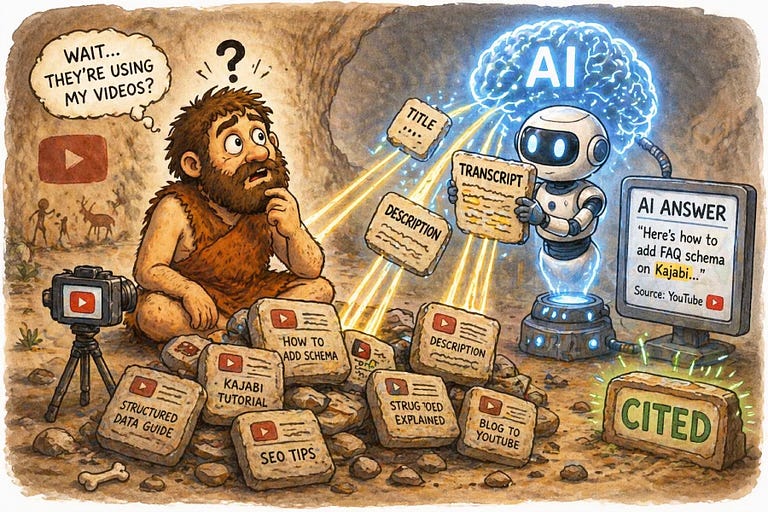
YouTube is being cited by AI systems millions of times a year. Most of the creators behind those videos have no idea it is happening.
Subscriber count does not matter for AI citation.
Neither does view count, engagement rate, or how long you have been posting. Across multiple AI citation datasets, including OtterlyAI’s YouTube Citation Study 2026, the pattern is consistent: YouTube shows up in roughly 16% of all LLM answers across ChatGPT, Perplexity, and Gemini combined, and citation frequency has effectively no meaningful correlation with audience size.
What it correlates with is structure. Specifically, whether an AI system can extract a clear answer from your video without watching it.
Here is how it works.
– – -
Why YouTube Is Now the Most Cited Domain in AI Search
YouTube has one structural advantage that no other video platform shares: it is heavily represented in training data used by modern LLMs. Datasets like HowTo100M and Kinetics were built directly on YouTube transcripts and metadata. That prior relationship means LLMs do not just crawl YouTube at retrieval time. They have a pre-existing familiarity with YouTube as a knowledge source that no other video platform comes close to matching.
According to OtterlyAI’s YouTube Citation Study 2026, long-form video accounts for 94% of AI citations. Shorts account for 5.7%. The gap is structural, not marginal. Every other video platform, including Vimeo, TikTok, and Dailymotion, collectively accounts for roughly 0.1% of AI video citations.
YouTube is infrastructure for AI knowledge retrieval. Most creators are still using it as a broadcast channel.
– – -
Layer One: The Transcript Is the Product
AI systems primarily rely on transcripts, not the video itself. Multimodal models can process video frames, but across retrieval pipelines for citation, text is the operative layer.
If your transcript is bad, your video does not exist to AI.
A 12-minute video produces roughly 2,400 to 3,200 words of transcript text. That is a full blog post sitting behind every video in your library, indexed and retrievable, that most creators have never treated as a content asset. When Perplexity cites a YouTube video, it lifts directly from transcript text. When ChatGPT references a specific moment, it is because the transcript contained a clean, self-contained claim at that point.
Auto-generated captions are not good enough. They contain errors, run sentences together, and produce fragmented text that retrieval systems struggle to chunk cleanly. Upload a corrected transcript for any video you want to be cited on a specific topic. This is not optional.
It is not production quality that separates cited from ignored. It is whether the transcript reads like a document or a ramble. In OtterlyAI’s citation dataset, structured videos with clear arguments generate 40 to 80 citations per 100,000 views. Unstructured, rambling videos generate 2 to 5.
– – -
Layer Two: Your Description Is a Machine Brief, Not a Summary
The description does not get directly cited. What it does is determine whether your video gets retrieved in the first place.
AI systems read the description as a metadata signal before deciding whether the video answers a specific query. If your description says “In this video I share some thoughts on structured data,” a retrieval system has very little to work with. If it says “This video explains how to implement FAQPage schema on a hosted site without developer access, covering JSON-LD placement, validation with Google’s Rich Results Test, and common errors,” the system knows exactly what queries this video is relevant to.
In OtterlyAI’s citation research, description length showed a Pearson correlation of 0.31 with citation frequency. That is a meaningful relationship. Most YouTube descriptions run under 100 words. Cited videos tend to run 500 or more, with a clear structure: topic declaration up front, section-by-section summary in the body, key entities named throughout.
Write the description like you are briefing a researcher who needs to know what is in the video without watching it. Because that is exactly what you are doing.
– – -
Layer Three: Timestamps Create Multiple Citation Surfaces From One Video
This is the highest-leverage change you can make without recording anything new.
In OtterlyAI’s dataset, among timestamped videos cited by Google’s AI platforms, 78% were cited more than once, typically across two to five distinct chapters. The effect was observed specifically in Google AI Overviews and AI Mode. Other platforms including ChatGPT and Perplexity showed negligible timestamp citation during the observation window.
That matters for how you prioritize. If Google AI Overviews is your target, timestamps are one of the highest-value structural changes you can make. AI systems treat YouTube chapter labels the same way they treat H2 headings on a web page: as chunk boundaries that signal what each segment covers.
“Part 2” is not a chunk boundary. “How to validate your JSON-LD schema after installation” is a chunk boundary.
Only 31% of currently cited videos contain timestamps. Most creators never do this. That is the opportunity. Add structured chapter labels to existing videos and you immediately move into a better position than the majority of content already getting cited, without changing a single frame.
The labels should be descriptive enough to make sense without context:
```
0:00 Introduction
1:30 Why auto-generated transcripts hurt AI citation rates
4:15 How to write a description as a metadata document
8:00 Adding chapter timestamps to existing videos
11:45 Checking your citation presence in Perplexity and ChatGPT
```
Each label is a retrieval target. Treat them accordingly.
– – -
The FAQ-in-Description Question: Honest Answer
The idea of adding a structured FAQ block to a YouTube description has been circulating, and the logic behind it is sound enough to address directly.
The mechanism: FAQ format creates atomic Q&A pairs that retrieval systems can extract cleanly. This is well-documented for web pages. If AI systems parse YouTube descriptions the same way, a FAQ block in the description would produce better extraction targets than standard paragraph copy.
The problem: no controlled study exists on this specifically. What is confirmed is that description structure matters, Q&A format improves LLM extractability on web content, and descriptions are part of the metadata layer AI systems read. Whether FAQ format in a YouTube description specifically moves citation rates is an extrapolation, not a finding.
A few practical constraints also apply. YouTube collapses descriptions after roughly 200 characters. AI systems likely parse the full text, but there is no published research on whether collapsed text is treated differently. A YouTube description also cannot carry FAQPage schema markup the way an owned page can, which removes one of the main structural benefits the format provides on a website.
Fix the transcript first. Add timestamps. Then test a FAQ block if you want. Just do not mistake it for the primary lever.
– – -
Which AI Platform Cites YouTube, and How Much
Not all AI platforms pull from YouTube equally. Knowing this shapes where to invest effort.
Google AI Overviews and Perplexity together drive over 75% of all YouTube citations. Both have strong integration with YouTube’s transcript and metadata layers. Gemini cites YouTube more than any other source except Wikipedia. If visibility in Google’s AI ecosystem or Perplexity answers is the goal, YouTube content is a direct path.
ChatGPT is a different story. It contributes a low single-digit percentage of YouTube citations, roughly 4 to 5%, despite having one of the largest user bases of any AI platform. For ChatGPT visibility, the higher-leverage surface is your website content, not your YouTube library.
The practical implication: pair every YouTube video with a corresponding blog post or landing page. The video builds citation presence in AI Overviews and Perplexity. The page builds citation presence in ChatGPT. The transcript from the video can seed the blog post. None of this requires creating new content from scratch. It requires treating what you already have as infrastructure instead of inventory.
– – -
FAQ
Q: Does YouTube subscriber count affect how often AI systems cite my videos?
A: No. In OtterlyAI’s YouTube Citation Study 2026, the correlation between subscriber count and citation frequency was r = -0.03, effectively zero. 40.83% of AI-cited videos had fewer than 1,000 views at the time of analysis. What drives citation is transcript clarity, description length, and chapter structure.
Q: How do I make my YouTube transcript better for AI citation?
A: Upload a manually corrected transcript rather than relying on auto-generated captions. Structure your spoken content around clear, complete claims. Each major point should be a self-contained statement that makes sense without surrounding context, because retrieval systems pull individual chunks, not full videos.
Q: What should a YouTube description include to improve AI citation rates?
A: Start with a direct statement of the topic and the specific question the video answers. Follow with a section-by-section summary of the video’s content. Name the key entities: tools, platforms, schema types, processes. Aim for 500 words minimum. Write it as a brief for a researcher, not as promotional copy.
Q: Do YouTube Shorts get cited by AI systems?
A: Rarely. OtterlyAI’s YouTube Citation Study 2026 found long-form video accounts for 94% of AI citations. Shorts account for 5.7%. AI systems need enough transcript text to extract a coherent, citable claim. Short-form content does not produce enough text or structural depth to compete.
Q: Should I add an FAQ section to my YouTube video description?
A: Not until you have fixed your transcript and added timestamps. The FAQ block logic is sound but unproven for YouTube descriptions specifically, and it cannot carry schema markup the way an owned page can. Get the foundations right first.
Q: Why does Perplexity cite YouTube more than ChatGPT does?
A: Perplexity’s retrieval model is heavily weighted toward YouTube for how-to and informational queries. ChatGPT’s citation behavior skews toward web content, contributing a low single-digit percentage of YouTube citations despite its large user base. For Perplexity visibility, optimize your YouTube library. For ChatGPT visibility, prioritize your website.
– – -
You do not need more content. You need to make the content you already have readable to AI.
Every creator with a YouTube channel is sitting on a citation asset library. Most of them are optimizing for the algorithm that measures views. The one that measures citations works completely differently.
– – -
AI Visibility Studio helps websites and content systems become easier for AI to find, read, and cite. aivisibilitystudio.com