 Originally published on Medium ↗
Being ignored by AI is one problem. Being misquoted is a different one, and in some ways it’s worse.
When ChatGPT or Perplexity cites your content, it doesn’t copy-paste. It summarizes. And if your page isn’t structured to constrain that summary, the model fills the gaps with inference. Your carefully worded claim becomes a paraphrase you’d never have published.
Here are three structural changes that close the gap.
– – -
State Your Claim in the First 100 Words
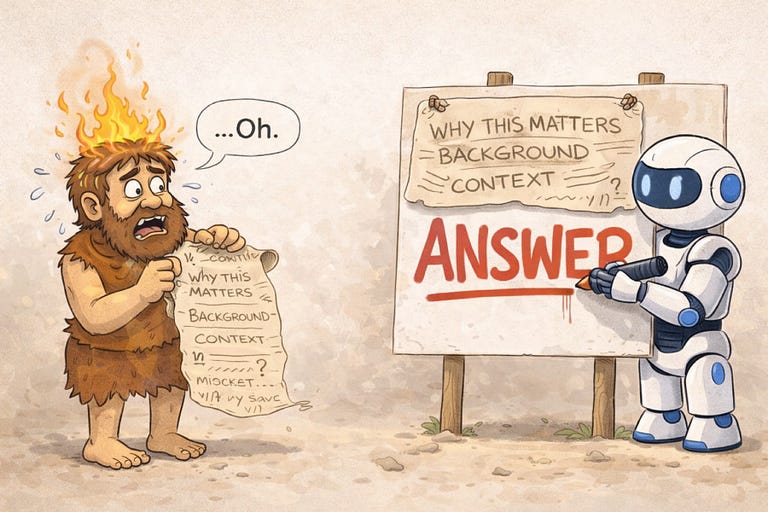
LLMs often prioritize the top of your page when forming an answer. If your opening section is context-setting, “background,” “why this matters,” “what most people get wrong,” the model is left to infer your actual position from whatever comes after.
The fix is simple and uncomfortable: state the answer before you explain it.
Instead of:
“A lot of course creators are frustrated that AI doesn’t recommend them. There are a few reasons for this, and they mostly come down to how your site is structured…”
Write:
“AI systems don’t cite you because your content doesn’t answer a specific question. Here’s how to fix that.”
The second version gives the model a sentence it can extract without interpretation. The first gives it something to paraphrase badly.
This isn’t about dumbing down your writing. It’s about giving AI a clean extraction point before it decides to improvise.
– – -
Use Explicit Answer Containers, Not Flowing Prose
When your knowledge lives inside paragraphs, AI systems have to guess where the answer starts and ends. When it guesses wrong, you get misquoted.
An FAQ section structured as actual questions and answers gives AI a clearly bounded extraction unit. The question defines the scope. The answer fills it. There is no ambiguity about where one ends and the other begins.
FAQPage schema reinforces this structurally. The JSON-LD block tells crawlers exactly which text is a question and which is the answer. That’s not a ranking trick. It’s a labeling system. You’re reducing the model’s interpretation surface.
Here’s what the JSON-LD looks like for a single FAQ pair:
{
  "@context": "https://schema.org",
  "@type": "FAQPage",
  "mainEntity": [{
    "@type": "Question",
    "name": "Why does ChatGPT misquote my content?",
    "acceptedAnswer": {
      "@type": "Answer",
      "text": "ChatGPT summarizes rather than quotes. If your content isn't structured with explicit question-answer pairs and clear entity definitions, the model fills gaps with inference, which produces paraphrases that may not reflect your original meaning."
    }
  }]
}
For hosted platforms users: paste this in a Code Block element at the bottom of the page. For WordPress or Webflow, it goes in a `<script type=”application/ld+json”>` block in the page footer.
– – -
Give Every Key Term a One-Sentence Definition on the Page
AI systems build their understanding of your content from what’s explicitly on the page, not from what you meant. If you use a term repeatedly without ever defining it, the model will use its training data to fill in the meaning. That meaning may not match yours.
Say you’re a financial coach who uses the term “wealth sequencing” to describe your proprietary framework. You’ve published eight articles on it. ChatGPT has never seen that term defined anywhere. So when someone asks about you, the model either skips the term or substitutes a generic definition from adjacent training data.
The fix is a one-sentence definition placed early on any page where the term appears:
“Wealth sequencing is the practice of ordering financial decisions by leverage rather than urgency.”
One sentence. You’ve now given the model a constraint. It can quote that or paraphrase it, but it can’t invent a different meaning from scratch.
DefinedTerm schema formalizes this for machines. It’s underused, genuinely useful, and maps well to how LLMs handle named concepts. Worth adding if you have proprietary language on your site. One note: Google’s Rich Results Test won’t surface DefinedTerm as a rich result, because Google doesn’t render it in search features. The schema is still worth implementing for LLMs that crawl and parse JSON-LD directly.
– – -
Frequently Asked Questions
Q: Why does ChatGPT misquote websites?
A: ChatGPT summarizes rather than quotes directly. If a page doesn’t have explicit answer structures and defined terms, the model fills gaps with inference from its training data, producing paraphrases that may differ from the original meaning.
Q: Does an FAQ section actually help AI visibility?
A: Yes, for a specific reason. FAQ sections create bounded question-and-answer pairs that AI systems can extract cleanly. FAQPage schema reinforces those boundaries with machine-readable labels, reducing the model’s interpretation surface.
Q: What is DefinedTerm schema and when should I use it
A: DefinedTerm is a [Schema.org](http://Schema.org) type for explicitly labeling a defined concept on your page. Use it when your site uses proprietary terminology, industry-specific language, or any term that could be interpreted multiple ways. It gives AI systems a constrained definition to work from instead of defaulting to training data.
Q: Will DefinedTerm schema show up in Google’s Rich Results Test?
A: No. Google doesn’t render DefinedTerm as a rich result in search features, so the test won’t flag it. The schema still works for LLMs and AI systems that crawl and parse JSON-LD directly.
Q: How do I add FAQ schema to a hosted platforms page?
A: Add a Code Block element to your hosted page and paste a JSON-LD FAQPage schema block inside it. hosted platforms renders it in the page source without affecting the visual layout. Validate the output at Google’s Rich Results Test before publishing.
Q: Does structured data guarantee AI will cite me correctly?
A: No. Structured data reduces the gap between your content and what AI extracts from it. It doesn’t eliminate interpretation entirely. No AI lab has published a spec that confirms an exact citation mechanism. These are practitioner-level best practices based on observed behavior.
– – -
The misquote problem isn’t going away. LLMs are summarizing machines, not quotation machines, and the more content they’re trained on, the more confidently they paraphrase. AI doesn’t misquote randomly. It misquotes where you left room for it.
If your site isn’t structured to constrain how AI reads it, you’re leaving your message up to interpretation. That’s exactly what AI Visibility Studio fixes.