If you run a business, create content, or sell expertise online, your About pages are doing far more work than most people realise.
Not your homepage.
Not your sales page.
Your person pages.
Founder pages. Team pages. Expert bios.
These pages are often the deciding factor for trust, both for humans and for the systems that decide who gets surfaced, quoted, or ignored.
And most people underbuild them.
Why These Pages Matter More Than You Think
When someone lands on a page about a person, they’re asking one question, even if they don’t say it out loud:
“Why should I trust this person?”
Systems that summarise, recommend, or reference content ask the same thing.
An authoritative About page answers that question clearly. A vague one creates doubt. And doubt is where trust dies.
If you want your site to be taken seriously, referenced, or cited, these pages are not optional extras. They’re part of the foundation.
Write the Page Yourself. Use Tools to Help, Not Replace You.
You should write the core of these pages yourself.
Not because tools are bad, but because authority pages depend on real specifics:
- Real credentials
- Real timelines
- Real roles
- Real responsibility
You can absolutely use tools to help with structure, layout, and clarity. But the facts need to come from you. If they don’t, the page ends up sounding generic, and generic pages don’t get trusted.
If You’re Bad at Writing, Speak First. Then Shape It.
One of the biggest mistakes people make with AI is treating it like a content vending machine.
They type:
“Write an About page about X, Y, and Z”
And then wonder why it sounds like everyone else.
If writing isn’t your strength, here’s a better approach:
Talk first.
Open your phone or laptop and speak out loud what you actually want to say. Explain who you are, what you do, how you got here, and what you’re responsible for. Don’t worry about structure or polish. Just explain it like you would to a real person.
Then use AI to:
- Clean it up
- Organise it
- Break it into sections
- Make it readable
You’re not asking AI to invent your credibility. You’re asking it to help structure your own words.
That difference matters.
Start With the Structure, Not the Story
This is where most people mess it up.
A strong authority page usually follows a simple order:
- Who this person is
- What they are qualified to do
- What they actually do now
- Supporting detail and context
- Proof points
Not the other way around.
Leading with a long story and hoping credentials get noticed later is a mistake. Both humans and systems skim first. Put the important stuff where it can’t be missed.
Education and Credentials Belong on the Page. Period.
This is not about bragging. It’s about clarity.
Education, certifications, licenses, and formal credentials should be clearly listed. Ideally in their own section, written in plain language.
If you remove education because it “doesn’t feel important,” you’re removing context.
If you hide credentials inside a paragraph, you’re weakening them.
For regulated, technical, or advisory work especially, credentials answer:
- What authority does this person have?
- What domain do they operate in?
- Are they formally recognised or licensed?
If the page is about a person, the authority needs to live on that page. Not assumed. Not borrowed from the brand.
Logos, Captions, and Alt Text Are Not Decoration
If you include credential logos, association logos, or professional badges, they need context.
That means:
- A visible caption naming what the logo represents
- Alt text that clearly explains the credential or affiliation
- Text on the page reinforcing the same qualification
This isn’t duplication for the sake of it. It’s confirmation.
Humans get visual reassurance.
Systems get explicit meaning.
Both matter.
The Slug Matters More Than People Admit
Yes, the page URL matters.
A clean, descriptive slug helps clarify what the page is about:
- /founder-jane-doe
- /senior-managment-profile
- /licensed-consultant
This removes ambiguity and makes it obvious that the page represents a person, not a blog post or a generic resource.
Messy or generic slugs are a missed opportunity.
Image File Names Are a Quiet Trust Signal
This is one of the most common mistakes people make.
Uploading images called:
- IMG_4839.jpg
- headshot-final-final.png
- new-photo.webp
tells systems nothing.
Instead, image file names should describe what they are:
- jane-doe-founder-headshot.webp
- senior-consultant-profile.webp
It’s a small thing, but these small things compound across a site.
Resize and Optimise Your Images Properly
Oversized images slow pages down and make sites feel sloppy under the hood.
You don’t need expensive software to fix this. Free tools like Squoosh let you:
- Resize images correctly
- Export them as WebP
- Keep quality high without bloating file size
Performance, clarity, and professionalism are part of trust.
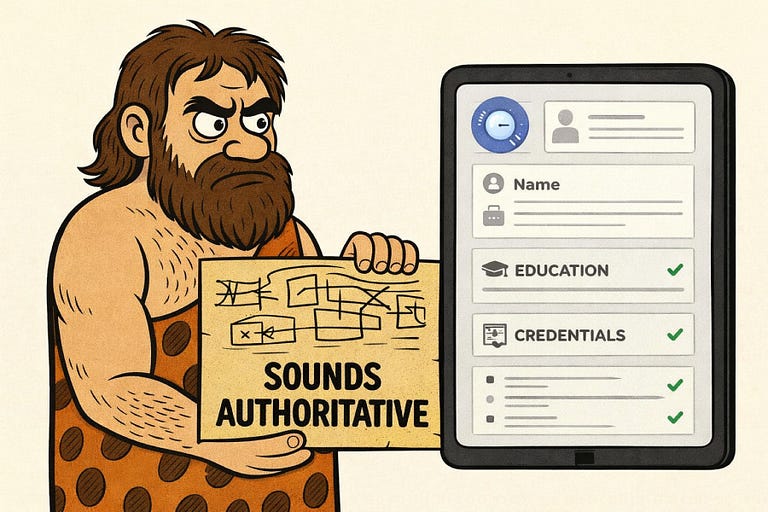
Why “Sounding Authoritative” Isn’t the Same as Being Structurally Trusted
A paragraph can sound confident and still leave key questions unanswered:
- What exactly qualifies this person?
- What domain are they recognised in?
- Is their authority implied or explicitly stated?
- Can this page be confidently classified and referenced?
Humans respond to tone.
Systems respond to clarity.
Good writing matters, but it doesn’t replace structure. Explicit education sections, clearly listed credentials, and consistent signals across text, images, and metadata remove ambiguity.
If you rely on tone alone, you’re asking systems to infer credibility.
If you rely on structure, you’re making credibility obvious.
Make Your Authority Machine-Readable Too
Once your page is clear for humans, the final step is making it clear for systems.
This is where structured data comes in.
You don’t need to go deep or technical. The goal is simple: explicitly state who the page is about, what that person does, and how they are qualified.
When done properly, this removes guesswork and makes the page easier to understand, classify, and reference.
Some platforms handle this better than others. For example, hosted platforms doesn’t support this particularly well by default, which is why additional tooling or configuration is often needed.
The Biggest Mistakes People Make
This is where pages get quietly weakened:
- Removing education because “no one reads it”
- Removing credentials for aesthetic reasons
- Hiding qualifications inside paragraphs
- Dropping logos without captions or alt text
- Uploading badly named, oversized images
- Letting personal preference override structure
These aren’t style decisions. They’re authority decisions.
Final Checklist: Building an Authoritative About Page
Use this as a simple gut-check for your own site:
- ☑ Clear name, role, and qualification near the top
- ☑ Dedicated education and credentials section
- ☑ Credentials written plainly, not implied
- ☑ Logos with captions and meaningful alt text
- ☑ Clean, descriptive page slug
- ☑ Image file names that describe the person
- ☑ Images resized and exported properly (WebP)
- ☑ Short, readable structure with clear sections
- ☑ Authority made explicit, not assumed
If most of these are missing, the page isn’t broken, but it is underperforming.