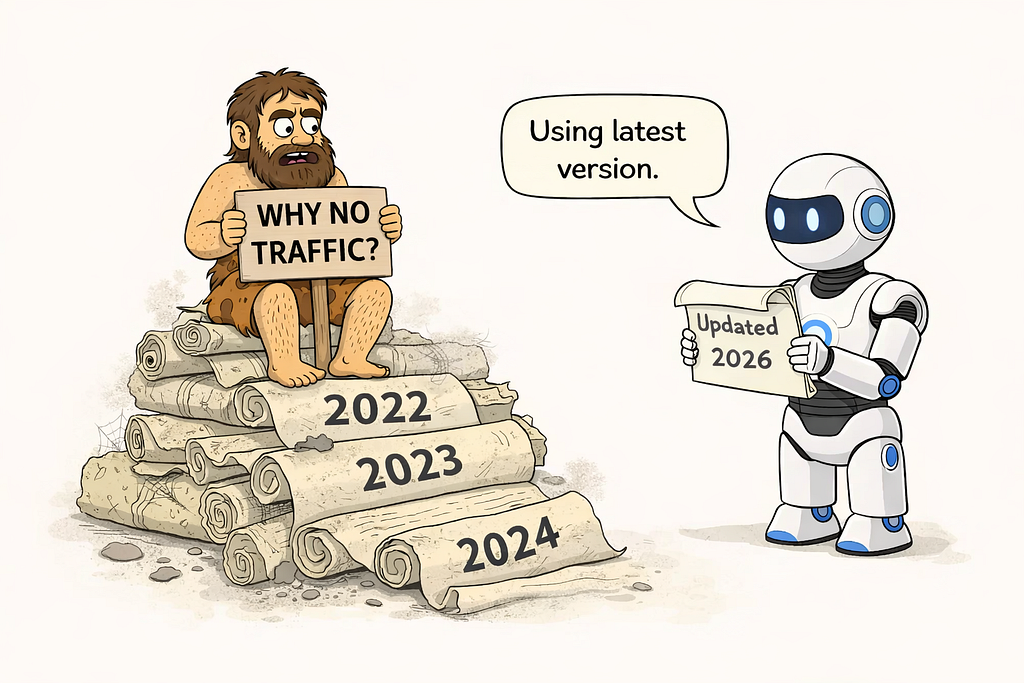
You do not have a publishing problem. You have a freshness problem.
Most creators already have enough content. The issue is that most of it has aged out of the AI citation window without anyone noticing.
Research tracking citation behavior found that 76.4% of ChatGPT’s top-cited pages were updated within the last 30 days. Content updated within that window gets 3.2x more AI citations than older content with similar authority and relevance. That library of posts you’ve built over two or three years? Most of it is not being cited. Not because it is bad. Because it looks stale to the systems making citation decisions.
Why AI Systems Favor Fresh Content
There is no separate AI database keeping your old posts alive.
Every major AI platform, ChatGPT, Perplexity, Google AI Overviews, pulls from live search indexes when generating answers. If your content has dropped in the index or simply stopped receiving crawl attention, it drops out of AI responses too.
Search engines already weight freshness as a ranking signal. When AI systems pull from those indexes, they inherit that bias. Fresh publish dates, recent updates, and active crawl signals get preferred at every layer: first by the index, then by the model selecting what to cite.
There is also a temporal query behavior worth knowing. Analysis of over 100,000 AI-generated sub-queries found that AI systems automatically append the current year into 28% of queries even when the user did not include it. A user asks “best schema setup for a course site.” The system queries “best schema setup for a course site 2026.” Your 2023 post does not match.
What Actually Counts as a Real Update
Changing “2025” to “2026” in your title is not a refresh. AI systems evaluate whether updates change the substance of the page.
A real update includes at least one of the following:
Adding a new statistic or replacing an outdated one with current data. This is the highest-signal change you can make. Research confirms that LLMs look for explicit in-content recency signals, specific numbers, dates, and “as of” statements, not just page timestamps.
Adding or expanding a section that closes a topical gap. If a competitor’s post covers something yours does not, that gap costs you citations. A 200-word addition on a missing subtopic does more than a full cosmetic rewrite.
Updating the “last modified” date alongside a schema change. The dateModified field in Article schema is the strongest technical signal for freshness. Update it only when you have made genuine content changes. Updating it without changing the content is detectable and does not help.
Adding or revising an FAQ section. FAQ content maps directly to how people query AI systems. A post that answers three questions is less citable than a post that answers eight. Adding questions you are seeing in search or in ChatGPT is substantive.
What does not count: resaving without changes, swapping images, updating formatting, or changing the title without touching the body.
Where to Start When You Have Hundreds of Posts
You do not need to refresh everything. You need to refresh the right things.
Start with posts that rank for a keyword but are not showing up in AI answers. These already have search authority. A freshness signal may be the only thing between them and AI citation.
Second priority: posts that cover topics where AI is actively generating answers. Type your post’s topic into ChatGPT or Perplexity. If AI is synthesizing an answer, it is pulling from somewhere. Your job is to be a better source than what it is currently citing.
Ignore posts that never ranked and never generated traffic. Refreshing weak content rarely produces strong results. Freshness amplifies existing authority. It does not create it.
How Often Does Content Need to Be Updated
It depends on the topic, but the general answer is more often than most creators expect.
For content in fast-moving fields, AI visibility, marketing, tech, finance, quarterly refreshes are the minimum. Research shows content older than 90 days without updates sees significant visibility reduction for queries where freshness matters.
For evergreen or foundational content, the window is more forgiving. Informational posts on stable topics can maintain citations for six to twelve months without updates. But even these should be reviewed annually and given at least a statistics refresh.
For your most important commercial pages, offers, services, outcomes you help clients achieve, monthly attention is worth it. Over 60% of commercial pages cited by ChatGPT were updated in the past six months. Stale offer pages lose citations to competitors who update theirs.
The hosted platforms-Specific Problem
hosted platforms does not have a built-in content refresh workflow. There is no dashboard showing you which posts are aging. No alert when a post crosses the 90-day mark without an update. No automated “last modified” signal unless you have added Article schema manually.
That means site owners are more likely to publish and forget than creators on platforms with content audit tooling.
The fix is the same regardless of platform: build a simple refresh calendar. List your top 20 posts. Assign a quarterly review date to each. Treat a refresh as a 30 to 60 minute task, not a rewrite project. Replace one statistic, add one FAQ, update the dateModified field in your schema if you have it.
That is enough to re-enter the citation window.
For non-site owners, the same logic applies. WordPress, Webflow, Ghost, none of them automatically surface your aging content for you.
Freshness is a discipline, not a feature.