 Originally published on Medium ↗
YouTube is now the most-cited domain in Google AI Overviews. Not occasionally. Consistently, across platforms, and pulling further ahead every month.
For course creators, that is either an opening or a missed opportunity. Which one depends entirely on how you have been publishing.
Why YouTube Citations Are Climbing
NP Digital analyzed over 10,000 AI-generated search overviews and found that YouTube citations grew 414% overall. “How-To” citations grew 651%. Visual demonstration content grew 592%. These are not incremental numbers.
BrightEdge’s analysis confirms the pattern. YouTube is the dominant video source in AI Overviews, cited approximately 200 times more than any other video platform. The growth is concentrated in specific content types: instructional queries, step-by-step demonstrations, product comparisons, and examples.
Opinion content and general commentary are not what AI systems are pulling. Teaching is.
What’s Actually Driving This
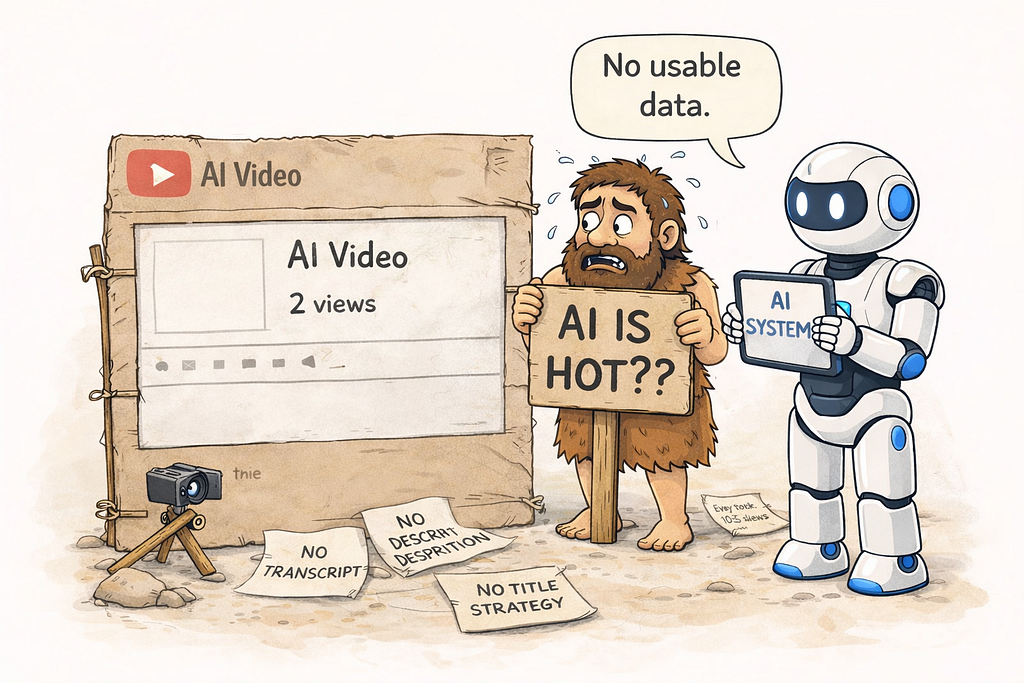
AI systems do not watch videos. They read the text associated with them.
Transcripts, captions, and keyword-rich descriptions are what allow AI engines to parse, retrieve, and cite video content. This is not speculation. Google’s video best practices documentation explicitly states that captions improve video indexability. Perplexity surfaces YouTube transcript passages directly in answers. ChatGPT Search retrieves YouTube content and attributes it.
The Adweek report from January 2026 put it plainly: transcripts and other text-associated content are what allowed YouTube “to flourish as a source that machines can easily read.”
Video without a transcript is a closed box. AI systems cannot cite what they cannot read.
Why This Matters More for Course Creators Than Anyone
Course creators are sitting on a large catalog of exactly the content AI systems prefer: instructional, step-by-step, demonstration-based teaching.
Most of it is locked inside video files, behind course platforms, with no machine-readable text layer attached.
That is the problem. Not the content itself.
hosted platforms now offers built-in transcription for newly uploaded videos on Growth and Pro plans, including an interactive editor and download options. That removes the technical barrier. The strategic gap is whether creators are doing anything with those transcripts beyond storing them.
A Video Embed Is Not a Strategy
Embedding a YouTube video on a page is not the same as building a page that AI can use.
A video embed by itself gives AI systems very little to work with. There is no readable text on the page. The video content stays inside the player. The page provides no supporting context, no answer structure, no metadata signals.
A transcript-backed page is different. The teaching exists in text form. AI systems can extract it, parse it, and connect it to the topic of the page. When the page is also structured clearly, with an answer-first format and supporting written context around the video, the retrieval surface expands significantly.
The video and the page start reinforcing each other instead of one carrying the other.
What Transcript-Backed Publishing Actually Looks Like
This is the workflow that positions video content for AI retrieval.
Publish the video to YouTube, with accurate captions. Auto-captions are a starting point, not a finish line. Errors in captions produce errors in what AI systems extract and cite.
Embed the video on your site. Not just as a player. As part of a page that answers the same question the video answers.
Add the transcript to the page. Edited for readability. Front-loaded with the core answer. Not a wall of filler text dropped below the fold.
Build written context around it. Related questions, key takeaways, a definition if one is needed. The page should be useful without the video, not just a parking spot for it.
Align metadata and structure. The page title, description, and headings should match the topic the video covers. Consistency across all three layers is what makes the content coherent to AI retrieval systems.
This is multimodal publishing. The same knowledge appears in video, transcript, written context, and structural signals. Each layer reinforces the others.
What to Do With Your Existing Content Library
Most course creators already have the raw material. The gap is structural, not creative.
Start with your highest-performing lessons. The ones that answer a specific, frequently asked question. Pull the transcript. Edit it for readability. Build a page around it.
Look at your YouTube uploads that are already getting traction. Add chapters with descriptive timestamps. Accurate chapter markers are another text layer AI systems can use.
For webinar replays and Q&A recordings, identify the specific questions that got answered and structure the transcript around those. A 90-minute recording becomes a set of retrievable answer segments, not one undifferentiated block.
None of this requires rebuilding your site or learning to code. It requires treating the transcript as infrastructure, not as an afterthought.
FAQ
Q: Does YouTube automatically generate transcripts for all videos? A: YouTube generates auto-captions for most videos in supported languages. Auto-captions are useful but often contain errors, especially for technical language, proper nouns, and domain-specific terms. Edited, accurate transcripts produce better retrieval results because they reduce misinterpretation by indexing systems.
Q: Can AI systems cite my course content if it is behind a paywall on hosted platforms? A: Not directly. AI systems cannot access gated content. The retrieval surface you control is the public-facing content: your YouTube channel, your blog pages, your free resources. That is where transcript-backed publishing creates citation opportunity.
Q: Does a YouTube video need to be embedded on my site to improve AI citation chances? A: Not necessarily. YouTube can get cited from the YouTube platform itself. But embedding the video on your site, alongside a transcript and supporting context, creates an additional retrieval path through your owned domain. Both matter. Owned site pages give you control over the structure and signals that surround the content.
Q: Why are How-To videos getting cited more than other content types? A: AI systems are optimized to answer specific questions. How-To content is structured around questions and step-by-step answers by design. That structure makes it easier for AI to extract a usable answer. Opinion pieces, brand stories, and promotional videos do not follow that pattern, so they are cited far less frequently.
Q: Does transcript length matter for AI citation? A: Accuracy matters more than length. A clean, edited transcript of a 10-minute video is more useful to AI systems than a 60-minute transcript full of filler and errors. Front-load the key answer or definition. AI systems show a strong positional bias toward content that appears early in the text.
Q: Is this only relevant for Google AI Overviews? A: No. YouTube citations are growing across platforms. Perplexity surfaces YouTube transcript passages in answers. ChatGPT Search retrieves YouTube content directly. Data from early 2026 shows YouTube appearing in 16% of LLM answers across major AI platforms, up from a much smaller baseline in mid-2025.
Course creators already have the teaching. What most of them are missing is the infrastructure that makes it readable.
AI Visibility Studio helps websites become easier for AI systems to find, read, and cite. aivisibilitystudio.com