 Originally published on Medium ↗
Here is the part of AI search nobody optimizes for.
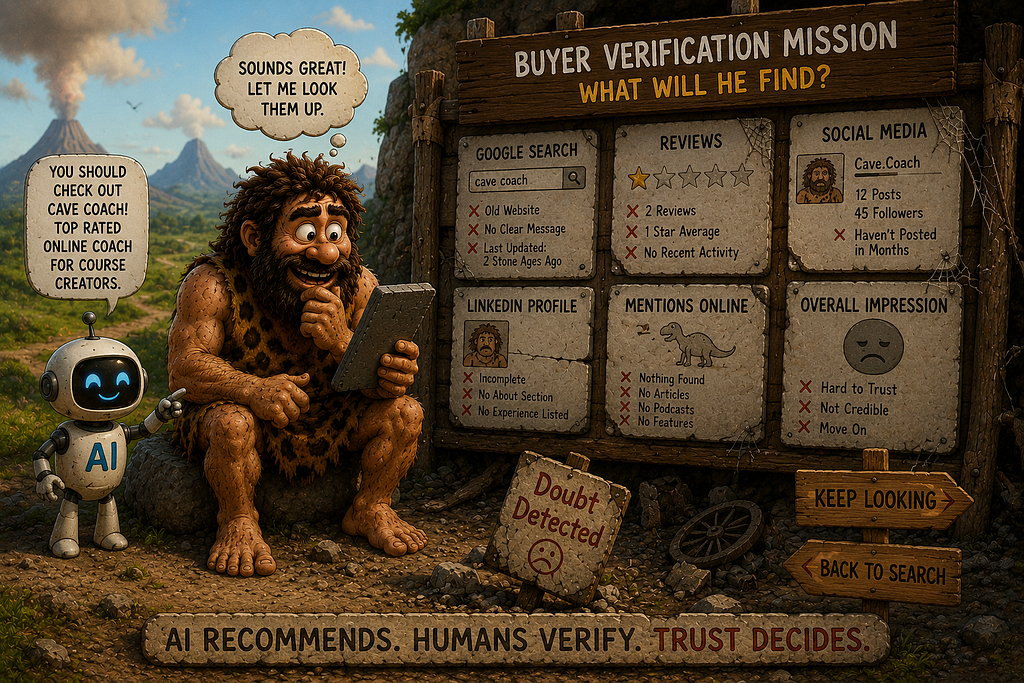
Here is the part of AI search nobody optimizes for. A buyer asks ChatGPT for a recommendation, your name comes up, and then they do not buy. They open a new tab and go look you up. What they find in that second step decides the sale, and most businesses have no idea what is there. Getting recommended is the start of the decision, not the end of it.
Key Takeaways
- Many consumers do not take an AI recommendation at face value. They verify it somewhere else before acting.
- Consumers check multiple platforms before buying, so a single strong page is not enough.
- The verification step happens on surfaces you may not control: reviews, social profiles, third-party mentions.
- Trust in AI recommendations drops as the stakes rise, which means higher-value purchases get checked harder.
- The fix is consistency across surfaces, so that whatever a buyer checks next confirms the recommendation instead of undermining it.
What Happens After AI Recommends a Business?
The buyer verifies it. An AI recommendation creates interest, but it rarely closes the decision on its own, because people treat a single AI answer as a starting point rather than a verdict.
Yext’s 2026 research framed this plainly: customers are using AI to research brands right now, and most of them are not taking the first answer at face value. The recommendation opens the door. The verification step is what determines whether the buyer walks through it.
This is the moment most AI visibility advice ignores. Everyone is focused on getting mentioned. Almost no one is asking what the buyer sees in the thirty seconds after the mention.
Where Do Buyers Go to Verify an AI Recommendation?
Wherever they can find a second opinion fast. That usually means a search of your name, your reviews, your social profiles, and any third-party page that mentions you, not just your homepage.
Fractl’s Q2 2026 consumer survey found that people check around 2.4 platforms before buying, which is why the recommended move is to be the consensus answer across search, social proof, video, reviews, and trusted media rather than optimizing for one destination. A buyer rarely stops at the first result. They triangulate.
That changes the job. Your website is one of several surfaces a buyer will touch, and the weakest one in the chain is the one that decides whether they trust the recommendation.
Why Does the Verification Step Matter More for Bigger Purchases?
Because trust in AI tends to fall as the stakes rise. The bigger the commitment, the harder a buyer checks before saying yes.
Yext’s research found that 57% of consumers still prefer traditional search engines for personal, medical, or financial topics. Nobody cross-checks a recommendation for a Tuesday pasta recipe. People absolutely cross-check before hiring a coach, buying a course, or signing a service contract.
This is the exact buyer a coach or consultant is trying to reach. The higher your price, the more verification happens before the sale, and the more your off-page presence has to hold up under a skeptical second look.
What Does a Buyer Find When They Check You?
Often, less than you think, and less of it under your control. The AI recommendation sends them looking, and the next thing they see might be a thin LinkedIn profile, a stale About page, two old reviews, or nothing at all.
Here is the failure in practice. AI tells a buyer you are the expert on a topic. The buyer searches your name. Your site has no clear statement of what you do, no recent content, and no consistent description of your business across the places they look. The recommendation evaporates, not because it was wrong, but because nothing confirmed it.
Now the version that works. AI recommends a business as a specialist in, say, retirement planning for teachers, and the buyer searches the name. They find a homepage that says exactly that, a LinkedIn profile that says the same, recent articles on the topic, and a reviews page describing that specific work. Every surface repeats the claim, so the recommendation hardens into a decision instead of dissolving into doubt.
Consistency is the quiet signal here. When your site, your profiles, and the third-party pages about you all describe you the same way, the verification step reinforces the recommendation. When they conflict or come up empty, the buyer’s doubt wins.
How Do You Win the Verification Step?
Make every surface a buyer might check say the same clear thing. The goal is that whatever they find next confirms what the AI told them.
Three moves matter most. Keep a clear, current statement of what you do and who you serve on your own site, so the first verification search lands on something definite. Maintain consistent descriptions of your business across the profiles and platforms people actually check, so nothing contradicts. And give your site machine-readable signals, such as Organization and Person schema, which can help search engines and AI systems better understand who you are and what you do.
None of this is about gaming an algorithm. It is about making sure that the moment of doubt, the one that happens right after the recommendation, resolves in your favor.
Frequently Asked Questions About AI Recommendations and Buyer Verification
Q: Do people trust AI recommendations enough to buy without checking?
A: Usually no. Research from Yext in 2026 found most consumers do not take the first AI answer at face value and verify it elsewhere before acting, especially for higher-stakes purchases.
Q: Where do buyers go to verify a brand after an AI recommendation?
A: They search the brand name and check reviews, social profiles, and third-party mentions, not just the homepage. Consumers check around 2.4 platforms before buying, according to Fractl’s 2026 survey.
Q: Why do bigger purchases get verified more heavily?
A: Trust in AI drops as the stakes rise. Yext found 57% of consumers still prefer traditional search for personal, medical, or financial topics, so high-value decisions get cross-checked harder than casual ones.
Q: What makes a buyer abandon a purchase after an AI recommendation?
A: A weak or contradictory verification step. If the buyer searches you and finds a thin site, stale content, or inconsistent descriptions across platforms, the doubt outweighs the recommendation.
Q: How do I make sure buyers trust me after AI recommends me?
A: Keep a clear, current statement of what you do on your own site, maintain consistent descriptions across the platforms people check, and add machine-readable schema that can help search engines and AI systems better understand who you are and what you do.
Q: Is the AI recommendation or the verification step more important?
A: Both, in sequence. The recommendation creates the opportunity, and the verification step decides whether it converts. Optimizing only for the mention and ignoring what a buyer finds next leaves the sale unfinished.
Everyone is working to get mentioned by AI. Getting mentioned is only part of the challenge. The businesses that win are the ones who are ready for the search that happens five seconds later, when a buyer quietly checks whether the machine was telling the truth.
AI Visibility Studio helps businesses build the signals that AI systems and human buyers both use to verify trust, from structured content and entity clarity to the metadata that helps AI understand who you are. aivisibilitystudio.com
References
- Yext, “7 Data-Backed Stats on AI Search Trust and Consumer Decision-Making in 2026”: https://www.yext.com/blog/7-data-backed-facts-on-ai-trust-and-consumer-decision-making-in-2026
- Fractl, AI Search Consumer Trust Study 2026 (1,008 consumers, 150 marketers, Q2 2026): https://www.frac.tl/ai-statistics/