 Originally published on Medium ↗
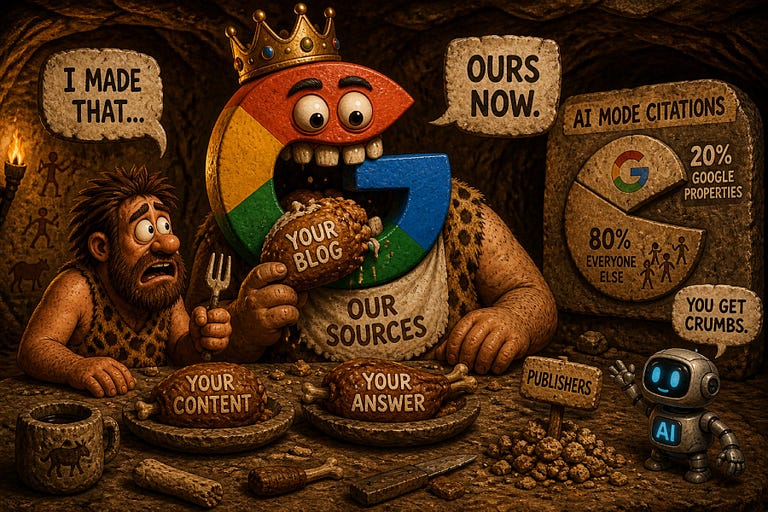
In June 2025, Google cited itself in 5.7% of AI Mode responses.
By February 2026, that figure had tripled to 17.42%.
Google.com is now the single most cited domain in AI Mode. Including YouTube, Google-controlled properties account for roughly 20% of all AI Mode citations. Nearly one in five citations inside Google’s own AI product points back to Google.
That does not look accidental. And even if it is structural rather than deliberate, the outcome is the same.
Key Takeaways
• Google.com is the single most cited domain in its own AI Mode, accounting for 17.42% of citations
• Including YouTube, Google-controlled properties account for roughly 20% of all AI Mode citations
• The figure tripled from 5.7% in June 2025 to 17.42% by February 2026, in under nine months
• Independent publishers are not losing to better content. They are competing against the platform itself.
• Verticals vary significantly. Finance and insurance give independent publishers more room. Travel and entertainment do not.
What the Data Actually Shows
SE Ranking analyzed 68,313 keywords across 20 industries and more than 1.3 million AI Mode citations to measure how often Google.com appears as a cited source.
The result: Google.com was cited more than any other website. By a large margin.
The composition of those citations has also shifted. In June 2025, 97.9% of Google’s self-citations pointed to Google Business Profiles, making the pattern primarily relevant to local search. By February 2026, 59% of Google citations in AI Mode pointed to traditional Google search result pages.
That shift matters. When AI Mode cites a Google search result, users who follow that citation land on another Google SERP, which may contain more AI summaries, ads, and Google Maps panels. The citation becomes a re-entry point into Google’s ecosystem, not an exit toward an independent publisher.
AI Mode appears to extend Google’s self-referencing approach by pushing users deeper into Google’s ecosystem, often through additional search results rather than external sites. This keeps users interacting with Google surfaces where ads, reviews, and other monetized content appear.
The Numbers Are Not Uniform Across Industries
Before concluding that independent content is finished, the industry breakdown is worth reading carefully.
Travel shows the highest Google self-citation concentration at 53.18% of AI Mode citations. Entertainment and Hobbies follows at 48.74%. Real Estate sits at 30.54%. Finance shows 5.13% and Insurance 6.48%, giving specialist content considerably more room in those categories.
Career and Jobs is the only industry where Google was not the top-cited domain. Indeed was cited 3.1 times more frequently than Google in that category.
The practical read: if you publish in travel, entertainment, or local search, you are competing for a smaller slice of citations than the headline 17% figure suggests. If you publish in finance, legal, insurance, or specialist professional services, the picture is less bleak. Google’s own properties do not dominate there, and structured, authoritative independent content still earns meaningful citation share.
Why This Is Happening
The most straightforward explanation is structural. Google’s index is richly interconnected with its own properties: Search, Maps, Business Profiles, YouTube, Flights, Support. AI Mode appears to use query expansion and retrieval patterns that draw heavily from Google’s broader index. When those sub-queries retrieve results, Google’s own pages frequently rank highly and get selected as citations. Whether this reflects deliberate design decisions or the emergent behavior of AI systems drawing from a self-referential index is not publicly confirmed by Google.
Both explanations lead to the same outcome for publishers. The referee and a player on the field are the same entity.
In February 2026, the European Publishers Council filed a formal antitrust complaint with the European Union, arguing that Google was using publisher content in AI Overviews and AI Mode without authorization, without effective opt-out mechanisms, and without appropriate compensation, while simultaneously directing users away from publisher sites and back into Google’s ecosystem. That complaint is ongoing. It has not produced any immediate structural change.
What Independent Publishers Can Actually Do
The honest answer is that some of this is not fixable at the content level. If Google has decided that a travel query is best answered by Google Flights and Google Maps, no amount of schema markup changes that outcome.
What is fixable is your position within the citation pool that remains.
Content that provides direct, specific answers to clearly defined questions tends to be favored over broad, general overviews. Topical depth and thoroughness, covering a subject at multiple levels of detail, gives AI Mode more material to draw from across related sub-queries. Entities that are clearly defined and linked within content improve AI Mode’s ability to classify and use it.
The finance and insurance citation gap is instructive. Those verticals require precision, accountability, and named expertise. Google does not have a “Google Tax Advice” property competing for that space. Independent publishers with genuine depth win there because the structural advantage Google holds in travel and entertainment does not apply.
The same logic holds for any niche where the answer cannot be reduced to a map pin or a product listing. Specialized knowledge, published consistently, with clear entity signals, and structured content that AI systems can extract cleanly, is still the most defensible position an independent publisher can hold.
Brand authority signals, including mentions on high-authority third-party sites, consistent entity information, and strong trust signals, all contribute to the underlying citation selection process. Being cited elsewhere increases the probability of being cited by AI Mode, because the system is partly reading external authority signals to decide who the credible sources are on a given topic.
The Uncomfortable Part
Google built the web’s most important discovery system. Publishers created content for it, optimized for it, and built businesses around the assumption that the system’s job was to send traffic outward.
That assumption is not holding.
Major websites experienced traffic declines ranging from 8% to 55% year-over-year, largely attributed to AI Overviews. Traditional news outlets suffered the most severe losses, with Business Insider and affiliated sites experiencing a 55% decline in organic search traffic between April 2022 and April 2025.
Being cited in AI Mode does not reverse that trend on its own. Wikipedia itself experienced an 8% decline in human page views despite being the single most referenced source in AI citations. Citation frequency and traffic are now partially decoupled. You can win the citation and still lose the visit.
The structural response to this is diversification: email lists, direct audiences, platform-independent content distribution. That is outside the scope of what AIVS does. The citation-layer response, making sure the content that does get cited is yours and not a competitor’s, is not.
Questions Worth Asking Before You Panic
Q: What percentage of Google AI Mode citations go to Google itself?
A: According to SE Ranking’s analysis of more than 1.3 million AI Mode citations across 68,313 keywords, Google.com accounts for 17.42% of all citations. Including YouTube, Google-controlled properties account for roughly 20% of total AI Mode citations. Google.com is the single most cited domain in its own AI product.
Q: Has Google’s self-citation rate in AI Mode always been this high?
A: No. In June 2025, Google cited itself in 5.7% of AI Mode responses. By February 2026, that figure had tripled to 17.42%. The type of citation has also shifted: in June 2025, nearly all Google self-citations pointed to Google Business Profiles. By February 2026, 59% pointed to traditional Google search result pages.
Q: Which industries are most affected by Google’s AI Mode self-citation?
A: Travel is the most affected, with 53.18% of AI Mode citations pointing to Google. Entertainment and Hobbies follows at 48.74% and Real Estate at 30.54%. Finance and Insurance are least affected at 5.13% and 6.48% respectively. Career and Jobs is the only industry where Google was not the top-cited domain.
Q: Can independent publishers still get cited in Google AI Mode?
A: Yes, particularly in verticals where Google does not hold a dominant property advantage. Finance, legal, insurance, and specialist professional services all show lower Google self-citation rates, meaning independent content with genuine depth and clear entity signals can still earn meaningful citation share. Topical authority, structured content, and named expertise remain the strongest signals available to independent publishers.
Q: Does being cited in AI Mode drive traffic?
A: Not reliably. Citation frequency and traffic are increasingly decoupled. Wikipedia is the most-cited source in Google AI citations and still experienced an 8% decline in human page views. Being cited builds brand presence and authority signals that influence future citations, but it does not replace the direct traffic that traditional organic rankings once generated.
Q: Why is Google citing itself so frequently?
A: The most straightforward explanation is structural. Google’s index is deeply interconnected with its own properties, and AI Mode appears to use query expansion and retrieval patterns that draw heavily from Google’s broader index. When those sub-queries retrieve results, Google’s own pages frequently rank highly and get selected. Whether this reflects deliberate design or emergent system behavior is not confirmed publicly by Google. The European Publishers Council filed a formal antitrust complaint with the European Union in February 2026 raising this concern.
⸻
Google optimizing for Google is not surprising.
The question is not whether it will keep happening. It will.
The question is whether your content is structured well enough to compete for the citation share that remains.
⸻
AI Visibility Studio helps websites become easier for AI systems to find, read, and cite.