 Originally published on Medium ↗
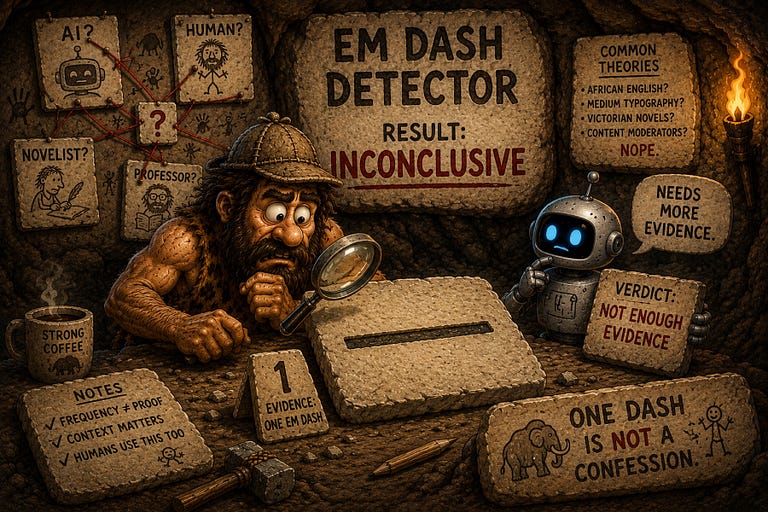
Somewhere in the last two years, the em dash became the internet’s favorite way to catch a robot. See one of those long dashes in a paragraph and people now assume a machine wrote it. That instinct is wrong, and it is doing real damage. Human writers who have used em dashes their whole lives are deleting them out of fear of being mistaken for ChatGPT, and the people relying on the dash to spot AI are being fooled anyway.
Key Takeaways
- AI does overuse em dashes. One analysis found GPT-4.1 uses them about 3.28 times more often than human writers in standard essays.
- That makes the em dash a probability signal, not proof. Plenty of careful human writers use it constantly.
- The popular explanations for why AI loves it are mostly wrong or unproven.
- One likely cause is two things stacked: training data heavy in long-form prose, plus reinforcement that rewards clear, structured answers.
- The same forces that flood AI writing with em dashes are why it reads generic, and generic is a visibility problem.
Is the Em Dash Actually a Sign of AI Writing?
Only in the way a tall person is a sign of a basketball player. It shifts the odds. It does not settle the question.
The overuse is real and measured. Independent researcher Freeburg found GPT-4.1 uses em dashes about 3.28 times more often than human writers in standard essays, and the habit barely responds to instructions telling the model to stop. Writers have documented asking ChatGPT and Claude repeatedly to drop the dash, only to watch it reappear two sentences later.
But “AI uses it more” is a different claim from “this dash means AI.” Long-form journalists, novelists, and anyone who came up reading The Atlantic use the em dash heavily and always have. Flagging the mark as proof punishes exactly the people who write well, which is the opposite of what a useful tell should do.
Why Are Human Writers Now Deleting Their Em Dashes?
Because AI detectors and casual readers treat the dash as evidence, so writers self-censor to avoid the accusation. It is a strange outcome where humans are changing how they write to seem more human.
One of the researchers who looked into this described doing it herself: cutting back-to-back long sentences, dropping semicolons, removing dash-filled phrases, all to avoid being flagged by AI detectors. The tools measure things like predictability and sentence variation, and a confident, structured style trips them.
That is the quiet cost of treating a punctuation mark as a verdict. To write in a way that reads as human, people are being pushed to write less precisely and less creatively. The tell does not just misfire. It degrades the writing it is supposed to protect.
So Why Does AI Actually Overuse the Em Dash?
The honest answer is that no AI lab has published a definitive explanation, but the evidence points to two forces stacked on top of each other. Neither is the simple story people repeat.
The first is the training data. Models learn from enormous amounts of long-form writing, essays, articles, books, where the em dash is far more common than in the texts most people actually read day to day, like emails and messages. One dataset that mimics AI training material showed em dash usage so high it had to be left off the chart. The model absorbs the mark as a normal feature of “good” writing.
The second is reinforcement. During fine-tuning, models are shaped to produce clear, well-organized answers, and the em dash is a convenient tool for that, it inserts an explanatory pause or breaks a complex idea into pieces. So the habit is not just learned, it gets rewarded, which pushes its frequency past the human baseline. Researchers describe this training-plus-reinforcement combination as one plausible explanation, while newer analysis also points to markdown-heavy training and post-training amplification as possible factors.
One recent paper makes that markdown link directly. Freeburg’s study across twelve models from five providers argues the em dash is “markdown leaking into prose,” the smallest surviving piece of the structured formatting models absorb from markdown-saturated training data. When the models were told to drop markdown, headers and bullets disappeared but the em dashes mostly stayed, ranging from 0.0 per 1,000 words in Meta’s Llama to 9.1 in GPT-4.1 under suppression. The paper is explicit that no full mechanistic account exists yet.
What About the Other Explanations You’ve Heard?
Most of them do not survive a close look. They are the kind of tidy stories that spread because they sound clever, not because the data backs them.
The “African English regulation” theory claims that overseas content moderators favor words like “delve” and dashes. But the moderation work is about removing harmful content, not editing style, and analysis of Nigerian English corpora found those dialects actually use fewer em dashes than standard American or British English. The “Medium auto-converted hyphens into em dashes” theory, which surfaced after Medium’s founder was cited connecting the platform’s typography habit to AI training, falls apart because the question is why AI uses the dash more than humans, not why it uses the dash character at all. And the “Victorian novels” theory, that AI learned it from digitized 1800s literature, is plausible as a contributor but cannot carry the whole explanation on its own.
The pattern across all of them is the same. Each picks one source and treats it as the answer, when the measured behavior is better explained by broad overrepresentation plus reinforcement. The simple story is satisfying. It is also mostly wrong.
What Does Any of This Have to Do With AI Visibility?
This is the part that matters for anyone publishing online. The same habits that flood AI writing with em dashes also help explain why so much AI writing feels generic, and generic content is a visibility problem.
An AI model defaults to the most statistically average version of whatever it produces, the median phrasing, the median structure, the median punctuation habit. That is why so much AI text feels interchangeable. It is built from the center of the distribution. The em dash is just the most visible symptom of a much larger default toward the average.
For getting cited by AI search, average is the enemy. AI systems are more likely to reuse content that gives them clear definitions, concrete numbers, named examples, and clean structure. Content that reads like every other AI-generated page has nothing for a model to latch onto. The lesson of the em dash is not “remove your dashes.” It is that distinctiveness is what separates content that gets used from content that blends into the noise.
Frequently Asked Questions About AI and Em Dashes
Q: Does using an em dash mean something was written by AI?
A: No. AI overuses em dashes, with one analysis finding GPT-4.1 uses them about 3.28 times more than human writers, but many skilled human writers use them heavily too. The dash shifts the probability, it does not prove authorship.
Q: Why does ChatGPT use so many em dashes?
A: The likeliest explanations combine training data full of long-form, markdown-heavy prose where em dashes are common, plus reinforcement during fine-tuning that rewards clear, structured answers. One 2026 paper argues the dash is “markdown leaking into prose.” No AI lab has confirmed a single definitive cause.
Q: Why can’t you get AI to stop using em dashes even when you ask?
A: The habit is deeply embedded in the model’s output style. Freeburg found GPT-4.1’s em dash use was highly resistant to prompt instructions and suppression, persisting even when the model was told to drop markdown formatting and other structural features disappeared.
Q: Is it true AI learned em dashes from African English moderators?
A: No. That theory does not hold up. Content moderation focuses on removing harmful material rather than editing style, and analysis of Nigerian English found it uses fewer em dashes than standard American or British English.
Q: Should I stop using em dashes in my writing?
A: Not for fear of detection alone. Avoiding a punctuation mark you use naturally pushes you toward less precise writing. The more useful goal is distinctive, specific content, which is also what AI search tends to cite.
Q: Why does AI-generated content all sound the same?
A: Because models default to the most statistically average phrasing and structure. The em dash overuse is one visible symptom of that pull toward the median, which is also why generic AI content struggles to get cited.
The em dash became a villain because it was easy to spot, not because it meant what people thought. The real tell of AI writing was never one punctuation mark. It is the steady pull toward the average, in every sentence, and that is the thing worth writing against.
AI Visibility Studio helps websites structure content so AI systems can find it, understand it, cite it, and actually use it when generating answers. aivisibilitystudio.com
References
- McGill University Office for Science and Society, “Why Did LLMs Steal Our Em-Dashes?” (May 8, 2026): https://www.mcgill.ca/oss/article/critical-thinking-student-contributors-technology/why-did-llms-steal-our-em-dashes
- E. M. Freeburg, “The Last Fingerprint: How Markdown Training Shapes LLM Prose” (arXiv, March 27, 2026): https://arxiv.org/abs/2603.27006
- Sean Goedecke, “Why do AI models use so many em-dashes?” (October 30, 2025): https://www.seangoedecke.com/em-dashes/