 Originally published on Medium ↗
Your content gets cited by AI but your brand never appears in the answer. Here’s what a ghost citation is, why it happens, and what to do about it.
AI Visibility Studio helps brands reduce ghost citations by making their expertise easier for AI systems to connect with their name.
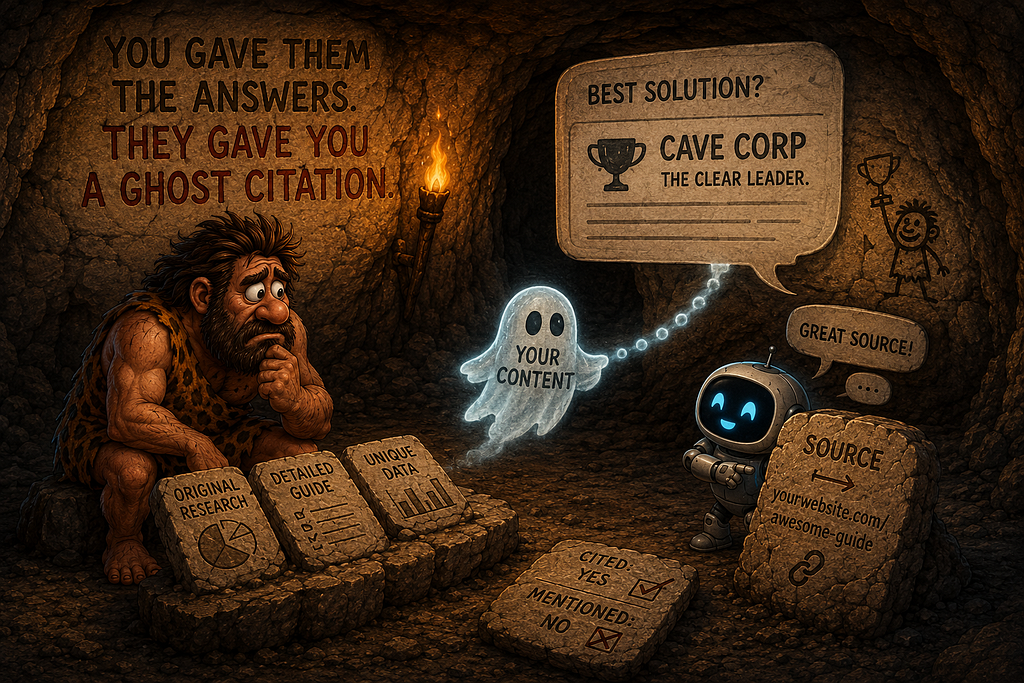
Your content may already be cited by AI search engines. Your brand may still be missing from the answer.
This is not a ranking problem. It is not only a technical problem. It is also a sentence-level writing problem, and most people working on AI visibility have not noticed it yet.
What Is a Ghost Citation?
A ghost citation happens when an AI system uses your content as a source but never mentions your brand name in the response it generates.
Your URL appears in the footnotes. A competitor’s name appears in the answer. The buyer reads a recommendation that was built on your research.
Seer Interactive coined the term after analyzing 541,213 LLM responses across 20 brands and six AI platforms in February 2026. Their finding is specific: when a brand is mentioned in an LLM response, its content citation rate is 53.1%. When the brand is absent from the response text, that citation rate drops to 10.6%.
Being cited without being named is not a neutral outcome. It is actively associated with lower overall citation presence.
Why This Happens: Citations Are Post-Hoc
The instinct is to assume AI works like a search engine: reads your content, evaluates it, decides you are credible, surfaces your brand. That sequence is wrong.
Seer’s leading hypothesis, backed by behavioral tests across 362,188 LLM responses, is that citations work in the opposite order. The model decides which brands to recommend first, using what it already knows from training data. Then it finds content to support that recommendation. Your well-structured blog post becomes the evidence for a competitor’s name.
This matters because it reframes the entire optimization problem. You are not trying to make AI like your content more. You are trying to make AI know your brand name well enough to attach it to the ideas it is already pulling from your content.
The Numbers Are Not Subtle
According to Growth Memo’s April 2026 analysis, 61.7% of LLM citations are ghost citations: the domain gets a source link but the brand name does not appear in the answer text. Only 13.2% of appearances convert into both a citation and a mention.
ChatGPT and Gemini behave differently here. ChatGPT cites sources in 87% of responses but mentions brands in only 20.7% of answers, functioning more like an academic paper: footnotes present, brand recognition absent. Gemini mentions brands in 83.7% of responses but only generates a citation link 21.4% of the time.
If you are optimizing for one platform and measuring on another, you may be solving for the wrong signal entirely.
Seer documented one case directly: a client’s blog post was cited more than 100 times over a 25-day period with zero brand mentions in those responses. The team added explicit brand language to the post. Twenty-nine days later, brand mentions remained at zero.
The page was still cited. The classification had not shifted.
That timeline is not necessarily a failure of the fix. It reflects how slowly AI systems may absorb brand-level changes. They do not re-evaluate content in real time. Changes you make today become inputs to how future model versions perceive your brand.
What AI Actually Extracts From Your Content
Daniel Shashko’s March 2026 analysis of 42,971 AI citations, cited by Practical Ecommerce, found that AI Mode and Gemini often cite self-contained sentences of 6 to 20 words. These short, complete statements appear to function as the building blocks of AI responses.
The first sentence of each major section carries disproportionate weight. If your brand name is not in that sentence, it likely does not travel with the extracted fact.
Compare these two versions of the same claim:
There are five approaches to compliance training that reduce regulatory risk.
At [Brand], our approach to compliance training starts with a five-part framework that reduces regulatory risk.
The first sentence is informative. The second is citable with attribution. Some AI citation systems appear to favor short, self-contained factual sentences. The brand name in the second version is part of the fact.
How to Write Sentences That Travel With Your Brand Name Attached
The fix is not adding more schema or restructuring your headings. It is making your brand name the grammatical subject of the ideas AI is already extracting from your content.
Three patterns that help:
State the method before the claim. Instead of “Structured data improves AI citation rates,” try “The AI Visibility Studio approach to structured data focuses on schema that identifies the brand alongside the claim, not just the content type.”
Attach your name to your original data. If you publish a finding, the sentence should name you as the source. “Our audit data across 200 sites shows…” is citable with attribution. “Studies show…” is not.
Use your brand name early in each section. Growth Memo’s analysis found that 44.2% of all LLM citations come from the first 30% of a page’s text. The first paragraph of each section is where extraction concentrates. If your name is not there, it is likely not being extracted.
None of this requires rewriting your entire site. It requires knowing which pages are already being cited and updating the opening sentences of the sections being pulled.
What This Means for Schema and Structured Data
Schema does not solve the ghost citation problem. It addresses a different layer: whether AI can correctly identify what your content is about and confirm entity relationships.
That matters. An Organization schema that connects your brand name to your area of expertise helps AI systems build the parametric knowledge that determines which brands they recommend in the first place. But schema is a background signal. It does not change how your sentences are extracted.
The most useful thing schema does for ghost citations is indirect: accurate entity data in your structured markup reduces the likelihood that AI associates your brand with an incorrect description or a competitor’s positioning. It keeps your brand name tethered to the right claims across the web.
The writing layer and the schema layer are not redundant. They work on different phases of the same problem.
Frequently Asked Questions About Ghost Citations
Q: What is a ghost citation in AI search?
A: A ghost citation is when an AI system uses your content as a source but does not mention your brand name in the response it generates. Your URL appears as a footnote while a competitor’s name appears in the actual recommendation.
Q: How common are ghost citations?
A: According to Growth Memo’s April 2026 analysis, 61.7% of LLM citations are ghost citations. The domain receives a source link but the brand name does not appear in the answer text.
Q: Does adding more schema markup fix ghost citations?
A: Not directly. Schema helps AI systems correctly identify your brand and its areas of expertise, which may reduce ghost citations over time by strengthening parametric memory. But it does not change which sentences get extracted from your content. That is a writing problem, not a markup problem.
Q: How long does it take to fix a ghost citation after updating content?
A: Seer Interactive’s documented case suggests weeks to months, not days. AI systems do not re-evaluate content in real time. Updates become inputs to future model versions. Seer’s own case study showed no measurable movement 29 days after content changes went live.
Q: Does ChatGPT handle ghost citations differently than other AI platforms?
A: Yes. ChatGPT cites sources in 87% of responses but mentions brands in only about 20.7% of answers. Gemini does the opposite: it mentions brands far more often than it generates citation links. If you are only tracking one platform, you may be missing a significant part of the picture.
Q: What is the most actionable first step to reduce ghost citations?
A: Identify which of your pages are already being cited in AI responses, then check whether your brand name appears in the answer text alongside those citations. If it does not, update the first sentence of each major section on those pages to include your brand name as the grammatical subject of the claim being extracted.
Getting cited is not the finish line. It is closer to the starting line. The question that actually matters is whether the AI is saying your name or just borrowing your thinking.
AI Visibility Studio helps websites become easier for AI systems to find, read, and cite. aivisibilitystudio.com