Here is something that breaks the usual advice. When ChatGPT or Google’s AI names a source, most of the time that source is not ranking anywhere near the top of normal Google results.
Key Takeaways
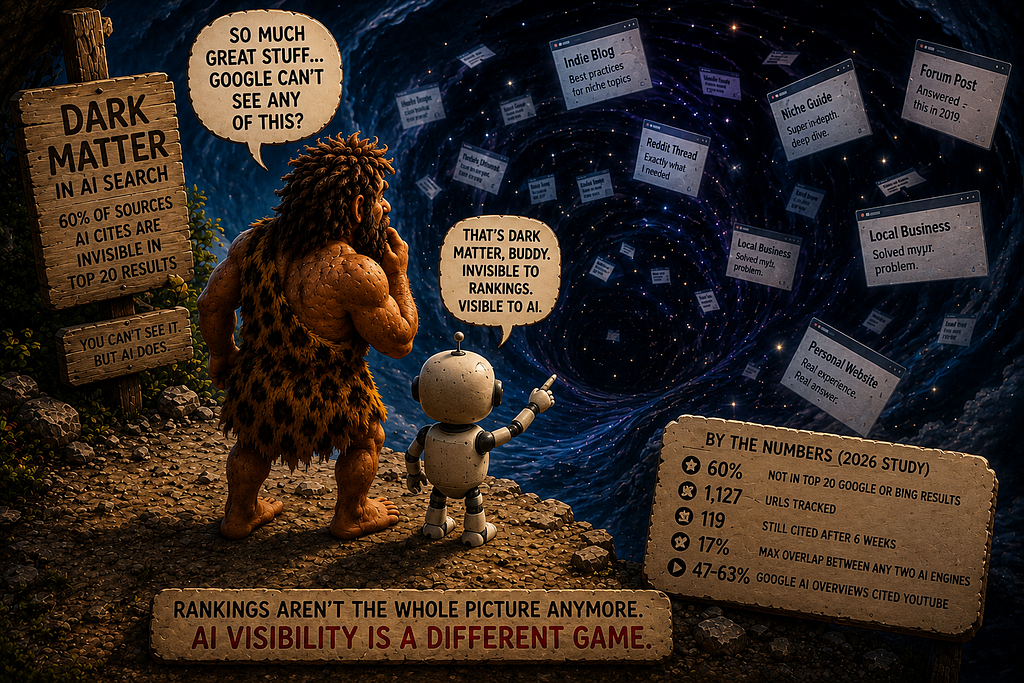
- A 2026 study found that 60% of the pages AI engines cite do not rank in the top 20 organic results on Google or Bing for the same query.
- The researchers call these invisible-but-cited pages “dark matter,” because standard SEO tools cannot see them.
- AI citation slots are unstable. The study’s Citation Retention Rate averaged 33% over 28 days, meaning about two-thirds of cited URLs were replaced within four weeks.
- The AI engines barely overlap. The most any two shared was 17% of cited domains, so there is no single playbook.
- The practical takeaway is that ranking on Google and being cited by AI are now two different games measured by two different tools.
What Is AI Visibility, in Plain Terms?
AI visibility measures whether AI systems cite your content and represent your business accurately when answering questions in your category. It is the AI-era version of “showing up in search,” except the AI gives one synthesized answer instead of a page of links.
Traditional SEO asks a simple question: where does my page rank on Google for a keyword. AI visibility asks a different one: when someone asks ChatGPT, Perplexity, Gemini, Copilot, or Google’s AI Overviews about my topic, does my content get pulled into the answer.
Those sound like the same thing. The new data says they are not, and the gap between them is bigger than almost anyone assumed.
What Is “Dark Matter” in AI Search?
Dark matter is the term researchers gave to pages that AI cites but that do not rank in the top 20 organic Google or Bing results for the same query. The name is borrowed from physics, where dark matter is the mass you cannot see but can prove is there by its effects.
The study, a 6-week analysis of 1,127 URLs across five AI engines by Digital Authority Partners, found the dark matter rate held at 60%. Across three measurement waves two weeks apart, it read 62%, then 57%, then 60%. Steady, not a fluke.
In plain terms: if you looked at every source the AI used to answer questions in your field, six out of ten would not appear in the first twenty organic Google or Bing results for that same query. They are influential and invisible at the same time.
Why Can’t My SEO Tools See These Pages?
Because your SEO tools read the Google results page, and AI does not stay on the Google results page. Traditional rank trackers like Ahrefs, Semrush, and Google Search Console pull their data from where pages rank in search. That is the world they were built to measure, though several are now adding separate AI-tracking features.
AI engines appear willing to pull from sources that traditional search rankings would overlook. In the Digital Authority Partners 2026 study, Perplexity surfaced an average of 5.9 citations per query, often citing sources that were not highly visible in traditional search results, and during the study period Copilot pulled from sources like Etsy and Bing-only domains that no other engine touched. None of that shows up in a rank tracker. These were the patterns at the time of the analysis, and any given engine’s sourcing can shift.
So you can have a dashboard that says you are doing fine, while the majority of the pages winning your category inside AI answers are ones your dashboard was never built to detect. The tool is not broken. Standard rank tracking is measuring a different thing than AI citation visibility.
Why Do AI Citations Keep Disappearing?
Because AI source selections appear to change constantly, often within a matter of weeks. A page that gets cited today has a strong chance of being dropped and replaced within a month on at least one engine.
The proof is blunt. The study tracked citations across three waves and found a Citation Retention Rate averaging 33% over 28 days, meaning roughly two-thirds of cited URLs were replaced by entirely different sources within four weeks. Of the 1,127 unique URLs catalogued, only 119 appeared in all three measurement waves. Citation Retention Rate is the metric the researchers created to measure how many AI citations persist over time.
For a normal business owner, the lesson is uncomfortable but clear. A citation is not a trophy you win once. It is a position you hold, and holding it means keeping content fresh and present, not publishing once and walking away.
Do All the AI Engines Cite the Same Pages?
No, and this is the finding that kills the idea of one universal trick. The engines barely agree with each other on who to cite.
The study measured how much any two engines overlapped in the domains they cited. The highest overlap between any two was 17%, and between 78% and 85% of all cited domains were unique to a single engine. One more telling detail from the same dataset: during the study period, Google’s AI Overviews cited YouTube videos in 47% to 63% of its responses, far more than any other engine did.
This means being cited in ChatGPT tells you almost nothing about whether you are cited in Perplexity or Gemini. Each engine is drawing from its own corner of the internet. You are not optimizing for “AI.” You are optimizing for several different systems that happen to look similar from the outside.
So What Do You Actually Do About It?
Stop treating your Google rank as your whole visibility picture, and start thinking in terms of presence across many surfaces. If AI pulls from pages outside the top 20, from different sources per engine, and rotates them monthly, the winning approach is broad, structured, and maintained.
Three things follow from the data. Track AI citations as their own number, separate from your Google rankings, because your rank tracker is blind to most of them. Keep your content current and structured, since citations rotate and clean, specific content is easier to re-cite. And build presence across more than one surface, because no single engine and no single page covers the field.
None of this is a trick. It is the opposite of a trick. It is accepting that the measurement you have been trusting only shows part of the board, and adjusting what you watch.
Frequently Asked Questions About AI Citations and SEO Rankings
Q: Do pages need to rank on Google to be cited by AI?
A: No. A 2026 study found 60% of the pages AI engines cite do not rank in the top 20 organic results on Google or Bing for the same query. Ranking and being cited are now largely separate outcomes.
Q: What is dark matter in AI search?
A: It is the term for pages that AI cites but that do not appear in the top 20 organic search results, so standard SEO tools cannot see them. One study measured this at around 60% of all AI citations.
Q: Why can’t Ahrefs or Semrush show my AI citations?
A: Their core rank-tracking reads data from the search results page, where pages rank, so it cannot detect citations from pages beyond the visible results. Some of these tools are adding dedicated AI-visibility features, but standard rank tracking alone cannot show the full AI citation picture.
Q: How long does an AI citation last?
A: Often not long. In one 2026 study, the average Citation Retention Rate was 33% over 28 days, meaning about two-thirds of cited URLs were replaced within four weeks, and only 119 of 1,127 catalogued URLs appeared in all three measurement waves.
Q: If I show up in ChatGPT, will I show up in Perplexity too?
A: Not necessarily. The same study found at most 17% domain overlap between any two AI engines, with most cited domains unique to a single engine. Each one draws from a different set of sources.
Q: How do I track my AI visibility if my SEO tools can’t?
A: Track it as its own metric, separate from Google rankings, using citation counts and source-share by platform. Treat AI presence as a distinct channel rather than folding it into organic rank reports.
Q: Can a page rank poorly on Google and still influence AI answers?
A: Yes. The study found many cited pages were outside the top 20 organic search results. A page can have little traditional search visibility and still become a source used by AI systems.
Everyone is still checking their Google rankings to see how visible they are. The study suggests that number now misses most of the story, because the pages answering your customers inside AI are mostly ones your rank tracker was never built to find. That does not mean rankings stopped mattering. It means rankings are no longer the entire visibility picture, and you cannot fix what your tools were not designed to see.
AI Visibility Studio helps businesses measure and improve how AI systems find, understand, cite, and describe their content. aivisibilitystudio.com
References
- Digital Authority Partners, “AI Visibility in 2026: 4 Findings From a 6-Week Study of 1,127 URLs Across 5 AI Engines” (June 6, 2026): https://www.digitalauthority.me/resources/ai-visibility-study/