 Originally published on Medium ↗
Your page is indexed. Your content is accurate. Your answer is better than the one ChatGPT gave.
And yet, someone else got the citation.
The problem is not what you wrote. It is what the pipeline did with it before the model ever saw a word.
Key Takeaways
• ChatGPT usually does not evaluate your full page like a human reader. In retrieval-based systems, pages are commonly broken into smaller chunks before relevant passages are selected for the answer.
• Most citation failures happen at the retrieval or extraction stage, not because your content is wrong
• Content that cannot be cleanly chunked is content that cannot be reliably cited
• The fix is structural, not a rewrite
What RAG Actually Is (Without the Developer Jargon)
RAG is the pattern behind many AI search systems, and it is the simplest way to understand why pages get found, fragmented, selected, or ignored. ChatGPT, Perplexity, and Google AI Overviews all exhibit retrieval-based behavior, though the exact implementation differs by platform and is not fully documented publicly.
The name tells you what the pattern does. It retrieves content first, then generates an answer from what it found. The model is not working from memory. It is working from a small stack of text fragments pulled from the web at the moment you asked the question.
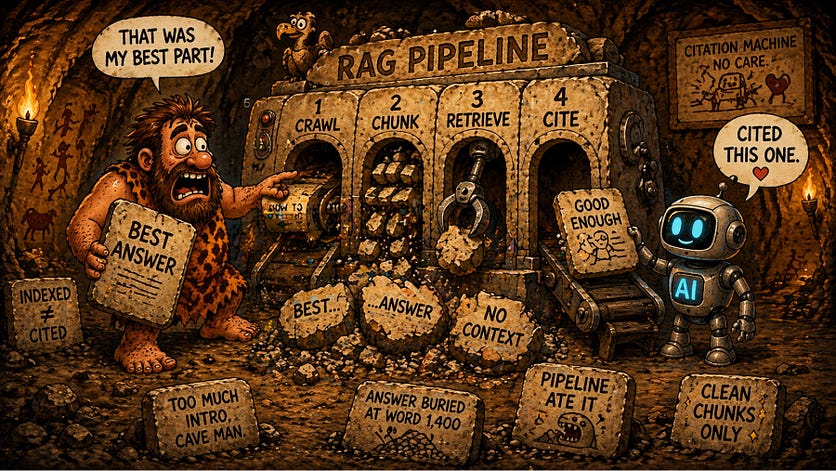
The pipeline has four stages. Every one of them is a place where your content can fail.
Stage 1: Crawl and Ingestion
Before anything else, a crawler visits your page and ingests the text. This is where rendering problems kill visibility before the pipeline even starts.
If your content is loaded via JavaScript and the crawler does not execute scripts, it sees an empty page. If your page structure is ambiguous: no clear headings, run-on sections, boilerplate text mixed with actual content, the ingestion process pulls in noise alongside signal.
Clean HTML, server-side rendering, and clear structural separation between header, body content, and footer all matter here. This is not a design question. It is a machine-readability question.
Stage 2: Chunking
This is where most publishers lose citations they should have won.
After ingestion, the system breaks your content into chunks: small segments of text, often a few hundred tokens, commonly somewhere in the 200 to 1,000 token range depending on the system. These chunks are what actually get stored and retrieved. Not your page. Not your article. Chunks.
The chunking process follows boundaries. Good boundaries: headings, paragraph breaks, logical section endings. Bad boundaries: mid-sentence cuts, sections that blend two different concepts, answers buried inside long narrative passages.
If your core claim sits inside a 600-word block of context-setting prose, the chunker splits it. The claim ends up in one chunk, the evidence in another, and neither chunk makes full sense on its own. The model retrieves one of them, finds it incomplete, and moves on to a source that put the answer in a self-contained 200-word section.
Kevin Indig’s analysis, covered by Search Engine Land, found that 44% of verified ChatGPT citations came from the first third of a page. That is partly a chunking phenomenon. The first sections of a well-structured article tend to produce clean, self-contained chunks. The rest tends to produce fragments.
Stage 3: Retrieval
Once your content is chunked and stored, retrieval matches incoming queries against those chunks using vector search. This is semantic matching, not keyword matching. The system is looking for meaning, not exact phrases.
This is where entity clarity matters. If your chunk says “it helps with the problem many businesses face,” that is not a retrievable claim. If it says “FAQPage schema makes question-and-answer relationships explicit for machines, which can support extraction and attribution when the content is already retrievable,” that is a retrievable claim. Specific, named, declarative.
Vague content is not penalised. It is simply invisible. The vector search finds the closest semantic match to the query. Ambiguous chunks lose to specific ones, every time.
Stage 4: Extraction and Attribution
The retrieved chunks are passed to the language model as context. The model generates an answer from them and attributes the source.
This is the stage most people assume is where citation decisions happen. It is not. By this point, if your content was not retrieved in Stage 3, the model never saw it. If it was retrieved but the key claim was split across two chunks in Stage 2, the model extracts what it can and may attribute a cleaner version from a competing source.
The model is not judging the quality of your full article. It is working with whatever the retrieval system handed it. A well-written 2,000-word post with the answer buried at word 1,400 will lose to a mediocre 400-word post that put the answer in the first paragraph, every time the chunker treats them equally.
Why Being Indexed Is Not Enough
Indexing means your page can be found. Citation means a specific part of your page was selected, extracted, trusted, and used in an answer.
Those are not the same thing.
A page can be indexed perfectly and still fail at citation because the answer is buried, split across sections, surrounded by boilerplate, or written too vaguely for the retrieval system to match it to a query. The pipeline does not reward existence. It rewards extractability.
What This Means for How You Structure Every Post
Four things you can control, starting today.
One section, one concept. Each H2 section should cover exactly one idea. Do not define a term and explain its implementation in the same section. Split them. The result is cleaner retrieval and easier extraction.
Lead every section with the answer. The first 40 to 60 words of each section are the most likely to form a clean, self-contained chunk. State the point first. Prove it after. This is the same principle as the ski ramp fix, applied at section level rather than article level.
Use declarative, named language. “Schema markup helps AI systems understand your content” is a weak chunk. “FAQPage schema makes question-and-answer relationships explicit, which can support extraction and attribution when the content is already clean and retrievable” is a strong chunk. Name the thing. State the effect. Attribute the claim.
Keep sections between 150 and 400 words. Too short and there is not enough context for accurate retrieval. Too long and the system splits your argument mid-thought. Staying in that range keeps most of your content within a single retrievable chunk regardless of the platform.
None of this requires starting over. It requires reading what you already have and asking one question per section: if this were the only thing the model saw, would it answer the query?
Frequently Asked Questions About Why ChatGPT Cites Other Pages
Q: What is a RAG pipeline and why does it matter for getting cited by AI?
A: RAG stands for Retrieval-Augmented Generation. It is the architecture most AI search systems use to answer questions from live web content. The system retrieves chunks of text from indexed pages, then passes those chunks to a language model to generate an answer. If your content is not cleanly chunked and retrievable, the model never sees it, regardless of how accurate or well-written it is.
Q: Why did ChatGPT cite a worse source instead of my page?
A: Almost always a chunking or retrieval issue, not a quality issue. If your core answer is buried in a long narrative section, the chunking process may split it across multiple fragments. Neither fragment makes complete sense alone, so the retrieval system passes on them. A shorter, cleaner source with the answer in a self-contained section wins the citation instead.
Q: How long should each section of my blog post be for AI citation?
A: Between 150 and 400 words per section is a practical target. RAG systems chunk content into segments often in the range of a few hundred to around 1,000 tokens depending on the platform. Sections shorter than 150 words may lack enough context for accurate retrieval. Sections much longer than 400 words risk being split mid-argument.
Q: Does RAG work the same way across ChatGPT, Perplexity, and Google AI Overviews?
A: The core architecture is similar across all three: retrieve, rank, extract, generate. The specific chunking strategies, retrieval models, and ranking signals differ between platforms. Content that is cleanly structured, entity-rich, and section-level self-contained tends to perform well across all of them.
Q: What is the biggest structural mistake that stops content from being cited by AI?
A: Burying the answer. If your most citable claim appears after several paragraphs of context-setting, the chunker often separates the claim from its context. The resulting chunks are incomplete and lose retrieval ranking to sources that front-loaded the same information. Move the answer to the top of each section and the claim to the first 50 words of the article.
Q: Does schema markup help with getting cited by AI?
A: Schema markup does not fix retrieval by itself. It helps most at the extraction and attribution layer by making content type, authorship, entities, and question-and-answer relationships easier for machines to identify. If the visible page content is weak or poorly structured, schema will not rescue it. But when your content is already clean and retrievable, schema strengthens the signal at the point where the model decides what to attribute and to whom.
⸻
The model did not ignore your content.
The pipeline did, four stages before the model got involved.
⸻
AI Visibility Studio helps websites become easier for AI systems to find, read, and cite. aivisibilitystudio.com