 Originally published on Medium ↗
Most people assume that if they clean up their website, add schema, and write better copy, AI will start recommending them. That is part of the story. But Muck Rack’s December 2025 follow-up to its “What Is AI Reading?” study tracked more than a million AI citation instances and found that 82% of citations come from earned media, and 94% from non-paid sources. The original July 2025 study put those figures even higher: 89% earned, 95% non-paid. A May 2026 update showed the pattern holding steady, with earned media accounting for 84% of AI citations across more than 25 million links. Either way, your own site accounts for a small fraction of what AI systems actually read when they decide how to describe you.
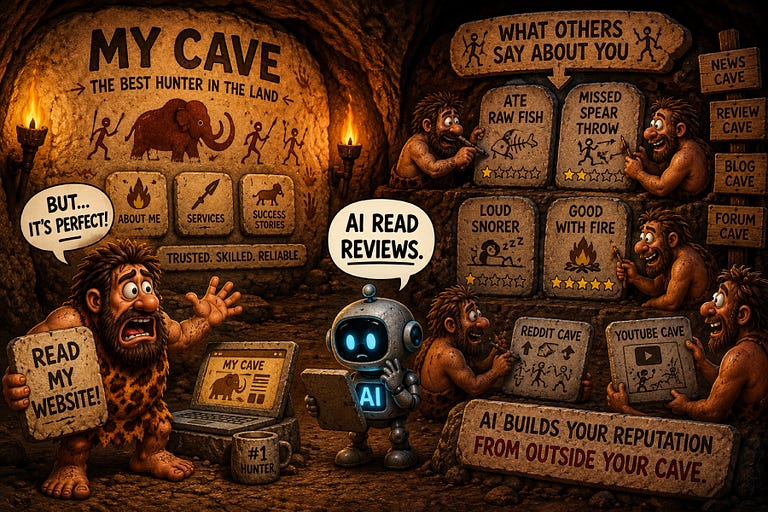
AI does not form a reliable picture of your brand from your about page alone. It forms one by reading what other people have written about you.
– – -
Key Takeaways
- AI systems build brand understanding from third-party corroboration, not just your homepage
- Muck Rack found most AI citations come from earned media and non-paid sources
- Journalism, YouTube, Reddit, reviews, and industry blogs heavily influence how AI describes you
- A well-structured website still matters because it gives outside sources something consistent to reference
– – -
Where AI Actually Learns What You Do
When ChatGPT or Perplexity answers a question about your category, it is more likely retrieving previously indexed or cited material than actively reading your sales page in real time. It is pulling from third-party coverage: journalism, industry blogs, review platforms, forums, YouTube transcripts, and press mentions.
A study by Muck Rack ([“What Is AI Reading?”](ran hundreds of thousands of prompts across ChatGPT, Gemini, and Claude and tracked every source cited. Journalism alone accounted for 20 to 30% of all citations. For queries that implied recency, that number jumped to 49%.
Your blog post, written in your voice, published on your domain, sits in a much smaller pool.
– – -
Why AI Trusts Other Sites More Than Yours
This is not an algorithm quirk. It is a trust signal.
AI systems are designed to synthesize corroborated information. If ten independent sources describe you the same way, the model has high confidence. If only your own site describes you that way, it does not know whether to trust it. A brand saying it is the best at something and a journalist saying the same thing are not equivalent inputs.
Multiple citation analyses across ChatGPT, Claude, and Perplexity consistently find the same pattern: the overwhelming majority of cited sources are third-party publications, not brand-owned content. Owned content appears to compete for a much smaller share of citation opportunities than third-party sources.
Your site is necessary. It is not sufficient.
– – -
The Specific Sources That Are Shaping Your AI Presence Right Now
The citation landscape is not evenly distributed. Certain source types appear consistently across platforms.
Journalism and editorial coverage carries the most weight for recency-sensitive queries. Community platforms like Reddit and YouTube are heavily cited for experience and opinion queries. Review platforms appear when someone asks “is this worth it.” Industry directories and aggregators fill in the gaps for category-level searches.
If none of those sources currently mention you accurately, or at all, AI systems are building your reputation from silence, or worse, from whatever they can find.
One large-scale citation analysis by Trakkr Research examined nearly 8.8 million citations across more than 200,000 domains and found the citation graph is dominated by sources outside any single brand’s control. The practical implication: you can have a well-structured website with solid schema and still be invisible in AI answers if your third-party footprint is thin.
– – -
What This Means for Coaches, Creators, and Small Businesses
Most people in this position have spent their energy on their own site. That is not wasted. Owned content is what gives third-party sources something to reference. Original research, data, frameworks, and well-structured content on your site becomes the source journalists and bloggers cite, which then becomes what AI cites.
But that chain only works if the third-party pickup happens.
Muck Rack’s December 2025 follow-up report found something useful here: press release citations distributed through major newswires increased roughly fivefold between July and December 2025, driven largely by ChatGPT and Gemini. The cited press releases had a clear structural pattern. They included statistics, bullet points, and objective language rather than marketing copy. Structure mattered as much as placement.
For a course creator or coach without a PR budget, the accessible version of this is: guest posts on mid-authority industry blogs, podcast appearances with show notes that get indexed, being quoted as an expert in someone else’s article, and publishing YouTube content with transcripts that get crawled.
None of that requires a publicist. It requires showing up in places other than your own domain.
– – -
What to Do With Your Own Site in the Meantime
Your site still matters for one critical reason: it gives AI something to corroborate. When a third-party source mentions you, AI systems often cross-reference your own pages to verify consistency. That corroboration only works if your pages are structured clearly enough to be read. If you are not sure yours are, start with this guide on how AI extracts answers from page openings.
If your homepage says you help online coaches grow their business, but your about page says you are a digital marketing consultant, and your Kajabi sales page says you are a business strategist, AI has no clean entity to latch onto. It will either describe you vaguely or not cite you at all.
Entity consistency is the minimum viable version of site optimization for AI visibility. Your name, your niche, what you specifically do, and who you serve should read the same across every page. Not slightly different. Identical in substance.
Schema and structured content help too. But they are working at the margin compared to what an accurate, widely distributed third-party presence does.
– – -
Frequently Asked Questions
Q: Why does AI cite other websites about my brand instead of my own site?
A: AI systems are built to synthesize corroborated information from multiple independent sources. A single brand’s own website is treated as one input, not independent validation. Third-party coverage, especially journalism, reviews, and community discussion, carries more trust weight because it represents external corroboration rather than self-description.
Q: Does optimizing my website for AI actually matter if third-party sites drive most citations?**
A: Yes, but for a specific reason. Your site provides the primary source that third-party coverage references. Well-structured content with clear entity signals gives journalists, bloggers, and reviewers accurate information to cite, which then gets picked up by AI. The chain runs: your site gives others something accurate to say about you, and AI cites what they say.
Q: What kinds of third-party content does AI cite most often?
A: Journalism and editorial coverage dominates for time-sensitive queries, appearing in roughly 49% of citations where recency matters, according to Muck Rack’s research. Community platforms like Reddit and YouTube appear heavily for experience-based queries. Review platforms show up when users ask evaluative questions. The specific mix varies by AI platform.
Q: How do I build third-party AI citations without a PR budget?
A: The most accessible options are guest posting on industry blogs that rank in your niche, being quoted as an expert in roundup articles, publishing YouTube content with crawlable transcripts, and participating genuinely in community forums like Reddit where your expertise is relevant. Press releases distributed through major newswires increased roughly fivefold in AI citation rates between July and December 2025, according to Muck Rack’s research, with cited releases tending to include statistics, bullet points, and objective language rather than marketing copy.
Q: How long does it take for third-party coverage to show up in AI citations?
A: Recency matters significantly. Muck Rack’s research found that half of all AI citations come from content published within the last 11 months, with citation activity heavily weighted toward newer content, especially shortly after publication. New coverage can begin influencing AI answers relatively quickly once indexed, though consistency over time compounds the effect.
Q: Should I stop optimizing my own site and focus only on earning coverage elsewhere?
A: No. Your site is the foundation that third-party coverage points back to. If your site has inconsistent messaging, missing entity signals, or thin content, earned coverage has less to corroborate. The most effective approach is parallel: maintain a well-structured owned site while actively building your third-party presence.
– – -
Some businesses are already being described by AI systems every day without realizing they had no control over the narrative.
Everyone talks about making their site more readable for AI. Fewer people ask who else is writing about them. Those two questions are not equally important right now.
– – -
AI Visibility Studio helps websites build the structured foundation that third-party coverage can recognize, repeat, and corroborate.