 Originally published on Medium ↗
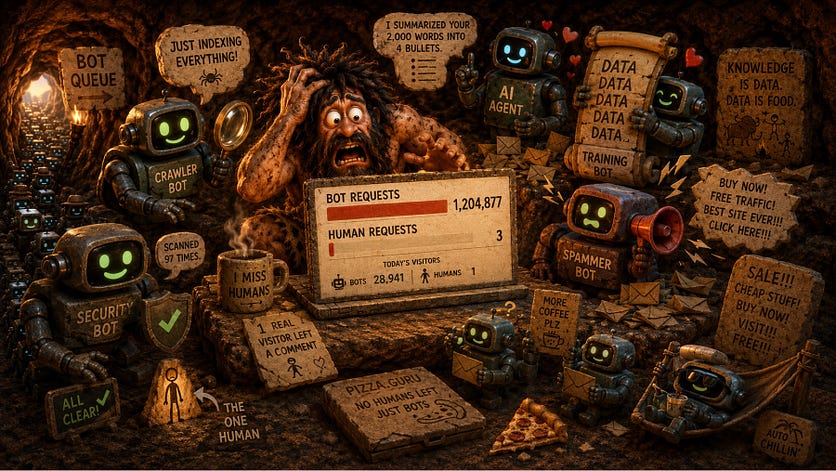
Cloudflare’s June 2026 data shows bots overtaking humans in HTTP requests to HTML content. Requests are not visitors, but the shift still matters.
In early June 2026, Cloudflare Radar showed automated requests outnumbering requests classified as human in its worldwide view of HTTP requests to HTML content. Its CEO said the milestone arrived roughly 18 months earlier than his original end-of-2027 prediction. The usual response to this is alarm, some version of the internet is dead. That is the wrong read, and so is the opposite mistake of turning it into a claim about your own visitor numbers. It is narrower than that, and still worth your attention.
Key Takeaways
- In early June 2026, Cloudflare Radar showed bots generating about 57.5% of HTTP requests to HTML content across its network, compared with about 42.5% classified as human.
- Requests are not visitors. One bot can generate thousands of requests where a person generates a handful, so this does not mean most of your visitors are machines.
- AI crawlers and agents appear to be major contributors to the recent growth, but Cloudflare’s overall bot figure also includes traditional search crawlers, scrapers, security tools, malicious bots, and other automated traffic.
- Not all automated traffic is useful. The sensible response is to manage bots by purpose, not to welcome or block all of them.
- If your site is built only for people to read, you may be ignoring a rapidly growing layer of automated discovery and interaction.
What Did Cloudflare Actually Report?
That bots had crossed the halfway line in one specific measurement. On June 3, 2026, Cloudflare CEO Matthew Prince shared Radar data showing automated requests accounting for 57.5% of HTTP requests to HTML content, compared with 42.5% classified as human. Prince described it as the first time bots had overtaken human traffic in Cloudflare’s measurement of web page requests.
The result arrived roughly 18 months earlier than his original end-of-2027 prediction, and several months earlier than his later early-2027 estimate. Prince attributed the unexpectedly early crossover to the rapid growth of agentic traffic.
There is one important caveat about the date. June 3 was when Prince shared the result, not necessarily the exact day of the crossover. He later acknowledged that the underlying data was somewhat messy and the precise crossover point was difficult to identify, although Cloudflare’s figures clearly showed bots ahead by then.
This metric counts HTTP requests classified as automated or human and filters them to HTML responses, representing web page traffic across Cloudflare’s network. It does not measure all internet activity, such as video streaming, email, gaming, mobile app use, or time spent online. It is also not a count of unique visitors.
Cloudflare Radar is a live dashboard, so its percentages change over time, and other organisations using different datasets and definitions report lower bot shares.
Why Are There Suddenly So Many Bots?
Because AI added new categories of automation on top of the old ones. The traditional picture of bot traffic was search crawlers indexing pages and spammers causing trouble. That traffic did not go away, but AI-related automation has grown quickly alongside it.
AI-related automation now includes training crawlers that collect material for models, search and retrieval crawlers that help systems find current information, and agents that browse or act on a user’s behalf. Cloudflare now lets site owners manage AI traffic according to three broad purposes: Search, Agent, and Training.
The volume difference helps explain the shift. Prince illustrated it with a shopping example: a person might visit five websites while researching a digital camera, whereas an agent could potentially visit five thousand. That is an illustrative scenario, not measured average behaviour, but it shows why request counts can tip quickly once delegated browsing becomes common.
Does This Mean the Internet Is Dead?
No, and that framing gets the story backwards. The alarming version says the web is filling up with machines talking to machines while people fade out. The useful version is quieter: a growing share of page requests comes from software, and some of that software is working for real people.
Not all of those machines are useful. The category includes legitimate search crawlers and AI agents, but also scrapers, spam bots, security scanners, and malicious automation. Treating every bot as a prospective customer would be as naive as treating every bot as an attacker.
The important shift is that some machine traffic now represents real people delegating discovery, research, or action to software. When someone uses a browsing-enabled AI system to research a recommendation, software may read and retrieve webpages on their behalf. When someone sends an agent to book a service, software is the thing reading your page.
That is why blanket blocking is the wrong instinct. Blocking every bot indiscriminately may reduce discovery and agent access, while some site owners have entirely valid reasons to block training crawlers or abusive scraping. The better approach is to distinguish useful crawlers and agents from unwanted training, scraping, or malicious traffic, which is why Cloudflare separates its controls by Search, Agent, and Training.
What Does This Mean for Your Website?
It means automated systems now generate a larger share of HTML page requests across Cloudflare’s network than requests classified as human. That does not mean bots are most of your customers or even most of your unique visitors. It does mean machine access is no longer a marginal technical concern.
The three viewers model still holds. People read and decide, crawlers discover and retrieve, and agents may compare or act on a user’s behalf. Cloudflare’s data does not tell us the exact balance on any individual website, but it shows that automated interaction has reached enormous scale.
And the practical response has not changed, which is the reassuring part. You do not build a separate site for the machines. The same clean structure, honest labels, and key information available in crawlable HTML serve all three at once. The growth in automated requests does not demand new tricks. It just raises the cost of being unreadable to software.
Frequently Asked Questions
Q: What percentage of web traffic is bots in 2026?
A: In early June 2026, Cloudflare Radar showed bots accounting for about 57.5% of HTTP requests to HTML content across its network, compared with about 42.5% classified as human. That figure should not be treated as the percentage of all internet use or of unique website visitors.
Q: Why has bot traffic overtaken human traffic?
A: Cloudflare’s CEO attributed the earlier-than-expected crossover to rapidly growing agentic traffic. Cloudflare has separately documented major growth in AI training and mixed-use crawlers, although its 57.5% figure does not isolate exactly how much traffic came from AI agents.
Q: Is bot traffic bad for my website?
A: It depends on the bot. Legitimate search crawlers and user-directed agents may support discovery and useful tasks. Other bots scrape content, inflate metrics, probe security weaknesses, or attack accounts. Manage bots by purpose rather than treating all automation as good or bad.
Q: Do I need to do anything different now that automated requests have grown?
A: You need to make sure your site is readable by machines as well as people, which mostly means clean structure, descriptive headings, honest button and form labels, and keeping key information available in crawlable HTML rather than only inside images or interactions that software may not be able to access. It is the same work that helps the people who visit, not a separate build.
Q: Are all these bots AI agents?
A: No. The category includes traditional search crawlers, scrapers, security scanners, and other automated traffic. AI-related crawlers and agents are widely cited as important contributors to the recent increase, but Cloudflare’s 57.5% figure does not isolate them as the sole cause.
The number does not prove that machines are most of your customers, and anyone selling you that reading is overreaching. What it does confirm is that automated systems are now a major part of how the web gets accessed. The sites that adjust will not do anything dramatic. They will just make sure the software reading their page on a customer’s behalf can actually understand what they do.
AI Visibility Studio helps websites structure content so AI systems can find it, understand it, cite it, and actually use it when generating answers. aivisibilitystudio.com
References
- NBC News, “Bot web traffic has overtaken human web traffic, data shows” (June 5, 2026): https://www.nbcnews.com/tech/tech-news/bot-web-traffic-overtaken-human-web-traffic-data-shows-rcna348522
- Cloudflare Blog, “Building the Business Model for the Agentic Internet” (July 1, 2026): https://blog.cloudflare.com/agentic-internet-bot-report/
- Cloudflare Blog, “Your Site, Your Rules: New AI Traffic Options for All Customers” (July 1, 2026): https://blog.cloudflare.com/content-independence-day-ai-options/
- Cloudflare Radar, Bot vs Human traffic: https://radar.cloudflare.com/traffic