 Originally published on Medium ↗
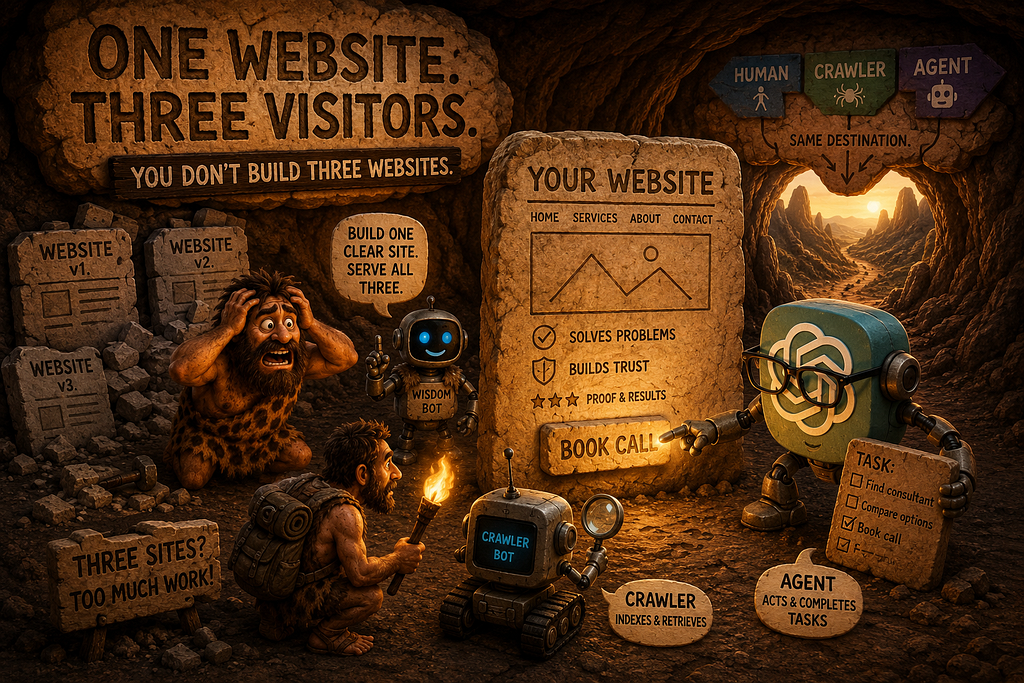
Three audiences, one site. Clean structure, honest labels, one page meaning one thing serves all of them.
Every page on your website is now visited by three very different readers. One is a person. One is a crawler. One is an AI agent acting on someone else’s behalf. The instinct is to think that means building three websites. It does not. The work is building one site that all three can read, and telling one story clearly enough that each takes what it needs.
Key Takeaways
- Your site now has three viewers: people, AI crawlers that index for citation, and AI agents that act on a user’s behalf.
- They read the same page for different reasons, but they do not need three different sites.
- Google’s own guidance treats agents as a new kind of visitor but points to the same accessibility and clarity work that already serves people, not a separate build.
- The differentiator is not machinery. It is telling one clear story that a person trusts, a crawler can cite, and an agent can act on.
- Build the single site well, and all three viewers are served by the same structure.
- Medium now automatically generates a Table of Contents for properly structured articles, reinforcing the importance of clear heading hierarchy.
Who Are the Three Viewers, and What Does Each One Want?
Three audiences, three reasons for being on your page. Understanding what each wants is the whole game, because their needs overlap more than they conflict.
The person wants to understand and trust you quickly. They scan, they judge your credibility in seconds, and they act on feeling as much as fact. They forgive messy structure if the writing connects.
The crawler wants to understand and classify your page correctly. Bots like GPTBot, ClaudeBot, and PerplexityBot read your page to understand what it is about, what questions it answers, and how it relates to other sources, so they can retrieve or cite it later in an AI answer. They forgive nothing that is unclear or hidden.
The agent wants to get a job done. An agent arrives with a task: find a consultant, book a call, compare three options. It needs to operate your page, not just read it. It judges you on whether it can complete the task without hitting a dead end. We covered this shift in more depth in AI Can Now Act on Your Website, Not Just Read It.
Why Does the Crawler See Your Site So Differently From a Person?
Because it does not experience your design, it parses your structure. A person sees a hero image, a nice font, a confident headline, and forms an impression. A crawler sees none of that feeling. It sees headings, text, links, and markup, and it builds its understanding entirely from those.
This is why a beautiful website can still be invisible to AI. If your key message lives inside an image, a slider, or content that only appears after client-side JavaScript executes, the crawler may see a blank space where your best point should be.
The person and the crawler are reading the same page and coming away with two different versions of it.
Your job is to make those two versions say the same thing, so what impresses the person is also what the crawler can classify and cite. Getting discovered is only the first step, as we covered in Your Sitemap Gets You Discovered by AI, It Does Not Get You Cited.
What Does the Agent Need That the Other Two Do Not?
It needs to act without a mouse or a pair of eyes. A person clicks a button because they can see it says “Book a call.” A crawler does not care about the button at all. An agent has to find that button, understand what it does from its label alone, and use it, all without seeing the screen the way a person does.
So the agent exposes the weaknesses the other two hide. A button labelled only “Submit” is fine for a person who can see the surrounding context and useless to an agent that has only the label. A form field with no label, a checkout that only works with a hover, content that depends entirely on client-side rendering, each of these stops an agent cold while a person glides past.
If that sounds familiar, it should. It is the same list of problems that has always blocked people using screen readers. The agent is just the newest visitor to need the clarity you always owed the people.
If you remember only one thing from this article, make it this:
Person: Wants to understand and trust you. Fails when the messaging is confusing.
Crawler: Wants to understand, classify, and retrieve your page. Fails when important content is hidden or unclear.
Agent: Wants to complete a task. Fails when buttons, forms, or workflows are not machine-readable.
Do You Need a Special Version of Your Site for the Machines?
No, and this is the part most people get wrong. The instinct is that serving crawlers and agents means bolting on machinery, a separate agent interface, an AI-only content variant, some special file that speaks robot. It does not.
Google’s own web.dev guidance, last updated April 2026, frames agents as a new type of visitor and makes the point directly: the same semantic HTML, descriptive labels, and stable structure that help people and screen readers are what help agents. In its separate guidance on AI features, Google states you do not need to create new machine-readable files or markup to appear in those features, and there is no special schema.org structured data you need to add. The accessibility and clarity work is what agents need, and it is the same work that serves everyone else.
That is the quiet truth under the whole “three audiences” conversation. You are not building three sites. You are building one site clear enough that three very different visitors can each extract what they came for. Clean structure, honest labels, content in the HTML, one page meaning one thing. Do that, and you have served all three at once. When we ran a public agent-readiness scanner on a site we manage, this is exactly what the results confirmed, covered in We Ran an Agent-Readiness Scanner on a Website We Manage.
How Do You Tell One Story That Works for All Three?
You decide what the story is before you decide how to structure it. Most sites fail here not because their markup is wrong but because they never got clear on what they actually do and who they do it for. A vague story cannot be rescued by schema.
Start with the thing a person needs to believe and an agent needs to act on: what you do, who you do it for, and the proof it works. Then structure that story so each viewer can reach it. The claim a person trusts becomes the clear statement a crawler can cite. The service a person wants becomes the labelled action an agent can take. The proof a person scans becomes the specific, structured evidence a machine can extract and compare.
This is the method we bring to the sites we build. We break the story into the pieces each viewer needs, then rebuild it into one page where those pieces reinforce each other instead of competing. The person gets a page that reads well. The crawler gets a page it can file and cite. The agent gets a page it can operate. One story, told once, structured so nobody has to squint.
The technology will keep changing. The need for clear structure, honest language, and pages that are easy to understand will not.
Medium Just Confirmed Why Structure Matters
Medium has introduced a built-in Table of Contents that is automatically generated for stories using headings and subheadings.
Readers can now:
- Instantly scan an article
- Jump directly to sections that interest them
- Navigate long-form content without endless scrolling
Writers do not need to enable anything manually. If an article is structured correctly using headings and subheadings, Medium generates the navigation automatically.
This reinforces an important point:
Clear content structure is no longer just an SEO recommendation. It directly improves usability across modern publishing platforms.
For AI systems, the benefits go even further.
Well-structured articles make it easier for language models to:
- understand the hierarchy of ideas
- locate specific answers
- extract sections accurately
- summarise content
- reference individual topics with greater confidence
In other words, the same content structure now benefits:
- People
- Search engines
- AI crawlers
- AI assistants
- Publishing platforms like Medium
The direction is becoming increasingly clear:
One well-structured article serves every audience better.
New signal worth paying attention to: Medium is now rewarding structured writing with automatic navigation. That’s another example of platforms recognising that clear heading hierarchy creates a better reading experience for both people and machines.
Frequently Asked Questions
Q: What are the three audiences for a modern website?
A: People who read and decide, AI crawlers that index your content to cite it in answers, and AI agents that act on your site to complete tasks for a user. All three read the same page for different reasons.
Q: Do I need to build a separate version of my website for AI?
A: No. Google’s web.dev guidance frames agents as a new kind of visitor but recommends the same semantic HTML and accessibility work that already serves people, not a separate build. Google also states you do not need new machine-readable files, markup, or special schema.org structured data to appear in its AI features.
Q: Why can AI not read my beautiful website?
A: Because crawlers and agents parse structure, not design. If your key content lives inside images, sliders, or only appears after client-side JavaScript executes, a machine may see a blank space where your message should be, even if it looks perfect to a person.
Q: What is the difference between an AI crawler and an AI agent?
A: A crawler reads your page to index and potentially cite it in an answer. An agent operates your page to complete a task, like booking or comparing. A crawler needs to understand you, while an agent needs to use you.
Q: How do I make my site work for people and AI at the same time?
A: Build one clear site rather than three. Use clean HTML, descriptive headings, honest button and form labels, real proof, and keep important content out of scripts and images. That single structure serves all three viewers.
Google’s documentation, AI crawlers, and now publishing platforms like Medium are all moving in the same direction. The future belongs to content that is clearly organised, easy to navigate, and understandable by both people and machines.
Everyone is talking about the three audiences. Most advice ends with “add more technology.” The better strategy is much quieter. Tell one clear story, structure it properly, and every visitor, whether person, crawler, or agent, leaves with the same understanding.
AI Visibility Studio helps websites structure content so AI systems can find it, understand it, cite it, and actually use it when generating answers. aivisibilitystudio.com
References
- Google web.dev, “Build agent-friendly websites” (updated April 1, 2026): https://web.dev/articles/ai-agent-site-ux
- Google Search Central, “AI Features and Your Website”: https://developers.google.com/search/docs/appearance/ai-features
- Cloudflare Blog, “Introducing the Agent Readiness score” (April 17, 2026): https://blog.cloudflare.com/agent-readiness/