 Originally published on Medium
Correction, 27 September 2026: The original version of this article treated the first 30% of a page as a citation boundary. That was too strong. A pattern observed in a dataset does not establish a rule for ChatGPT, or prove that moving a paragraph causes more citations. We have removed the unsupported thresholds and guarantees below. Our comparison of Google and Microsoft’s content guidance explains the correction in more detail.
Put the answer where a reader can find it. Then give them the evidence. That remains useful editorial advice without a percentage attached.
What the ski ramp idea can and cannot tell you
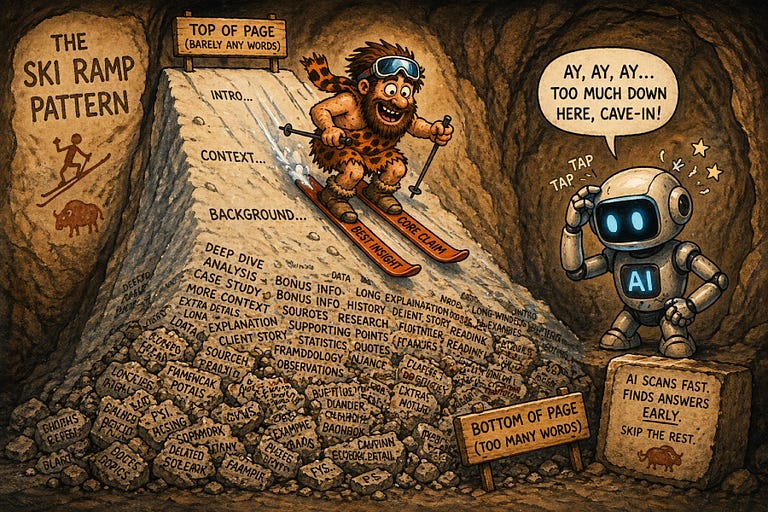
The original article used the term “ski ramp” to describe citations concentrated near the beginning of pages in a reported study. It went further and claimed that answers placed later effectively did not exist for AI. That conclusion did not follow from the observation.
Where citations appeared in one dataset cannot tell you why a particular page was selected, whether its position caused the selection, or whether the same result will hold for another query or system. This article should not have presented those claims as settled facts.
How to make an article easier to use
- State the answer early. Let readers confirm that the page addresses their question before asking them to work through the background.
- Keep evidence beside the claim. Include the source, date, example or measurement needed to judge it. Keep limitations attached too.
- Use descriptive headings. Tell readers what each section explains. A heading about checking crawler access is more useful than a vague “Next steps”.
- Keep the depth the question needs. Put the conclusion first when helpful, but retain the instructions and context that make it usable.
No fixed percentage or word count
There is no established first-30% rule to apply here. Nor does this article establish an ideal introduction length, answer-block length or total page length for AI citations.
Google’s guidance for its generative AI search features says there is no ideal page length and no requirement to break content into tiny pieces. Organise the page for the person using it.
Keep the qualifications that make your answer accurate
The original advice also encouraged definitive language at the expense of qualifications. Clear writing helps. Removing uncertainty from an uncertain finding makes it less trustworthy. Say what the evidence supports and where it stops.
Does this apply to Kajabi articles?
The same editorial checks work on Kajabi: a clear opening, descriptive headings, useful evidence and relevant links. Changing the layout alone does not establish that a page is crawlable, indexed or likely to be cited.
How should you judge the result?
Check whether readers can find and use the answer. Track search performance and enquiries, and record AI citations against a consistent set of questions if that is part of your measurement. Treat changes as observations to investigate, not proof that a formatting choice caused them.
For a repeatable approach, see our guide to measuring AI visibility.